The IT Infrastructure Check-Up: What You Need to Know About Assessments
March 12, 2026


Explore health service administration careers, leadership skills, degrees, salaries, and job outlook for modern healthcare executives.
October 24, 2026

Learn how Healthcare Management Administrators Inc optimizes self-funded plans, provider networks, and clinical quality for employers.
October 17, 2026

Upgrade your healthcare claims management for maximum accuracy with Next Level Technologies, serving Columbus, Ohio and Charleston, WV.
October 10, 2026
March 12, 2026
IT infrastructure assessment services are professional evaluations of your technology environment, including hardware, software, networks, and security practices. These assessments identify weaknesses, inefficiencies, and compliance gaps that could disrupt operations or put your data at risk.
What IT Infrastructure Assessment Services Cover:
Your network is the backbone of your business. When it becomes unavailable or unreliable, employee productivity drops, customer satisfaction suffers, and your bottom line takes a hit. Many mid-sized businesses don't realize the risks they face from outdated technology until system downtimes cost them revenue and customer trust.
The stakes are high. Research shows that a network infrastructure assessment can help businesses improve network performance by up to 30% and improve security by up to 50%. These aren't just numbers—they represent real productivity gains, reduced downtime, and protection against increasingly sophisticated cyber threats.
The challenge is knowing where to start. Most businesses struggle with frequent system issues, security concerns, and technology that can't keep pace with growth. An IT infrastructure assessment provides the roadmap you need to move from reactive firefighting to proactive optimization.
I'm Steve Payerle, and since founding Next Level Technologies in 2009, I've helped businesses across Columbus, Ohio and Charleston, WV transform their technology operations through comprehensive IT infrastructure assessment services and strategic IT planning. Our team's extensive cybersecurity training and technical experience have enabled us to identify critical vulnerabilities and efficiency gaps that other providers often miss.
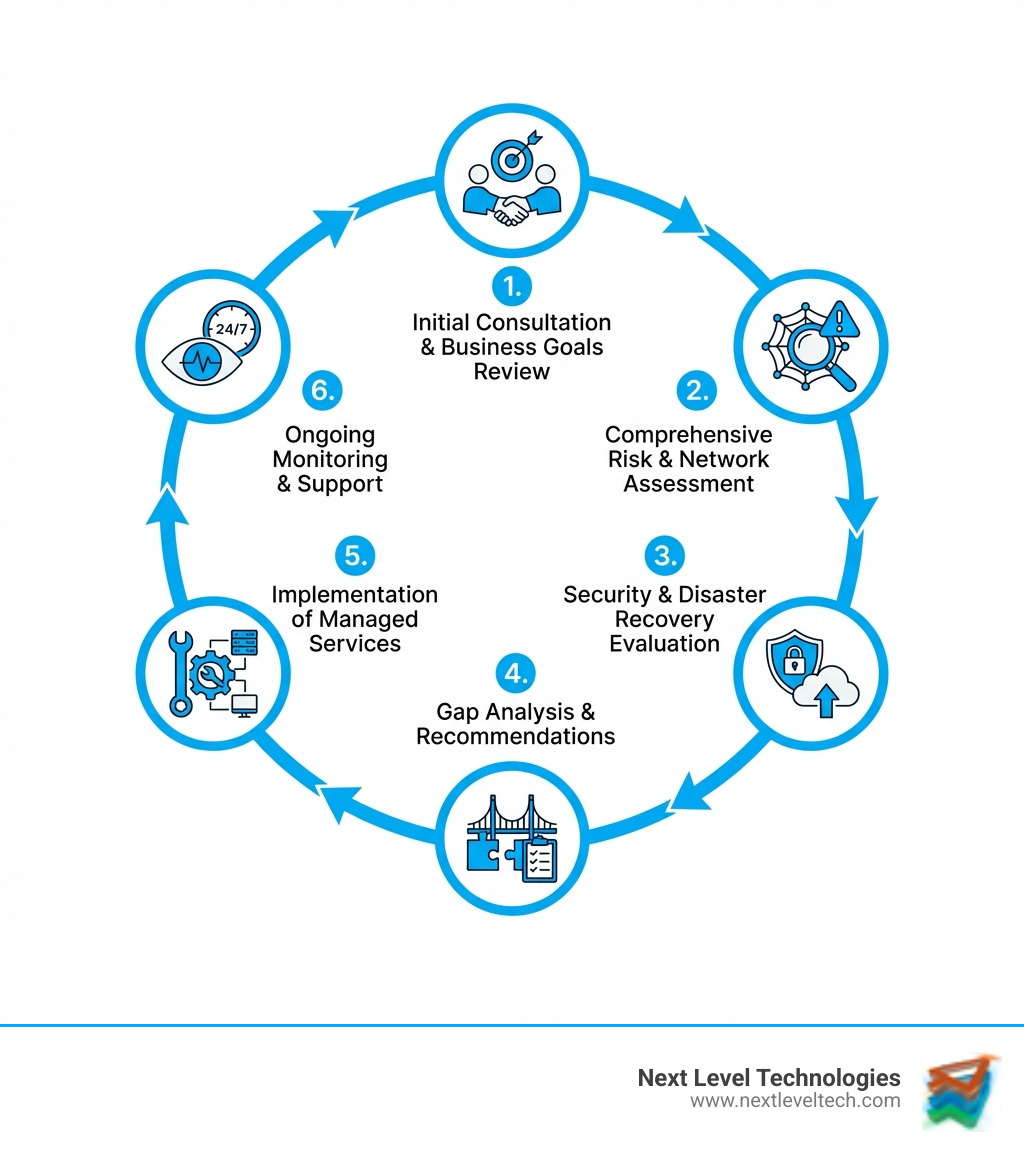
Simple guide to IT infrastructure assessment services:
Think of an IT assessment as a comprehensive physical for your business’s digital body. Just as a doctor checks your heart rate, blood pressure, and reflexes, IT infrastructure assessment services examine the vital signs of your technology. We look at everything from the physical cables in your server room to the invisible data packets flying through your Wi-Fi.
At its core, this service is an exhaustive review of your data, systems, applications, and operations. We aren't just looking for what’s broken today; we are looking for what might break tomorrow. This involves a deep dive into IT Infrastructure and Security to ensure your "backbone" is strong enough to carry the weight of your business goals.
For many, especially those looking for IT Infrastructure for Small Business, the technology stack often grows "organically"—which is a polite way of saying it’s a bit of a mess. You might have added a server here, a few cloud subscriptions there, and three different types of laptops over five years. An assessment brings order to that chaos, creating a baseline of what you actually own and how well it’s performing.

What exactly are we poking and prodding during this "check-up"? We break it down into several critical areas:
Not every business needs the same level of scrutiny. Depending on your goals in Columbus or Charleston, we typically offer three tiers of assessment:
If your network is working "fine," you might wonder why you should bother with an audit. The reality is that "fine" is often the precursor to "failure." Proactive IT infrastructure assessment services are the best way to catch a spark before it becomes a four-alarm fire.
The primary driver for most of our clients is risk mitigation. You can't protect what you don't know you have. By identifying aging hardware or unpatched software, we help you avoid the catastrophic costs of unplanned downtime. Furthermore, these audits drive operational efficiency. Imagine your team being 30% more productive because they aren't waiting for files to load or applications to crash.
The data speaks for itself: Network performance can improve by 30% and security by 50% following a professional assessment. This isn't just a "nice to have"—it's a competitive advantage. In industries like manufacturing or healthcare, that extra uptime translates directly into increased revenue. To get a truly unbiased view, many organizations opt for an IT Internal Audit to verify that their current IT provider is meeting expectations.
In today’s world, security isn't just about a firewall; it’s about a comprehensive posture. During an assessment, we perform intense vulnerability scanning to find the "open windows" in your digital house.
For our neighbors in Columbus and Charleston, compliance is often a major concern. Whether you need to meet the Cybersecurity Audit and Compliance Solutions requirements for government contracting or ensure HIPAA compliance for a medical practice, an assessment is the first step. We also evaluate your Cloud-Based IT Asset Management to ensure that your data in the cloud is just as secure as the data on your local hard drive.
Can your business survive a disaster? Whether it’s a burst pipe in your Columbus office or a sophisticated ransomware attack, you need a recovery plan.
An assessment evaluates your current backup systems and disaster recovery protocols. We ask the hard questions: How long would it take to get back online? Is your data actually being backed up, or is the software just saying it is? We’ve seen cases where companies thought they were safe, only to find their backups had been failing for months. Don't let your business be a cautionary tale—read how we helped one company avoid disaster in our post: Is Your Manufacturing IT Infrastructure on the Verge of Collapse?.
We don't just show up and start unplugging things. A professional IT assessment follows a structured, non-disruptive methodology. Our goal is to gather data while your business continues to run smoothly.
The process begins with Findy. We talk to your leadership and your staff. Why? Because the "people" part of the equation is just as important as the "tech" part. If your employees are using workarounds because the official system is too slow, that’s a major finding.
Next, we move into Analysis. We use automated tools to scan your network, inventory your assets, and monitor performance. This helps us understand the IT Asset Life Cycle of your equipment—identifying what needs to be replaced now and what can wait until next year’s budget.
Finally, we perform a Gap Analysis. We compare where you are now to where you need to be (your "target state"). The result is a Strategic Roadmap—a prioritized list of recommendations that align your technology with your business goals.
A typical assessment for a mid-sized organization in West Virginia or Ohio takes between 2 to 4 weeks. This isn't 2 weeks of us sitting in your office; it’s the time required to collect meaningful data, analyze it, and craft a custom report.
What do you get at the end? You won't just get a pile of technical jargon. You'll receive:
Knowing exactly what you have is especially critical for local businesses. We've written extensively on The Importance of IT Asset Management in Columbus Ohio to help local leaders understand why this documentation is a financial and operational necessity.
As mentioned, the standard timeline is 2 to 4 weeks. The exact duration depends on the size of your infrastructure and the complexity of your systems. A single-office medical practice in Worthington will be faster than a multi-state manufacturing firm with hundreds of endpoints. The "active" part of the assessment—interviews and on-site visits—usually only takes a few days, while the data collection and analysis happen in the background.
Absolutely. In fact, we prefer it. A roadmap is only useful if you actually drive the car. We specialize in helping businesses transition from the "finding" phase to the "fixing" phase with minimal disruption. Whether it’s migrating to the cloud or hardening your cybersecurity, our team has the technical experience to handle the heavy lifting.
While they overlap, they have different goals. A risk assessment focuses on the "CIA triad": Confidentiality, Integrity, and Availability. It’s primarily about security and compliance. An infrastructure assessment is broader; it looks at performance, hardware lifecycles, and cost-efficiency. Think of a risk assessment as checking the locks on your doors, while an infrastructure assessment checks the foundation, the plumbing, and the electrical system, too. Both are vital, which is why we often include an IT Asset Management Application Guide to help you manage both aspects effectively.
Your technology should be an engine for growth, not a source of stress. Whether you are operating out of Columbus, OH, Worthington, OH, or Charleston, WV, the health of your IT environment dictates the speed at which your business can move.
At Next Level Technologies, we pride ourselves on serving the "overlooked" industries—the businesses that need enterprise-level expertise without the enterprise-level ego. Our staff undergoes constant, extensive cybersecurity training to ensure we are always one step ahead of the threats facing our local community.
Don't wait for a system crash to find out where your weaknesses are. Let us help you build a stable, secure, and scalable foundation for your future.
Ready to take your tech to the next level?Schedule a Call with our Experts or explore our Managed IT Services and IT Support to see how we can protect and grow your business.
Explore health service administration careers, leadership skills, degrees, salaries, and job outlook for modern healthcare executives.
October 24, 2026
Learn how Healthcare Management Administrators Inc optimizes self-funded plans, provider networks, and clinical quality for employers.
October 17, 2026
