Health Service Administration Career Pathways and Core Leadership Competencies
October 24, 2026


Explore health service administration careers, leadership skills, degrees, salaries, and job outlook for modern healthcare executives.
October 24, 2026

Learn how Healthcare Management Administrators Inc optimizes self-funded plans, provider networks, and clinical quality for employers.
October 17, 2026

Upgrade your healthcare claims management for maximum accuracy with Next Level Technologies, serving Columbus, Ohio and Charleston, WV.
October 10, 2026
October 24, 2026
Health service administration is the work of organizing and managing the services that deliver health care. Administrators oversee staff, budgets, daily operations, compliance, and quality across settings such as hospitals, clinics, and health systems. Their goal is to help care teams serve patients safely and effectively.
It is a career for people who can connect clinical needs with business decisions. Today, that also means understanding the technology behind patient records and reliable operations. Next Level Technologies, based in Columbus, Ohio, with a second location in Charleston, WV, supports healthcare organizations with staff who bring technical experience and extensive cybersecurity training.
Similar topics to health service administration:
In formal biomedical nomenclature, the National Library of Medicine cataloged health services administration under its Medical Subject Headings (MeSH) in 1998 (ID: D006298) as the organization and administration of health services dedicated to the delivery of healthcare. It is categorized under both "Disciplines and Occupations" and "Health Care Organization and Administration," spanning ethics, economics, statutory regulations, clinical governance, and system planning (Begun & Kaissi, 2004).
The operational scope of the discipline is massive. In the United States, roughly 300,000 individuals serve in administrative capacities ranging from clinic managers to hospital system chief executives. The financial stakes are equally significant: the nation spends approximately $218 billion annually on hospital administration alone, which accounts for roughly 1.43 percent of the entire American gross domestic product. While peer nations allocate an average of 12 percent of hospital expenditures toward administrative functions, American hospitals direct roughly 25 percent of their operational budgets to administrative workflows, billing compliance, insurance negotiation, and facility coordination. For modern providers, mastering these operational mechanics is central to comprehensive healthcare management.
Healthcare administration originated in the late 19th and early 20th centuries, when hospitals were largely managed by head nurses or non-clinical "wardens" and "superintendents." These early supervisors focused purely on facility hygiene, physical maintenance, and supply counts.
The formalization of the field began in 1934, when the University of Chicago established the first graduate degree curriculum in hospital administration. As medicine evolved from isolated community facilities into integrated delivery networks, the field transformed. Modern administrators act as strategic executives coordinating complex relationships between third-party payers, pharmaceutical suppliers, regulatory agencies, and multi-facility clinical systems.
The terms describing leadership within health sectors are often used interchangeably, yet distinct boundaries define their day-to-day focus:

Operating a resilient medical delivery model demands diverse executive capabilities. Leaders must balance compassion with clinical accountability and financial precision.
Administrators must enforce rigorous risk management programs that protect both patients and organizational viability. Key obligations encompass HIPAA privacy rules, HITECH requirements, and the accreditation standards established by bodies like The Joint Commission.
In digital environments, safeguarding patient health information requires robust administrative safeguards alongside structured healthcare IT service management. Establishing automated audit trails, maintaining access controls, and training staff on cybersecurity hygiene are core administrative responsibilities.
Digital systems form the operational backbone of healthcare delivery. Administrators direct the adoption of electronic medical record systems, practice management portals, and automated scheduling infrastructure.
Maximizing digital efficiency requires dependable electronic health record support that eliminates clinical software downtime, maintains data accuracy, and streamlines clinical charting workflows across departments.
A career in healthcare administration begins through targeted academic preparation paired with experiential learning in clinical or business settings. Prospective professionals can review the Career Outlook for Health Administrators to evaluate career pathways and entry points across public and private delivery environments.
Academic credentials range from focused undergraduate degrees to specialized doctorates:
When selecting graduate education, institutional quality is validated by the Commission on Accreditation of Healthcare Management Education (CAHME), the gold standard for healthcare management curricula.
Mid-career administrators enhance their credentials through professional organizations:
Driven by an aging population, rising chronic illness rates, and system-wide technology modernizations, demand for healthcare leadership remains exceptionally strong.
The U.S. Bureau of Labor Statistics projects employment of medical and health services managers to grow by 23 percent from 2024 to 2034, which is significantly faster than the average for all occupations. This growth translates to approximately 62,100 job openings annually over the projection decade.
Compensation reflects this high demand. The median annual wage for medical and health services managers stands at approximately $117,960. Professionals in top executive roles or major metropolitan networks earn upwards of $219,080 annually. Earning an advanced degree consistently drives strong compensation gains, as highlighted in analyses on the Return on Investment for Health Administration Master's Degrees.
Healthcare administration roles exist across every segment of American healthcare:
Professional development in healthcare administration typically follows a structured progression:
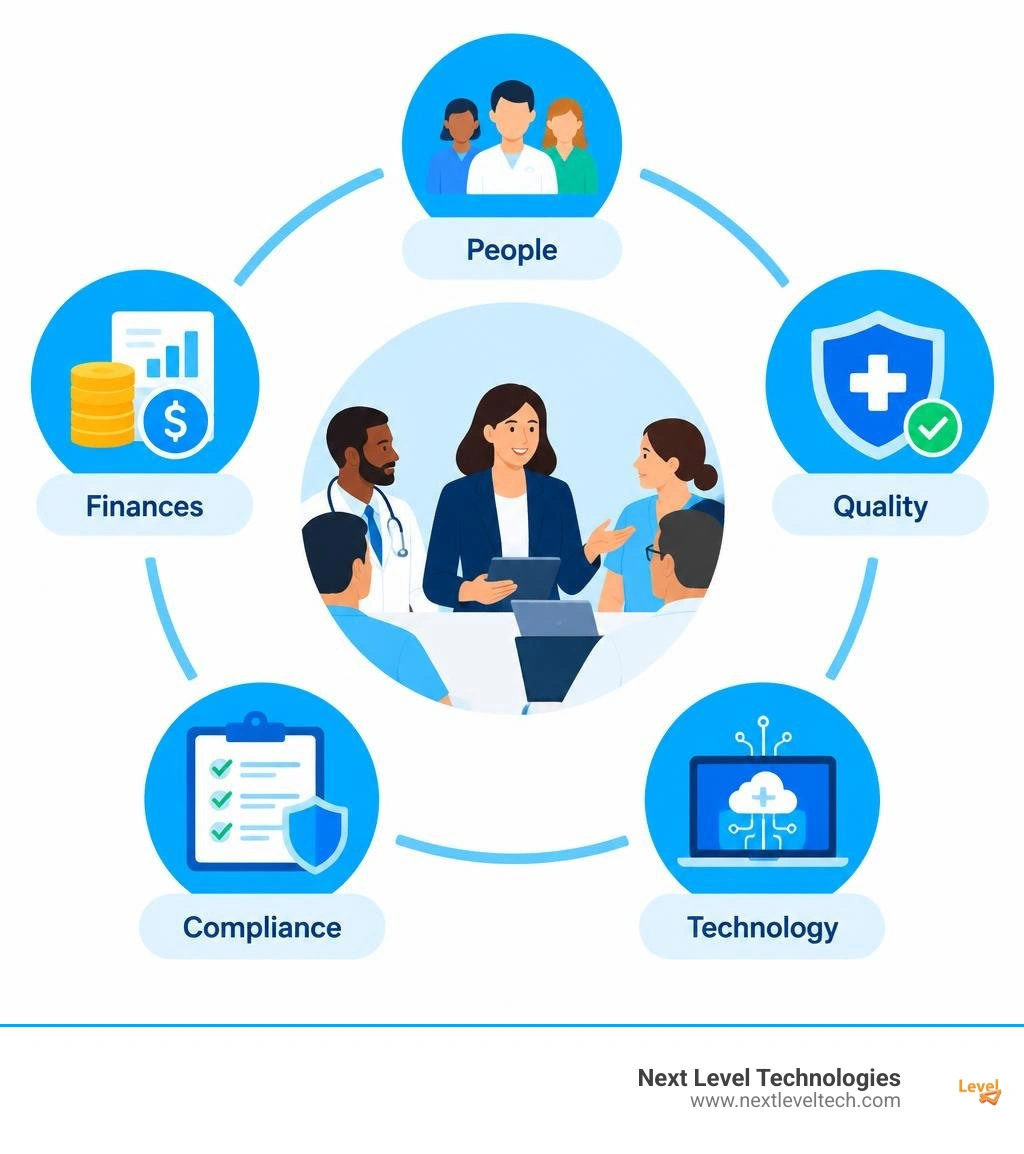
Healthcare administrators must oversee multiple operational domains to ensure uninterrupted patient care and financial sustainability.
Administrators frequently specialize in distinct functional areas:
Modern healthcare operations depend heavily on secure, resilient technical infrastructure. Health system administrators must safeguard patient portals, manage server capacity, maintain VoIP communications, and ensure compliance with strict cybersecurity requirements.
Partnering with technical professionals for strategic healthcare IT consulting enables administrative teams to prevent costly network outages, implement zero-trust access controls, and defend against evolving ransomware threats. Our staff leverages extensive cybersecurity training and decades of technical experience to ensure healthcare networks remain secure, compliant, and continuously operational.
For entry-level roles, a bachelor's degree in health services administration or business is standard. For hospital leadership and executive positions, a CAHME-accredited Master of Health Administration (MHA) or Master of Health Services Administration (MHSA) is the industry benchmark.
Hospital administration focuses on inpatient care, emergency departments, and acute care facilities. Health services administration encompasses the entire healthcare ecosystem, including outpatient ambulatory centers, health insurance plans, government agencies, and community health networks.
Entry-level administrators, such as healthcare data analysts or assistant practice managers, typically earn between $55,000 and $75,000 annually. Compensation grows as professionals assume multi-departmental responsibilities or complete graduate education.
Health service administration provides the organizational framework that allows clinical care teams to operate safely, efficiently, and effectively. As healthcare delivery models evolve, skilled leaders who understand clinical operations, regulatory compliance, and digital infrastructure are essential to organizational success.
Next Level Technologies, with its main location in Columbus, Ohio, and a second location in Charleston, WV, supports healthcare providers in achieving operational excellence. Our team brings deep technical experience and extensive cybersecurity training to help healthcare administrators eliminate IT disruptions, secure sensitive patient records, and build sustainable clinical operations through integrated healthcare management services.
Begun JW, Kaissi A. "Definition and scope of health services administration.." The Journal of health administration education, 2004. PMID 15189026.
Learn how Healthcare Management Administrators Inc optimizes self-funded plans, provider networks, and clinical quality for employers.
October 17, 2026
Upgrade your healthcare claims management for maximum accuracy with Next Level Technologies, serving Columbus, Ohio and Charleston, WV.
October 10, 2026

