Everything Employers and Providers Should Know About Healthcare Management Administrators Inc
October 17, 2026


Learn how Healthcare Management Administrators Inc optimizes self-funded plans, provider networks, and clinical quality for employers.
October 17, 2026

Upgrade your healthcare claims management for maximum accuracy with Next Level Technologies, serving Columbus, Ohio and Charleston, WV.
October 10, 2026

Discover how a healthcare management services organization boosts practice efficiency, cuts overhead, and protects clinical autonomy.
October 3, 2026
October 17, 2026
Healthcare Management Administrators, Inc. (HMA) helps employers run self-funded health plans. As a third-party administrator, it supports benefits administration, claims processing, and coordination with providers and plan members. For employers, the key distinction is that HMA administers the plan; the employer generally funds covered claims.
That work depends on clear records and secure data sharing. Next Level Technologies, with a main location in Columbus, Ohio, and a second location in Charleston, WV, brings technical experience and extensive cybersecurity training to the IT systems healthcare organizations rely on.

Healthcare management administrators inc terms to know:
Third-party administrators (TPAs) play an essential role in the modern healthcare ecosystem by bridging the gap between plan sponsors, medical providers, and participants. Operating as an independent administrative engine, a TPA delivers the operational backbone necessary to run custom benefit structures without requiring the sponsor to build internal insurance operations from scratch. Public corporate records, such as the corporate registration profile of Healthcare Management Administrators, Inc., demonstrate decades of continuous operation in navigating these complex regulatory and administrative environments.

For organizations evaluating self-insurance, the primary advantage lies in moving away from rigid, fully insured premiums toward financial transparency and tailored plan designs. Rather than paying a fixed fee to a commercial carrier that absorbs surplus margins, self-funded employers pay directly for employee healthcare claims as they occur.
Managing this exposure requires robust risk management tools, notably stop-loss insurance policies that protect against catastrophic individual claims (specific stop-loss) or unexpected aggregate claim spikes across the entire workforce (aggregate stop-loss). Implementing these financial controls alongside comprehensive healthcare management services empowers employers to actively manage healthcare spending while ensuring plan members receive high-quality clinical care.

Self-funded plan design allows organizations to tailor their health coverage to the distinct demographic and clinical needs of their workforce. Instead of settling for standard commercial packages, plan sponsors can build modular programs covering essential preventive services, specialized chronic disease interventions, behavioral healthcare, and modern family-forming solutions like fertility benefits.
Managing these plans requires precise technical execution. Effective claims management in healthcare serves as the primary mechanism for auditing billing accuracy, applying agreed-upon fee schedules, and ensuring appropriate coverage rules are applied before funds are disbursed.
When claims flow through automated adjudication engines, administrative teams can pinpoint high-cost drivers, optimize prescription drug formularies, and introduce targeted wellness incentives. These targeted initiatives lower net costs while encouraging employees to seek timely, preventive interventions.
Modern benefit management often intersects with diverse payment and delivery frameworks, including Affordable Care Act (ACA) market regulations, Medicare Advantage coordination, and Medicaid managed care programs. TPAs must ensure that benefit designs meet statutory affordability standards, out-of-pocket maximum caps, and mandatory preventive service coverages.
A key operational priority is establishing friction-free provider interactions through clean network contracting and rapid adjudication. When coordination breakdowns happen, automated workflows for denial management in medical billing help practices identify coding discrepancies, correct documentation issues, and eliminate lengthy payment delays.
Clear communication protocols regarding deductibles, copayments, and coinsurance levels give patients upfront clarity on their financial responsibilities, reducing administrative friction at the point of care.
Delivering high-value care requires strong alignment between administrative organizations and clinical teams. When administrative operations run smoothly, doctors and nurses can focus on clinical decision-making rather than burdensome paperwork.
Administrative friction—ranging from cumbersome credentialing cycles to slow prior authorizations—is a primary contributor to clinician dissatisfaction and operational overhead. Streamlining these interactions through dedicated portals, such as the official provider resources at Healthcare Management Administrators, helps facilities submit documentation quickly and verify coverage rules instantly.
Reducing administrative burdens directly supports clinical autonomy. When healthcare administrators automate routine eligibility checks and use transparent claim evaluation standards, practices spend less time disputing denials and more time engaging patients. Transparent data sharing fosters trust between payers, administrators, and clinicians, creating a stable environment for value-based care agreements that reward clinical quality and patient satisfaction over raw service volume.
Healthcare administration plays a vital role in dismantling barriers to care across underserved populations, including rural communities and individuals in institutional settings. Facilities seeking to improve care delivery frequently align their operations with national standards, such as those established by the National Commission on Correctional Health Care (NCCHC), which offers accredited continuing education and rigorous benchmarks to ensure constitutionally sound, high-quality medical services in correctional environments.
Quality improvement frameworks also depend heavily on analyzing real-world health data to optimize clinical guidelines:
Modern healthcare management relies entirely on a secure, dependable digital infrastructure. From processing high-volume transactions to running predictive health analytics, administrators depend on robust IT systems to safeguard patient privacy and maintain uninterrupted daily operations.
Clinical research and data analytics allow administrators to identify population health trends before they turn into operational crises. Applying advanced statistical metrics—such as multi-indicator concentration indices used across primary care networks to evaluate prescribing patterns—gives healthcare managers the oversight needed to detect anomalies, curb unnecessary costs, and guide resource allocation.
Data-driven infrastructure also helps organizations tackle major public health challenges:
Supporting these clinical workflows requires responsive electronic health record support that keeps patient histories, diagnostic images, and laboratory data readily accessible to authorized providers.
As healthcare systems connect more devices—including remote monitoring units, wearable sensors, and patient portals—the attack surface for malicious cyber threats expands significantly. A comprehensive, HIPAA-compliant digital health strategy must incorporate layered cybersecurity defenses, automated auditing, and continuous system monitoring.
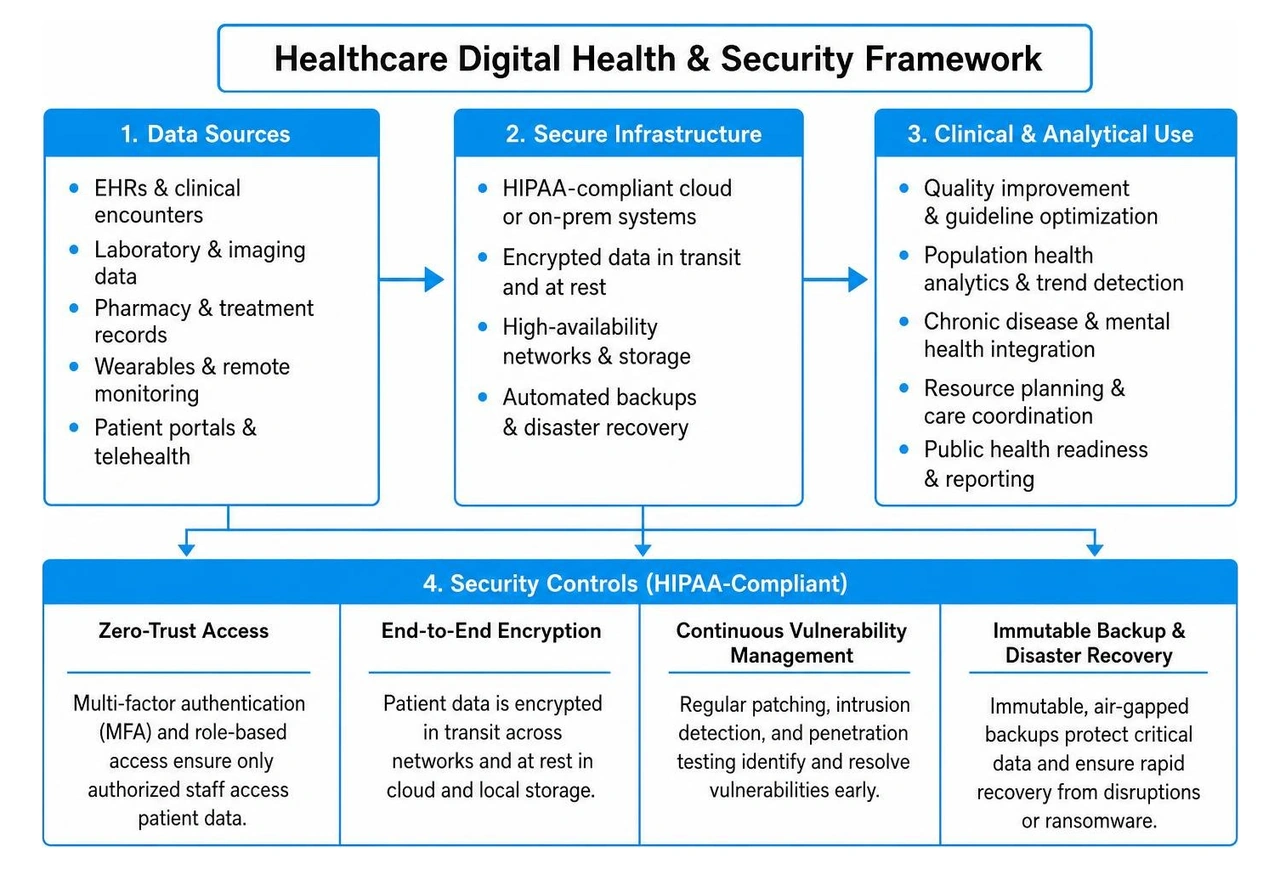
Healthcare organizations must implement several core technical controls to safeguard protected health information (PHI):
Maintaining these complex controls requires specialized expertise. Partnering with a dedicated provider for IT service management for healthcare and ongoing healthcare managed IT services ensures clinical systems remain secure, fully compliant, and operational around the clock.
A third-party health administrator manages the operational aspects of a health plan on behalf of an employer or plan sponsor. Key responsibilities include claims adjudication, member enrollment and eligibility tracking, provider network access coordination, customer service support, regulatory compliance reporting (such as ACA filings), and managing pharmacy benefit programs.
Self-funded health plans give employers direct visibility into their healthcare spending by billing them only for the medical services their employees actually use, rather than charging fixed, marked-up insurance premiums. This transparency allows employers to design targeted wellness initiatives, negotiate favorable provider rates, implement value-based benefit structures, and protect against catastrophic loss through customized stop-loss insurance policies.
Healthcare administrators handling Protected Health Information (PHI) must comply with the HIPAA Privacy, Security, and Breach Notification Rules. This requires implementing technical safeguards such as AES-256 data encryption, multi-factor authentication, granular role-based access permissions, comprehensive audit logging, regular risk assessments, and air-gapped disaster recovery systems to prevent data loss and unauthorized disclosures.
Successfully navigating employee benefits, provider networks, and self-funded plan administration demands seamless collaboration between administrative leaders, healthcare providers, and technical teams. When plan administration is supported by robust data analytics, proactive claims management, and streamlined provider workflows, organizations can lower operational overhead while delivering high-quality, patient-centered care.
At Next Level Technologies, we understand that modern healthcare administration relies heavily on secure, dependable technology. With our main location in Columbus, Ohio, and a second location in Charleston, WV, our staff brings extensive technical experience and advanced cybersecurity training to every client partnership. We help healthcare organizations, professional practices, and non-profits build HIPAA-compliant IT infrastructures, implement multi-layered cybersecurity protections, and maintain stable cloud networks.
Contact Next Level Technologies today to learn how our tailored healthcare management services can optimize your operational workflows, secure your critical clinical data, and keep your organization moving forward.
Upgrade your healthcare claims management for maximum accuracy with Next Level Technologies, serving Columbus, Ohio and Charleston, WV.
October 10, 2026
Discover how a healthcare management services organization boosts practice efficiency, cuts overhead, and protects clinical autonomy.
October 3, 2026

