Building Practice Efficiency: The Healthcare Management Services Organization Model Explained
October 3, 2026


Discover how a healthcare management services organization boosts practice efficiency, cuts overhead, and protects clinical autonomy.
October 3, 2026

Master denial management in medical billing with proven strategies to reduce denials, boost appeals success, and protect revenue cycle performance.
September 25, 2026

Compare the best healthcare learning management platforms for providers with Next Level Technologies, serving Columbus, Ohio and Charleston, WV.
September 19, 2026
October 3, 2026
A healthcare management services organization (MSO) handles a medical practice's non-clinical work, such as billing, IT, payroll, human resources, vendor management, and compliance support. It can help a practice reduce administrative strain and gain scale while physicians retain control of patient care and clinical decisions.
Before partnering with an MSO, practices should evaluate three things:
MSOs have become a major part of healthcare consolidation. They can give independent practices access to better systems, purchasing power, and operational support. But a poorly designed arrangement can put clinical autonomy, compliance, and patient trust at risk.
For healthcare organizations, secure technology is part of the equation. Next Level Technologies supports organizations from its main location in Columbus, Ohio and second location in Charleston, WV, with experienced IT professionals and extensive cybersecurity training to help protect the systems that keep practices running.
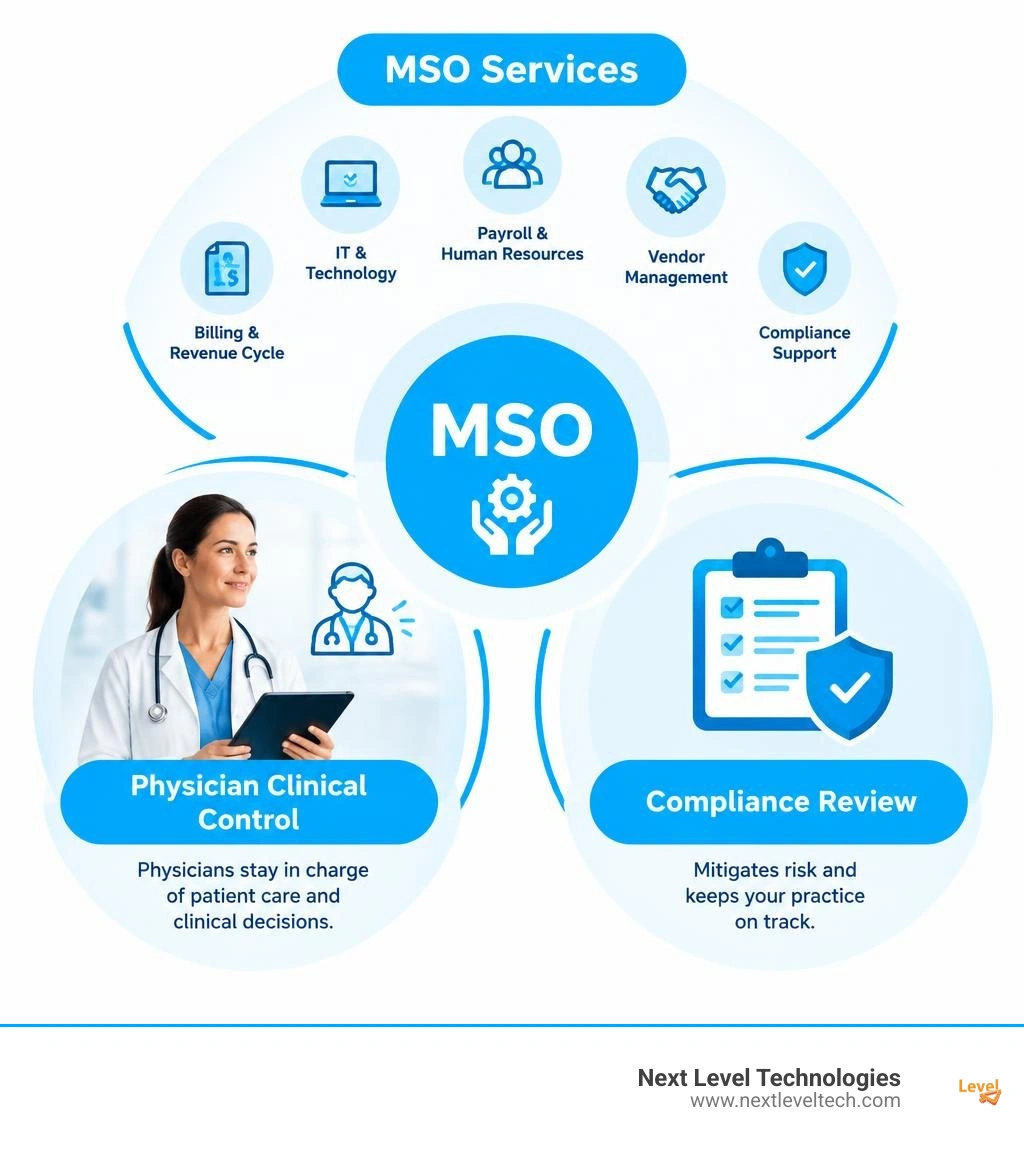
Healthcare management services organization terms to know:

A healthcare management services organization is an independent legal entity designed to provide administrative, operational, financial, and technical infrastructure to medical practices. By taking over burdensome back-office tasks, the MSO allows licensed providers to concentrate on delivering top-tier patient care.
In everyday operations, the clinical entity—such as a professional corporation (PC) or professional limited liability company (PLLC)—employs the physicians, mid-level providers, and clinical staff. Meanwhile, the MSO owns or leases the non-clinical assets, handles vendor contracts, employs administrative staff, manages facilities, and deploys digital systems.
A comprehensive healthcare management it services guide illustrates how these entities integrate electronic health record (EHR) platforms, billing software, and communication tools. Our staff brings deep technical experience and extensive cybersecurity training to these operational frameworks, ensuring that administrative handoffs never create vulnerabilities for practice data.
The operational framework of an MSO relies on a formal contract called a Management Services Agreement (MSA). Under this structure, tangible, non-clinical practice assets (like diagnostic machinery, office furniture, real estate leases, and IT servers) are often transferred to the MSO and leased back to the medical practice. This arrangement generates steady business revenue while freeing the clinical practice from administrative overhead and capital maintenance.
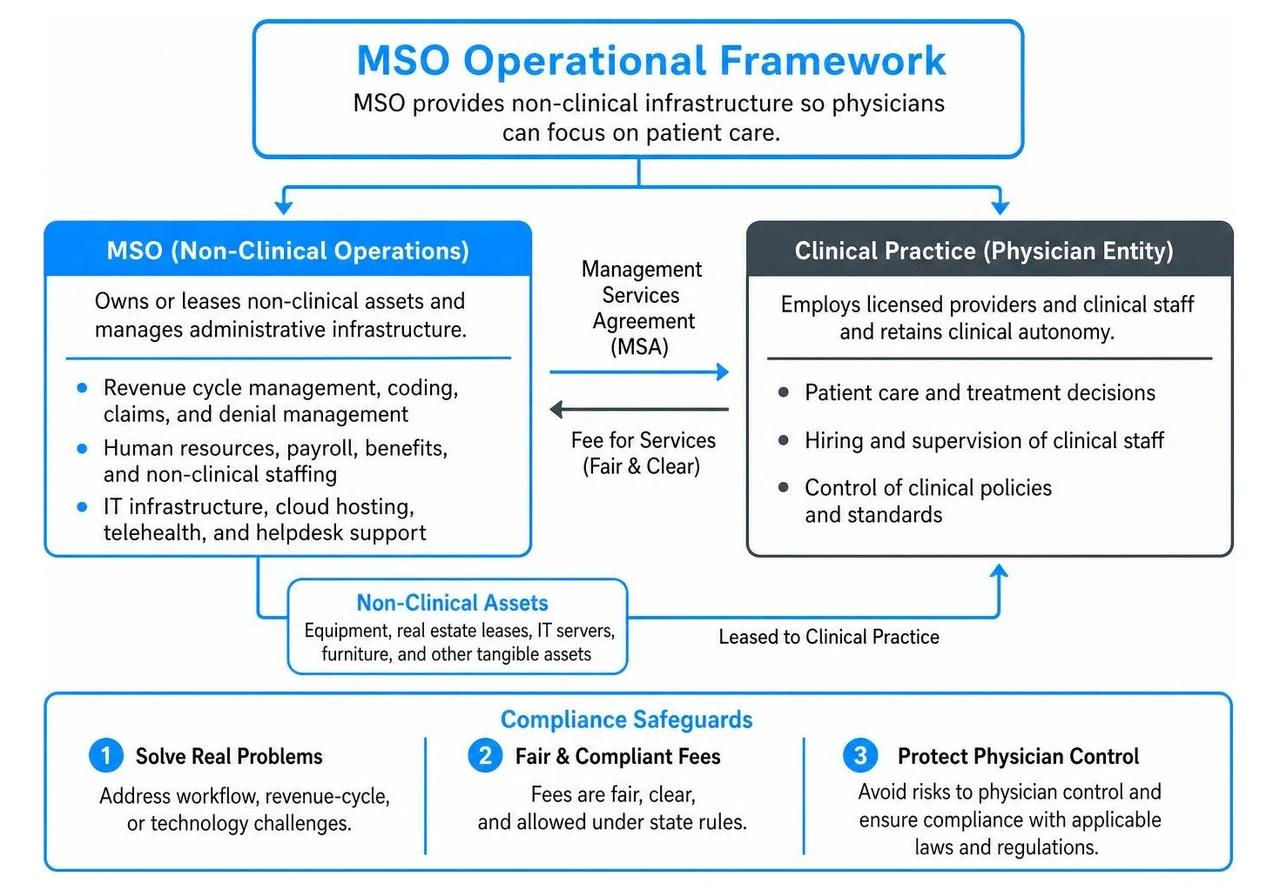
The core non-clinical functions managed by a standard MSO include:
The primary reason MSOs exist across the modern healthcare landscape is the Corporate Practice of Medicine (CPOM) doctrine. Established across 31 states with varying levels of enforcement, CPOM laws prohibit non-physicians—including corporations, private equity firms, and general business investors—from owning medical practices or employing physicians to practice medicine. The public policy rationale is simple: clinical decisions must be guided exclusively by patient health, not corporate profit margins.
To enable non-physician investment and operational expertise while complying with CPOM laws, the industry relies on the "friendly physician" or "captive practice" model. In this setup:
When properly structured, the friendly physician model preserves clinical independence while giving the practice access to outside capital, seasoned executives, and scalable business infrastructure.

Independent practices face mounting financial pressure. Today, nearly 80% of physicians across the United States are employed by or affiliated with hospitals, health systems, or corporate entities. In fact, non-hospital corporate owners, such as private equity groups and health insurers, now own 30.1% of physician practices, surpassing traditional hospital system ownership at 28.4%.
Partnering with an MSO provides independent clinics with the scale needed to thrive in this consolidated environment without losing their practice identity. Group purchasing power lets an MSO negotiate steep volume discounts on medical supplies, software licenses, and liability insurance.
Furthermore, MSOs optimize payer relationships. By aggregating multiple clinical practices under a unified administrative umbrella, they can negotiate favorable reimbursement structures across commercial plans and programs like Mountain Health Trust (Managed Care), maximizing professional fee collections.
Technology is the operational backbone of any successful MSO. Managing disparate clinical locations requires centralized, reliable digital platforms. Deploying comprehensive healthcare managed it services ensures that multiple clinical sites can share secure networks, access real-time patient charts, and maintain synchronized billing workflows.
Specialized medical it services streamline day-to-day operations by:
Our engineers emphasize technical experience and extensive cybersecurity training to help medical practices bridge legacy clinical tools with modern cloud management platforms.
MSOs serve as the vehicle of choice for private equity (PE) firms investing in outpatient healthcare. PE firms deploy capital by creating an MSO platform that acquires the administrative assets of a large "anchor" practice, followed by smaller "add-on" clinics within the same specialty or geographic market.
This model has driven rapid consolidation in specialties like dermatology, gastroenterology, ophthalmology, and neonatology. In many geographic markets, private equity-backed market share exceeds 30% to 50%.
While PE-backed MSOs bring needed capital for facility upgrades, advanced equipment, and business expansion, consolidation can impact pricing. Research indicates that private equity acquisitions raised prices by 11% in dermatology, gastroenterology, and ophthalmology, and surged neonatology prices by 70%. In gastroenterology practices, claim prices climbed 28.4%, largely fueled by a 78.1% rise in professional fees. Practices evaluating capital partners must balance liquidity opportunities against long-term operational autonomy.
Because MSOs operate at the intersection of corporate finance and clinical practice, they are subject to strict regulatory scrutiny. Regulators look closely at whether an MSO is functioning as a genuine administrative vendor or acting as an unlawful corporate owner exercising control over patient care.
Key federal and state regulations governing MSO relationships include:
Data security is equally critical. Implementing robust healthcare network security services ensures that MSO platforms adhere strictly to HIPAA Security Rules, protecting electronic protected health information (ePHI) across all operational touchpoints.
The method an MSO uses to charge for its services is one of its largest compliance risk areas. Management fees must reflect Fair Market Value (FMV) for actual, necessary services rendered, and the arrangement must be commercially reasonable.
Common MSO compensation structures include:
Regular third-party FMV audits are essential to ensure management compensation remains defensible under regulatory review.
State healthcare policy is evolving rapidly in 2026, with lawmakers taking a closer look at corporate influence in medicine. Several states have introduced legislation expanding "material transaction reviews," requiring MSOs, health systems, and PE investors to give state agencies 30 to 90 days prior notice before closing practice acquisitions or entering long-term management agreements.
States like California, Oregon, and Massachusetts have led efforts to enforce ownership transparency, empowering state attorneys general to review or block transactions that could reduce competition or compromise care quality. Organizations supporting community healthcare, like The Columbus Organization: Home, operate in an environment where regulatory transparency and verified operational standards are paramount.
The Management Services Agreement is the core document governing the operational relationship between a medical practice and an MSO. A well-crafted MSA protects the clinical team, clearly defines operational boundaries, and withstands regulatory audits.
When drafting an MSA, both parties must understand why the healthcare industry must have managed it services integrated into their governance plan. Clear service level agreements (SLAs), detailed cyber liability allocations, and defined protocols for maintaining system uptime should be established from day one.
Key elements that every MSA must clearly define include:
Before signing a binding management contract, independent practice owners should conduct thorough due diligence across operational, legal, and technological fronts.
In a traditional practice acquisition, a hospital or health system purchases both the clinical operations and business assets, directly employing the physicians. In an MSO model, clinical ownership stays with a physician-owned professional entity (preserving CPOM compliance), while the MSO only owns the non-clinical assets and delivers administrative support.
No. State CPOM doctrines and professional licensing boards strictly prohibit non-physician investors or MSO managers from directing clinical protocols, overriding physician treatment choices, setting patient volume quotas, or interfering with medical judgment.
Fixed monthly fees or transparent cost-plus models set at verifiable Fair Market Value provide the safest legal footing. Percentage-of-revenue models are prohibited in several states and carry higher regulatory risk under federal and state anti-kickback statutes.
The healthcare management services organization model offers medical practices a dependable way to reduce overhead, adopt enterprise-grade technology, and build economies of scale while keeping clinical care in the hands of physicians. However, unlocking these benefits requires balanced governance, careful regulatory compliance, and a resilient technical foundation.
At Next Level Technologies, our teams support healthcare providers with proactive IT management, cloud solutions, and HIPAA-compliant data protection. With our main location in Columbus, Ohio and a second location in Charleston, WV, our staff applies more than 20 years of technical experience and extensive cybersecurity training to help medical practices stay efficient, secure, and compliant.
Explore how dedicated healthcare management services can help safeguard your clinical workflows, eliminate administrative downtime, and support long-term growth.
Master denial management in medical billing with proven strategies to reduce denials, boost appeals success, and protect revenue cycle performance.
September 25, 2026
Compare the best healthcare learning management platforms for providers with Next Level Technologies, serving Columbus, Ohio and Charleston, WV.
September 19, 2026
