Winning the War on Claim Denials in Healthcare Billing
September 25, 2026


Master denial management in medical billing with proven strategies to reduce denials, boost appeals success, and protect revenue cycle performance.
September 25, 2026

Compare the best healthcare learning management platforms for providers with Next Level Technologies, serving Columbus, Ohio and Charleston, WV.
September 19, 2026

Compare cloud backup services with this guide to backup cloud database service architecture, security, and disaster recovery.
September 12, 2026
September 25, 2026
Denial management in medical billing is the ongoing work of finding, fixing, appealing, and preventing unpaid insurance claims. A strong program does four things: verifies patient and coverage data before care, catches claim errors before submission, routes denied claims to the right staff quickly, and uses denial trends to fix the source of repeat problems.
This matters because a denial is not always lost revenue. About 63% of denied claims may be recoverable through an appeal, yet many are never reworked. With initial denial rates reaching 11.8% in 2024 and industry estimates commonly ranging from 12% to 15%, healthcare organizations cannot afford to treat denials as routine back-office noise.
The best teams focus on prevention first. Registration errors, eligibility failures, missing prior authorizations, coding mistakes, and weak clinical documentation drive many avoidable denials. They also track payer rules, appeal deadlines, and denial reason codes so small mistakes do not become permanent write-offs.
For healthcare organizations, reliable technology is part of the solution. Next Level Technologies supports organizations from its main location in Columbus, Ohio, and its second location in Charleston, WV, with technical experience and extensive cybersecurity training that help protect the systems, data, and workflows behind revenue cycle operations.
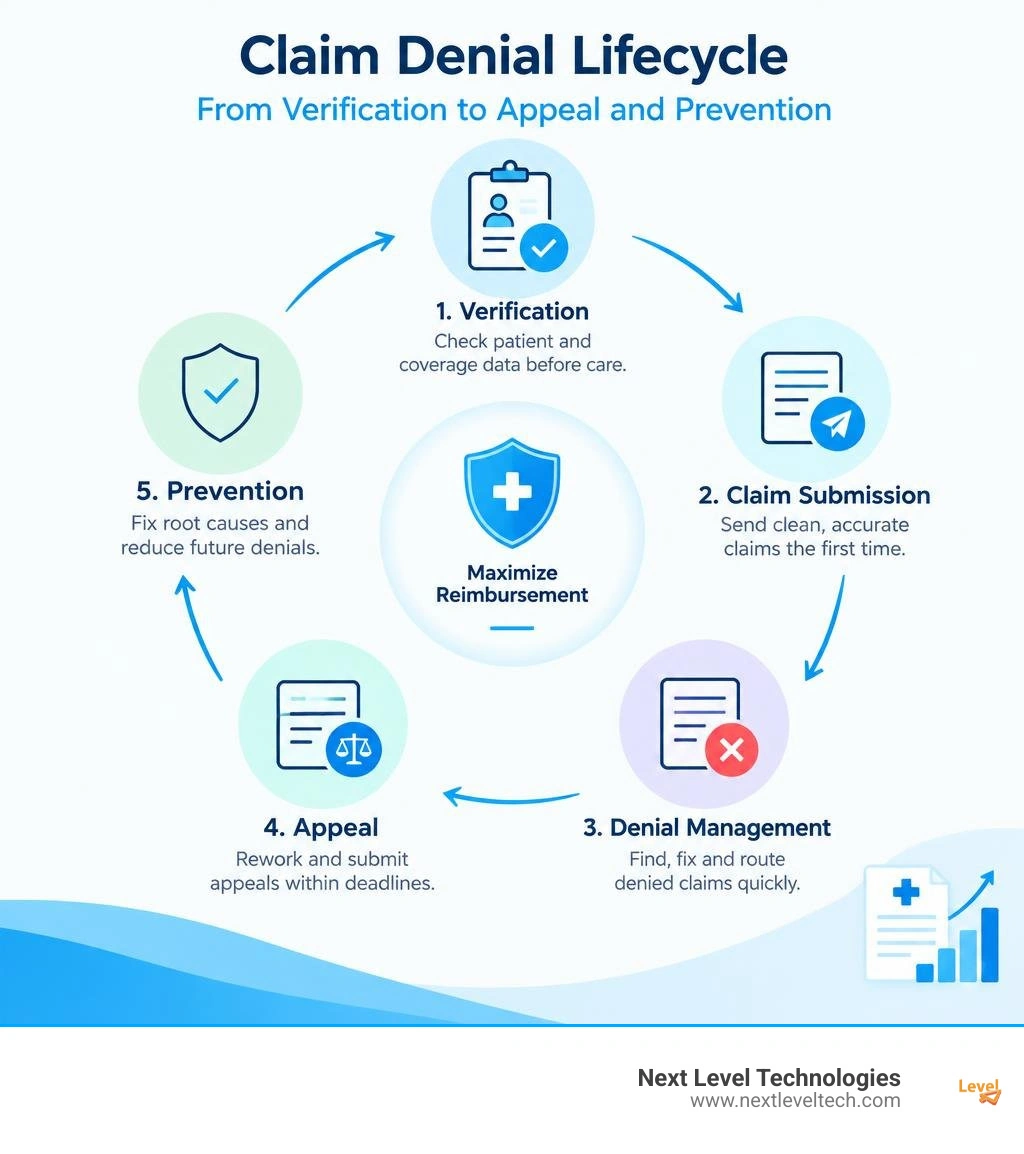
Glossary for denial management in medical billing:
Denial management is a structured discipline that protects the financial lifeline of a medical practice. Rather than simply writing off unpaid balances or letting files languish in an aged accounts receivable (A/R) queue, proactive revenue cycle management (RCM) treats every denial as actionable operational data. When claims stall, cash flow stumbles, and administrative overhead spikes.
Understanding the difference between initial claim barriers and actual payer adjudications is the first step toward reclaiming earned revenue.
Many billing teams accidentally conflate claim rejections with claim denials, but they represent entirely different stages of the billing lifecycle:
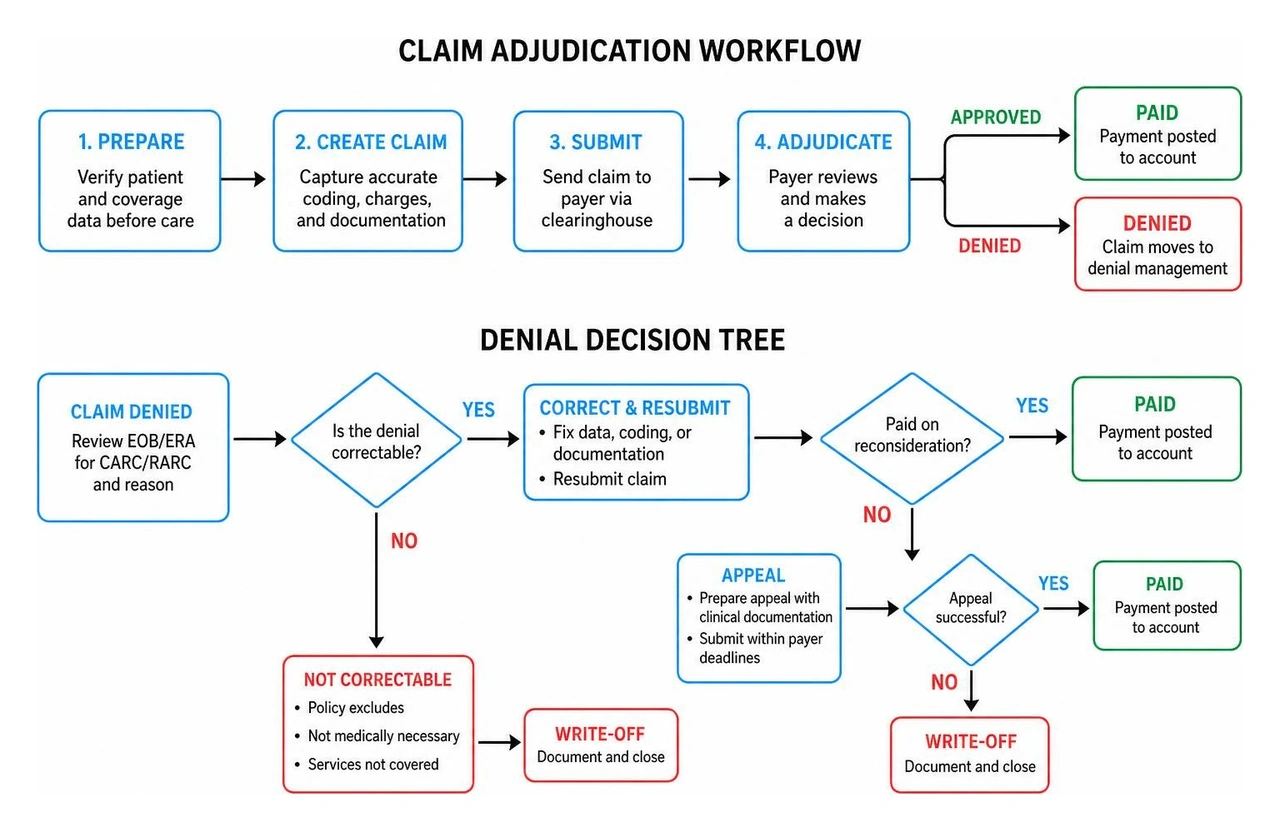
Resolving a true denial requires a systematic response: correcting technical errors, submitting formal redetermination requests, or assembling comprehensive clinical documentation packets.
The cost of claim denials extends far beyond uncollected reimbursement. U.S. hospitals lose an estimated $262 billion annually due to initial claim denials. Furthermore, healthcare providers spend approximately $19.7 billion each year merely appealing denied claims.
Reworking an individual denied claim costs between $25 and $181 in administrative labor, payer follow-ups, and documentation assembly. When nearly 65% of denied claims are never reworked or resubmitted, practices essentially leave hard-earned money on the table. Unmanaged denials degrade net collection rates, push days in A/R past the dangerous 90-day mark, and eventually trigger irreversible timely filing write-offs. Managing this burden requires a robust digital foundation; our team applies deep technical experience and extensive cybersecurity training to help clinics maintain secure, optimized systems that keep billing workflows moving without technical disruption.
Up to 90% of all claim denials are preventable. Denials are rarely random; they are predictable outputs of upstream process breakdowns across front-end registration, clinical documentation, and back-end coding. Today, healthcare organizations must leverage modern data analytics healthcare solutions to identify precisely where revenue leaks occur.
A successful denial management program relies on continuous root-cause analysis rather than ad-hoc troubleshooting. The most effective approach leverages standard CARC and RARC code groupings to classify incoming denials into actionable categories:
By aggregating denial data across 90-day audit cycles, practices can identify whether specific providers, front-desk shifts, or specialty service lines are driving outsized denial volumes.
Front-end operational errors account for roughly 50% to 61% of all claim denials. Roughly 68% of healthcare providers cite incorrect or incomplete patient information gathered during intake as a primary denial driver. Missing insurance cards, misspelled policyholder names, and unchecked secondary coverage rules immediately compromise clean claim submission.
Simultaneously, prior authorization issues represent nearly 35% of all non-clinical denials. Commercial carriers and Medicare Advantage plans frequently change their pre-certification rosters. To eliminate these bottlenecks, practices require seamless electronic health record support that integrates automated real-time eligibility (RTE) verifications at scheduling, pre-registration, and check-in touchpoints.
Mid-cycle revenue vulnerabilities stem from complex clinical decisions and intricate medical coding rules. Common mid-cycle drivers include:

When denials occur, having a standardized, disciplined recovery workflow separates high-performing practices from those that succumb to revenue leakage. A proven operational blueprint is the IMMP Framework:
Not all denials should be worked in the order they arrive. Working denials "newest-first" is an administrative trap that causes high-dollar and time-sensitive claims to expire.
Instead, establish a priority triage matrix that weights claims based on two core factors: Timely Filing Expiration and Net Dollar Value. While Original Medicare allows up to 120 days for a Level 1 redetermination request, commercial carriers and managed care organizations frequently enforce 30- to 90-day appeal windows. Soft denials (such as missing modifiers or simple data errors) with high recovery value should be corrected and dispatched within 48 to 72 hours of remittance receipt.
Well-prepared appeals achieve overturn rates of 40% to 60%, with best-in-class recovery teams exceeding 70%. Achieving these metrics requires moving away from generic form letters and developing structured "citation packets":
The most cost-effective denial is the one that never happens. Maximizing the First-Pass Clean Claim Rate (FPCR) reduces the reliance on costly, manual appeals. Achieving an elite clean claim rate above 98% requires pairing clinical rigor with enterprise-grade healthcare it service management to ensure that billing engines and practice management platforms operate seamlessly.
With commercial payers rapidly deploying automated screening engines to batch-deny claims within hours of receipt, healthcare providers must fight algorithms with algorithms.
Modern practices leverage rules engines and machine learning to intercept billing errors pre-submission:
Deploying these demanding data solutions requires resilient, compliant cloud architecture. Secure cloud computing healthcare platforms ensure real-time claims analytics and practice management software remain accessible, fast, and fully protected against outages.
Healthcare leaders often weigh the financial and operational trade-offs between managing denials internally or partnering with external billing firms:
You cannot improve what you do not measure. A proactive denial management strategy requires real-time tracking of objective Key Performance Indicators (KPIs).
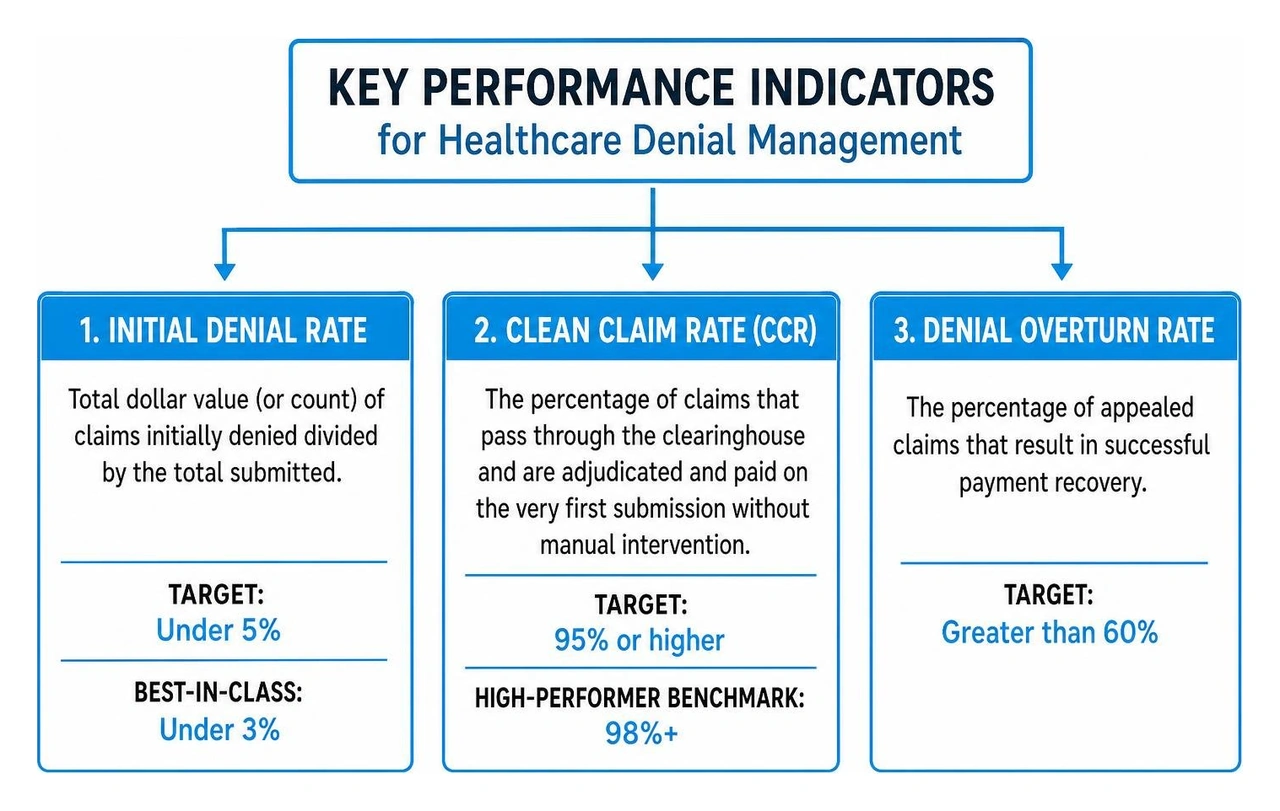
To maintain financial stability, revenue cycle leaders should continuously benchmark their operations against core industry targets:
Data tracking is meaningless without a structured review cadence. Healthcare practices should establish a two-tiered review process:
Maintaining strict system logging, role-based access, and continuous it compliance monitoring ensures that your financial analytics dashboards remain secure, auditable, and fully compliant with HIPAA regulations.
The broadly accepted healthcare industry benchmark for a healthy initial claim denial rate is below 5%, with top-tier, best-in-class organizations achieving rates below 3%. In contrast, unmanaged billing operations frequently experience denial rates between 12% and 15%. Over 41% of U.S. healthcare providers reported denial rates above 10% in 2025, highlighting the urgent need for systematic denial prevention programs.
A claim rejection occurs prior to payer processing—typically stopped by clearinghouse formatting or demographic validation checks—and does not generate a formal EOB. Rejections can generally be corrected and resubmitted immediately. A claim denial occurs after the payer has adjudicated the claim and officially declined payment based on clinical, medical necessity, or contractual policies, generating specific CARC and RARC codes that often necessitate a formal appeal.
Approximately 63% of all initially denied healthcare claims are potentially recoverable through well-structured appeals. Top-performing revenue cycle teams that utilize tailored appeal templates, attach relevant clinical notes, and quote payer guidelines consistently achieve first-level appeal overturn rates between 40% and 60%, with overall resolution yields surpassing 70%.
Managing claim denials is no longer just a back-office billing chore—it is a core operational strategy that protects the financial future of your practice. With rising administrative costs and automated payer algorithms driving initial denial rates higher across the country, healthcare organizations must replace reactive cleanup efforts with automated, root-cause prevention and disciplined recovery workflows.
At Next Level Technologies, we help healthcare organizations build strong, compliant, and resilient IT foundations that keep revenue operations running smoothly. Supporting clients from our main location in Columbus, Ohio, and our second location in Charleston, WV, our team brings decades of technical experience and extensive cybersecurity training to secure your practice management platforms, streamline EHR connectivity, and protect critical patient billing data. Explore how our comprehensive healthcare management services can eliminate technical downtime, ensure HIPAA compliance, and give your revenue cycle the stability it deserves.
Compare the best healthcare learning management platforms for providers with Next Level Technologies, serving Columbus, Ohio and Charleston, WV.
September 19, 2026
Compare cloud backup services with this guide to backup cloud database service architecture, security, and disaster recovery.
September 12, 2026
