Healthcare Learning Management: Comparing the Best Platforms for Providers
September 19, 2026


Compare the best healthcare learning management platforms for providers with Next Level Technologies, serving Columbus, Ohio and Charleston, WV.
September 19, 2026

Compare cloud backup services with this guide to backup cloud database service architecture, security, and disaster recovery.
September 12, 2026

Compare cloud based backup services with our ultimate checklist covering encryption, recovery, and compliance for your business.
September 5, 2026
September 19, 2026
General corporate platforms handle employee onboarding, general leadership videos, and basic sales quizzes effectively. In contrast, clinical environments require specialized capabilities. Healthcare organizations face stringent oversight from bodies like The Joint Commission, CMS, and OSHA. If an employee in standard retail forgets an annual security video, it leads to internal reminders. If a hospital misses mandatory infection control certifications, it risks citations, compromised accreditation, or patient safety failures.
Dedicated healthcare systems incorporate features that standard enterprise tools lack:
Maintaining these systems requires strong healthcare IT service management to ensure that course rosters sync accurately with active clinical directories. When technical teams coordinate user provisioning with HR systems, staff gain immediate access to required training from day one.
Continuing education in healthcare involves formal regulatory accountability. Clinicians must maintain state licenses, hospital privileges, and specialty board certifications through Continuing Medical Education (CME) and Continuing Education (CE) credits.
A dedicated learning solution automates these credit workflows. Instead of manually collecting paper completion certificates, clinicians can complete coursework, pass required post-tests, and immediately claim earned credits. Specialized platforms support fractional credit claiming down to 0.25-hour increments, allowing physicians to log education during brief clinical breaks.
Furthermore, platforms supporting Maintenance of Certification (MOC) track specialty requirements, allowing physicians across varied disciplines to complete required quality improvement and medical knowledge modules directly within their digital workspace.
Accreditation recordkeeping demands precision. Platforms must support reporting mechanisms for major accreditation bodies, such as the Accreditation Council for Continuing Medical Education (ACCME) and the American Nurses Credentialing Center (ANCC).
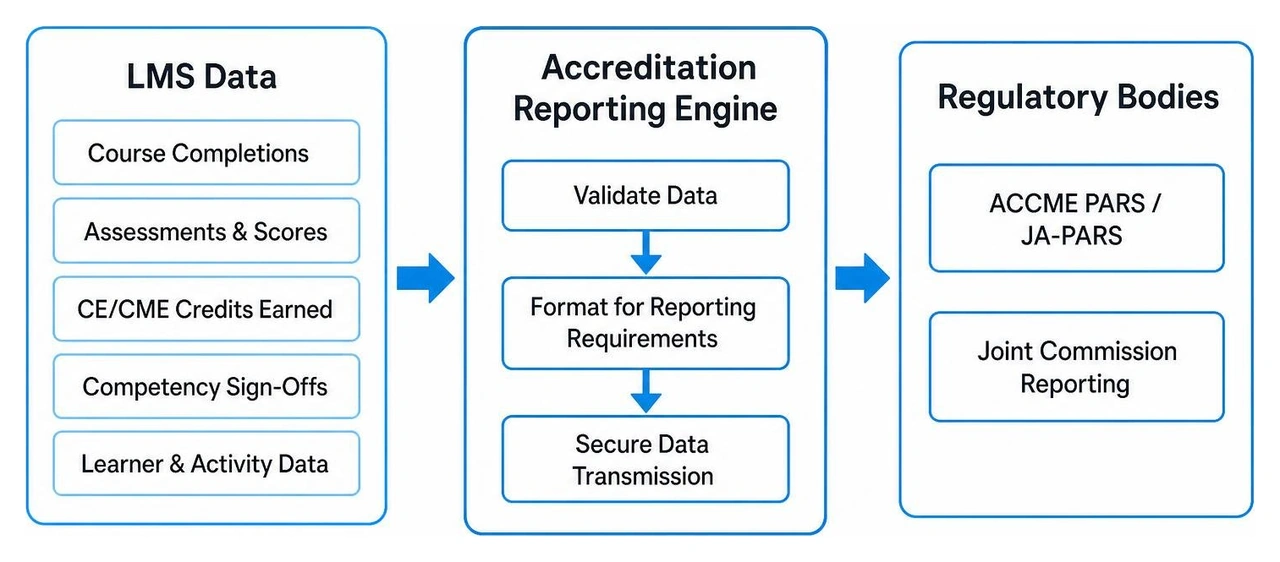
Purpose-built platforms connect directly with reporting portals like ACCME Program and Activity Reporting System (PARS) and Joint Accreditation PARS (JA-PARS). Rather than requiring administrative teams to export and re-key learner records, the platform transmits completed activity data directly to central registries. This automation eliminates manual data entry, prevents reporting discrepancies during accreditation renewals, and ensures audit readiness across clinical departments.
Selecting an educational platform requires evaluating both administrative tooling and user experience. Clinical staff face demanding schedules, making intuitive navigation and rapid access critical to adoption.
Key evaluation criteria include:
Organizations typically weigh dedicated clinical suites against generalized enterprise platforms. Both approaches have distinct architectural advantages depending on internal resources.
Purpose-built solutions, such as HealthStream, Relias, symplr Learning, EthosCE, and Medbridge, come tailored specifically for medical environments.
These dedicated systems minimize initial configuration because clinical pathways, CE trackers, and regulatory courses are pre-loaded. However, they can be less flexible if an organization wants extensive custom interface development outside standard healthcare paradigms.
Enterprise engines such as Cornerstone OnDemand, Absorb LMS, and Moodle provide robust, highly configurable foundations.
The trade-off lies in administrative overhead. Enterprise engines require internal instructional designers to build courses or manage third-party SCORM content packages, along with technical teams to construct custom reporting feeds for healthcare regulatory boards.
An educational platform is only as effective as the infrastructure supporting it. Because these systems store employee records, performance evaluations, and internal clinical workflows, strict technical safeguards are essential.
Systems must utilize 256-bit TLS encryption in transit and rest, paired with role-based access control (RBAC). Cloud deployments must maintain verifiable HIPAA compliance and SOC 2 certifications. Integrating Federated Single Sign-On (SSO) via SAML or OpenID Connect streamlines access, preventing password fatigue while ensuring terminated staff lose immediate access to proprietary internal policies.
Modern deployments also benefit from bridging the training platform with clinical systems. Implementing tailored electronic health record support helps ensure that technical issues do not interrupt workflow guidance or clinical documentation updates.
A comprehensive scoping review on medical LMS adoption published in the National Library of Medicine examines how digital learning platforms function within medical education (Kamath et al., 2025). The review noted that while 70.7% of medical students routinely used lecture slides, 71.9% used videos, and 71.3% accessed digital texts on their LMS, only 2.2% used the platforms to communicate with peers (Kamath et al., 2025). This reinforces that healthcare training platforms serve primarily as functional knowledge hubs, requiring reliable uptime, responsive design, and organized resource directories rather than social networking features.
Deploying a training platform across a healthcare facility requires active change management. Faculty, clinical educators, and attending physicians often have limited time to navigate complex user interfaces.
Successful rollouts rely on several key strategies:
When organizations need strategic guidance on network design, cloud migration, and workflow automation, engaging in dedicated consulting healthcare IT helps bridge the gap between clinical learning priorities and reliable IT architecture.
A clinical LMS is specifically engineered for medical workflows. It includes pre-loaded accredited clinical courses, preceptor evaluation checklists, partial-credit CME claiming, license expiration tracking, and direct integration with healthcare reporting bodies like ACCME and ANCC. General corporate systems focus on standard employee onboarding and business training, requiring manual setup to handle complex clinical compliance requirements.
Specialized platforms maintain built-in data bridges to regulatory registries such as ACCME PARS and JA-PARS. When a physician or nurse completes an accredited activity, the system verifies completion, calculates the appropriate credit hours, and transmits the attestation data directly to the reporting authority. This eliminates the need for administrators to manually export spreadsheets and re-enter learner records.
A healthcare training platform must maintain strict HIPAA compliance to protect sensitive workforce data and internal institutional protocols. Essential safeguards include end-to-end data encryption (AES-256 at rest and TLS in transit), granular role-based permissions, federated single sign-on (SSO), routine vulnerability scanning, and third-party verified SOC 2 Type II or HITRUST certifications.
A well-architected healthcare training platform transforms staff education from an administrative chore into a strategic driver of clinical excellence. Whether your organization implements a dedicated medical platform with pre-built CME tracking or adapts a flexible enterprise system, the ultimate goal is clear: maintaining audit readiness, reducing administrative burdens, and keeping your clinical workforce prepared to deliver high-quality patient care.
Deploying and maintaining these platforms requires a secure, high-performing technical environment. Next Level Technologies, with our main location in Columbus, Ohio and a second location in Charleston, WV, provides comprehensive technical expertise to ensure your medical education platforms, cloud databases, and clinical applications run smoothly. Our team's extensive cybersecurity training and decades of technical experience ensure that your staff remains protected against emerging security risks while maintaining continuous access to essential systems. Explore our full suite of healthcare management services to support your organization's IT and compliance infrastructure.
Kamath SG, Nayak KR, Nayak V, Verma S. "Leveraging learning management systems in medical education: a scoping review of use, outcomes, and improvement pathways.." Medical education online, 2025. PMCID PMC12713214.
Compare cloud backup services with this guide to backup cloud database service architecture, security, and disaster recovery.
September 12, 2026
Compare cloud based backup services with our ultimate checklist covering encryption, recovery, and compliance for your business.
September 5, 2026


