A Decision-Maker's Guide to Choosing HIPAA Compliant IT Support
October 30, 2026


Discover how hardware and software components of computer network systems work together for seamless data flow and security.
November 2, 2026

Learn how to choose HIPAA compliant IT support for your healthcare organization, with guidance on safeguards, vendor verification, and breach response.
October 30, 2026

Explore health service administration careers, leadership skills, degrees, salaries, and job outlook for modern healthcare executives.
October 24, 2026
October 30, 2026
Choose hipaa compliant it support that will sign a Business Associate Agreement (BAA), restrict access to patient data, encrypt sensitive information, and keep audit logs. Ask how the provider secures help desk tickets and remote support, trains its staff, and handles security incidents. Don’t rely on a compliance claim alone; ask for evidence of its safeguards.
Your organization remains responsible for its HIPAA obligations, even when an IT provider helps protect patient data. This guide explains what to check before choosing a provider. Next Level Technologies supports healthcare organizations from its main location in Columbus, Ohio, and its second location in Charleston, West Virginia.

Glossary for hipaa compliant it support:
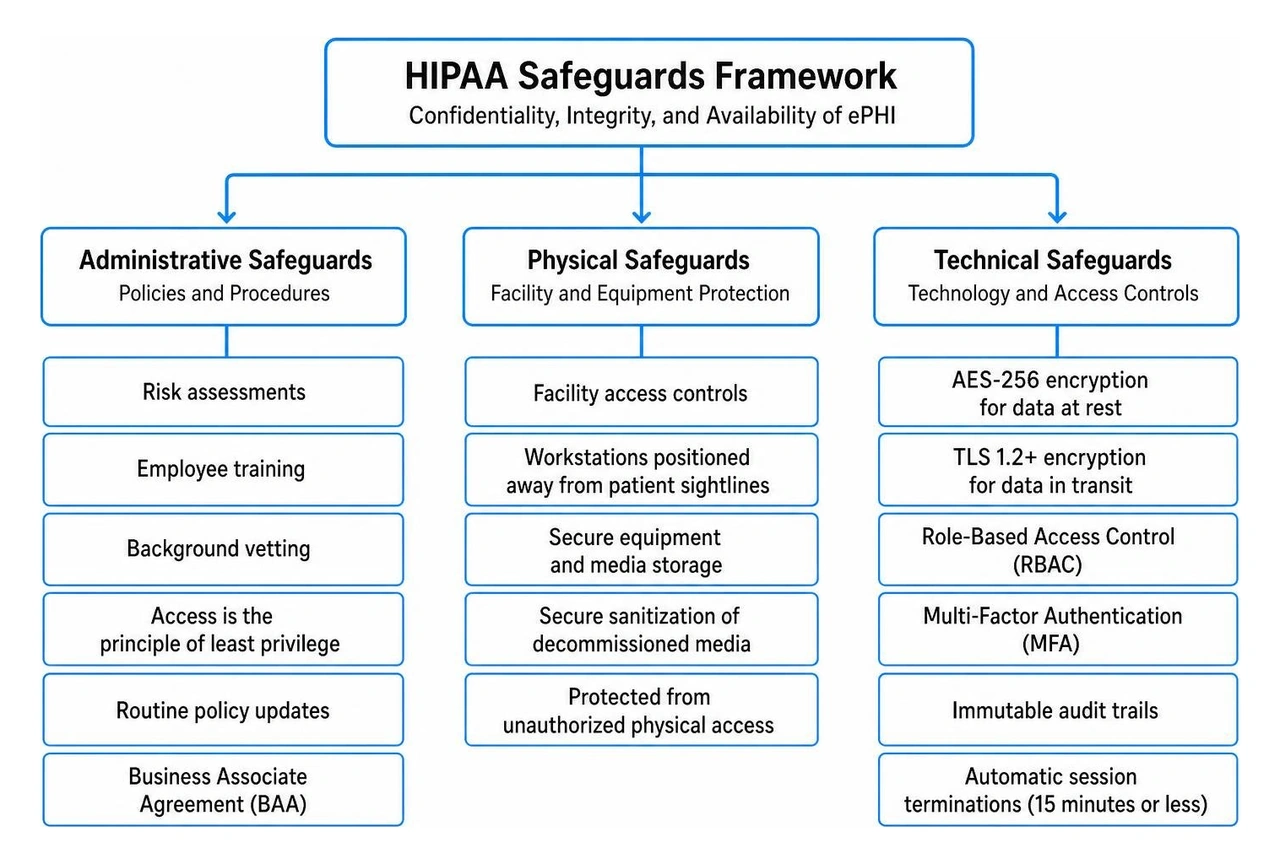
Healthcare technology should make delivering patient care seamless, yet clinical systems introduce regulatory exposure if they are misconfigured. The Health Insurance Portability and Accountability Act (HIPAA) Security Rule mandates that covered entities and their business associates implement comprehensive safeguards to ensure the confidentiality, integrity, and availability of electronic protected health information (ePHI). When technical support personnel troubleshoot practice management platforms, access workstations remotely, or route support tickets containing medical records, they handle regulated data.
Failing to secure these workflows can trigger civil monetary penalties from the Department of Health and Human Services (HHS) Office for Civil Rights (OCR). Penalties can reach up to $1.5 million per violation category annually. Beyond statutory fines, a data breach can erode patient trust that took decades to build. Healthcare leaders can review official HIPAA regulatory guidelines to understand state and federal enforcement expectations.
Partnering with experts who deliver managed IT services for medical practices ensures your technical infrastructure is built to withstand regulatory scrutiny. Any external team assisting with systems that store, transmit, or process patient data must execute a formal Business Associate Agreement (BAA) before touching a single device.
Technical safeguards represent the digital locks and alarms safeguarding clinical data. A qualified technical partner establishes defense-in-depth protections across every endpoint, server, and network switch.
Our engineers draw upon decades of field experience and extensive cybersecurity training to deploy robust healthcare network security services that keep clinics protected against sophisticated intrusions.
Compliance extends beyond firewalls and encryption keys. The administrative and physical protections established by your support partner ensure that real-world operations match regulatory standards.
Physical security requires strict facility access controls, standardized workstation positioning away from patient sightlines, and secure sanitization procedures for decommissioned storage media. Under structured healthcare IT service management, administrative controls formalize risk assessments, background vetting, and routine policy updates.

Everyday communication channels represent one of the most common vectors for unintentional ePHI exposure. When clinic staff email a screenshot of an error message containing a patient's chart number, or when an IT technician answers an unencrypted live chat request, sensitive health data enters the support ecosystem.
To maintain compliance, every service desk channel must be configured under the HIPAA Minimum Necessary standard. Our comprehensive IT service desk support guide 2026 explains how modern support centers secure tickets, restrict email notifications containing protected data, and isolate chat interactions behind authenticated portals.
Standard help desk software designed for retail or general commercial use often handles data in ways that violate healthcare regulations. Off-the-shelf platforms frequently store unencrypted ticket attachments, route full ticket histories over unencrypted standard email, and lack signed BAAs covering third-party integrations.
HIPAA-compliant help desk architectures enforce data residency controls, scrub sensitive identifiers from outgoing email notifications, and route remote screen-sharing sessions through dedicated, encrypted tunnels. This specialized architecture ensures that providers delivering electronic health record support can diagnose application errors without creating unmonitored data leaks.
Automated ticket triage and AI-powered help desk assistants can accelerate response times, but they introduce unique compliance hurdles. Generative AI tools and automated chatbots must never process patient information unless clear guardrails are enforced.
By applying these safeguards, practices adopting cloud computing healthcare solutions can leverage automation without exposing protected clinical records.

Any technology vendor can claim their services are secure, but healthcare leaders must independently verify these claims. Self-attestation is not proof of compliance. Independent validation separates reliable IT partners from providers that merely treat compliance as a marketing slogan. Our security compliance guide 2026 details how structured vendor assessments uncover hidden security risks before contracts are signed.
When vetting potential technology partners, request formal compliance documentation:
Reviewing these artifacts against recognized IT compliance standards gives leadership confidence that sensitive data remains protected.
A compliant tool in untrained hands can quickly lead to compliance violations. Our team frequently resolves configuration errors left behind by inexperienced vendors, including:
Addressing these flaws requires disciplined oversight and proactive data protection and security measures that eliminate common vulnerabilities.

Even resilient networks must be prepared for unexpected security incidents. A HIPAA-compliant IT support provider maintains tested incident response playbooks that align with the OCR Breach Notification Rule.
Under federal guidelines, covered entities must notify affected individuals and HHS without unreasonable delay, and no later than 60 calendar days following the discovery of a breach affecting 500 or more individuals. A disciplined IT partner provides immediate forensic preservation, log analysis, threat containment, and technical reporting to determine whether data exfiltration occurred. Relying on proactive IT support ensures your organization detects anomalous behavior before an incident escalates into a catastrophic public breach.
Technology alone cannot prevent a security breach if employees fall for social engineering schemes. Human error remains a leading cause of healthcare security incidents.
A dependable IT support provider pairs technical controls with continuous education, including simulated phishing campaigns, role-specific privacy refreshers, and clear security incident reporting drills. Deploying structured training modules through a specialized healthcare LMS complete guide helps administrative teams turn employees into an effective first line of cybersecurity defense.
Standard IT support focuses on general system uptime, basic hardware fixes, and software performance without regulatory oversight. HIPAA-compliant IT support operates under a signed Business Associate Agreement, using specialized tools with AES-256 encryption, role-based access, and immutable audit logging. Furthermore, the technicians delivering support possess extensive cybersecurity training and specialized knowledge of healthcare privacy rules to prevent accidental data leaks.
Yes. Under HIPAA regulations, any third-party software, cloud service, or remote monitoring platform that stores, processes, or transmits ePHI acts as a business associate. If your IT support provider integrates remote management agents, ticketing software, or cloud backup tools into your environment, a chain of signed BAAs must exist covering every underlying vendor.
If a support platform experiences a security incident, immediately isolate the affected systems from the broader clinical network, revoke active administrative credentials, and engage your incident response team. Preserve all system and network logs for forensic investigators. Under the HIPAA Breach Notification Rule, you must determine whether ePHI was compromised and, if necessary, notify affected individuals, HHS, and appropriate authorities within the statutory 60-day window.
Protecting patient privacy requires disciplined technical controls, clear operational workflows, and a trusted IT partner who understands healthcare regulations. Next Level Technologies brings more than 20 years of technical experience to medical practices, specialty clinics, and healthcare administrators.
With our main location in Columbus, Ohio, and our second location in Charleston, West Virginia, our teams deliver rapid response times, proactive system monitoring, and resilient cybersecurity. Our technical specialists maintain extensive cybersecurity training to ensure your systems remain secure, compliant, and available around the clock.
Contact us today to explore how our specialized healthcare management services can strengthen your security posture, streamline support operations, and protect your practice against modern cyber threats.
Discover how hardware and software components of computer network systems work together for seamless data flow and security.
November 2, 2026
Explore health service administration careers, leadership skills, degrees, salaries, and job outlook for modern healthcare executives.
October 24, 2026
