Upgrade Your Healthcare Claims Management Process for Maximum Accuracy
October 10, 2026


Upgrade your healthcare claims management for maximum accuracy with Next Level Technologies, serving Columbus, Ohio and Charleston, WV.
October 10, 2026

Discover how a healthcare management services organization boosts practice efficiency, cuts overhead, and protects clinical autonomy.
October 3, 2026

Master denial management in medical billing with proven strategies to reduce denials, boost appeals success, and protect revenue cycle performance.
September 25, 2026
October 10, 2026
For effective claims management, healthcare practices must implement proactive real-time eligibility verification, automated pre-bill scrubbing, and dedicated rejection versus denial routing queues. These operational controls prevent revenue leakage before claims ever reach a payer. Operating a sustainable medical practice requires consistent cash flow and airtight revenue protection. Yet, handling claims has become increasingly difficult as payer guidelines grow more complex. Industry research shows that 30 percent of healthcare providers experience an annual denial increase between 10% and 15%. Furthermore, 68% of respondents report that submitting clean claims is significantly more challenging than it was just a year ago.
When claims stall, cash flow dries up, administrative overhead surges, and practices suffer severe revenue leakage. Healthcare claims management is not just a routine administrative task—it is the operational engine that keeps a clinical organization solvent. Mastering healthcare claims management ensures that every service rendered is billed accurately, submitted promptly, and paid in full.
A common operational mistake in revenue cycle management is treating all unpaid claims the same way. In reality, there is a fundamental difference between a front-end rejection and an adjudicated denial:
Conflating these two events creates chaos. High-performing practices create distinct operational queues: front-end billing staff handle rapid-turnaround rejections, while specialized coding teams focus on root-cause denial management in medical billing to build successful appeal packages.
Every touch on an unpaid claim costs money. Approximately 90% of claim denials are still reworked with at least some human review before resubmission. When staff spend hours hunting down missing chart notes or researching rejection codes, your cost to collect skyrockets.
Prior authorizations represent another massive operational hurdle. An overwhelming 88 percent of physicians report that prior authorization burdens are high or extremely high. On average, clinical practices process 45 prior authorizations weekly, consuming roughly 14 hours of dedicated staff time.
When pre-authorization bottlenecks delay claim preparation, practices run right into strict timely filing windows. Payers enforce rigid submission deadlines ranging from 90 days to a year. Missing a timely filing limit means the claim is completely unrecoverable, forcing a permanent write-off. An optimized claims process eliminates these delays upstream.
Achieving clean claims requires a structured, multi-gate workflow where checks and balances occur at every stage of the patient encounter.
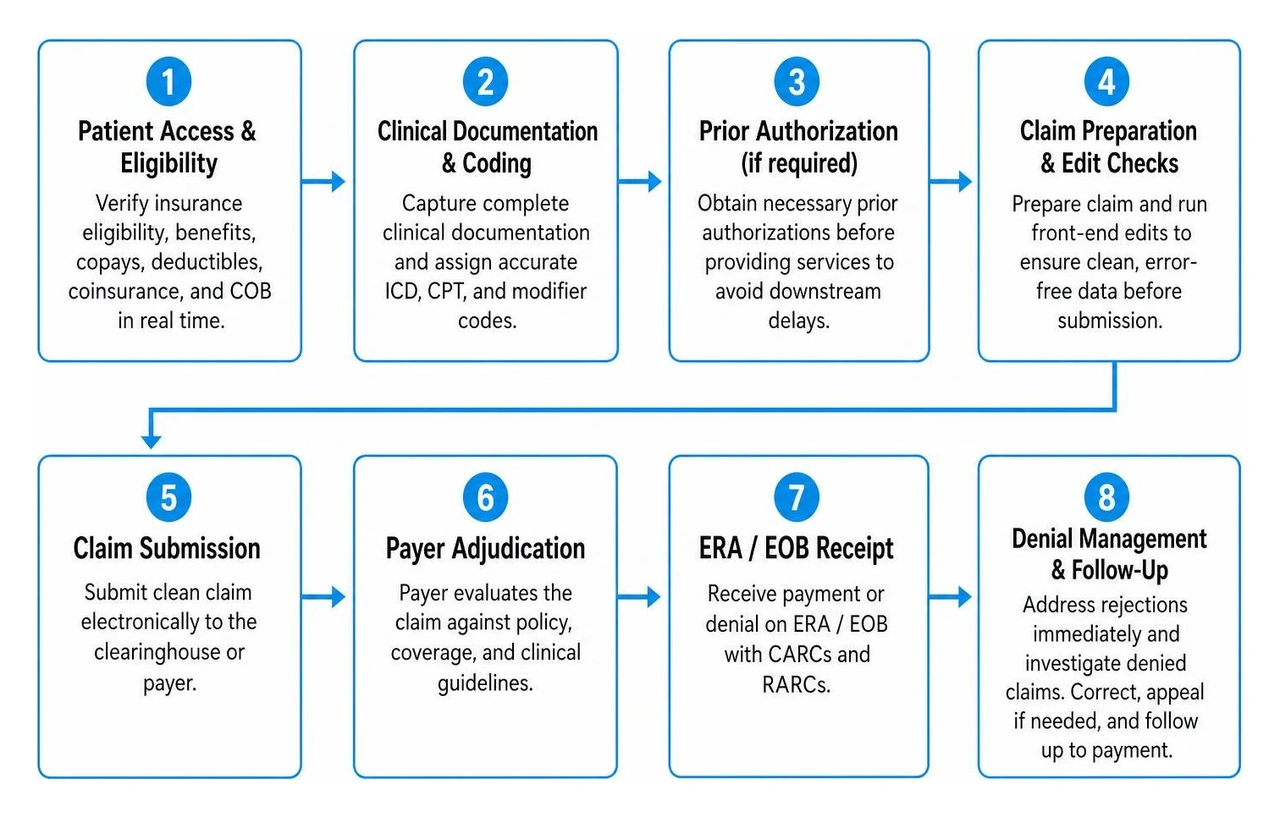
Over half of all claim rejections and denials originate at the front desk before the provider even sees the patient. Protecting revenue begins with proactive patient access controls:
Catching policy changes and inactive coverage before services are delivered drastically reduces uncollectible bad debt and administrative rework.
Once care is delivered, clinical documentation must be translated into compliant billing codes:
Our team at Next Level Technologies knows that maintaining smooth integration between your billing tools and clinical records is essential. Reliable electronic health record support guarantees that clinical notes flow into charge capture without dropped charges or manual double-entry errors.
Once charges are captured, the billing system generates an Electronic Data Interchange (EDI) 837 transaction file and sends it to a claims clearinghouse. The clearinghouse functions as a centralized gateway that scrubs and formats claims before passing them to commercial and government payers.
Clearinghouses run claims through comprehensive rules engines containing millions of continuously updated edits, including National Correct Coding Initiative (NCCI) guidelines, local coverage determinations, and payer-specific formatting rules. Advanced claim scrubbers flag invalid code combinations, missing modifiers, duplicate submissions, and missing authorization numbers.
By resolving these flags before final submission, high-performing healthcare organizations routinely achieve a 98.5%+ average clean claim rate and a 98%+ first-pass payer acceptance rate.
After the payer adjudicates the claim, they return an EDI 835 ERA file along with electronic funds transfer (EFT) reimbursement:
Modern medical billing relies heavily on purpose-built software architectures that replace manual data entry with intelligent automation.
Leading claims platforms offer end-to-end visibility across every account, featuring real-time claims tracking, built-in denial triage queues, and direct payer connectivity.
While 51% of healthcare providers leverage some basic software automation, only 11% have integrated modern AI technology into their claims workflows. This leaves an enormous opportunity for operational improvement.
AI-driven billing platforms transform traditional workflows through:
Adopting advanced data analytics healthcare solutions alongside scalable cloud computing healthcare infrastructure allows clinical practices to process large claim volumes with unmatched speed and minimal overhead.
Healthcare claims involve sensitive Protected Health Information (PHI), meaning every transaction must strictly adhere to federal and state privacy regulations. Managing these systems securely requires continuous adherence to HIPAA standards, role-based access controls, and robust audit logging. Our experts emphasize the value of proactive assessments, as outlined in our guide on is your data truly secure the shocking truth about hipaa compliance.
Modern interoperability relies on modern technical standards, including the HL7 FHIR Claim specification. This standard uses a structured three-tier hierarchy (claim items, sub-items, and detail components) to streamline pre-authorizations, pre-determinations, and electronic claims submissions across disparate health systems.
State laws also shape how disputed claims are resolved. For instance, state frameworks like Florida Statute 408.7057 dispute resolution guidelines establish structured dispute resolution programs for providers and health plans. Under this statute, providers have up to 12 months from a final claim determination to file a dispute, and both parties must provide requested documentation within 15 days. Understanding these regional frameworks ensures that organizations can successfully arbitrate stalled claims.
Protecting your data across every transmission gateway requires dedicated healthcare network security services to defend clinical endpoints against breaches, ransomware, and unauthorized data access.
To maintain a healthy revenue cycle, medical practices must continuously audit their performance against established industry benchmarks.
Monitor these core operational metrics every month to detect workflow bottlenecks early:
Faced with ongoing administrative complexity and staffing shortages, many clinical organizations evaluate whether to manage billing entirely in-house, outsource to specialized medical billing companies, or deploy a hybrid model.
If you maintain billing operations internally, partnering with experts for managed it services for medical practices ensures that your electronic billing connections, clearinghouse bridges, and workstations remain secure, updated, and fully operational without costly downtime.
A rejected claim is stopped before adjudication at the clearinghouse or payer gateway due to formatting, demographic, or technical syntax errors; it can be edited and resubmitted immediately. A denied claim successfully enters the payer’s processing system, is formally adjudicated against policy rules, and is refused payment, requiring an appeal or formal corrected claim.
Automated claim scrubbers audit billing files against millions of pre-configured clinical, demographic, and payer-specific rules before transmission. By catching missing modifiers, coding mismatches, and authorization gaps early, scrubbers prevent errors that would otherwise trigger payer rejections and adjudication denials.
Deadlines vary by jurisdiction and payer contract, but statutory dispute programs often establish specific timelines. For example, under Florida’s dispute resolution program, providers have up to 12 months from final adjudication to submit a dispute and must deliver all supporting documentation within 15 days of a request.
Building a high-performing claims management operation requires seamless coordination between clinical staff, billing specialists, and reliable IT systems. By verifying eligibility upfront, enforcing strict coding audits, leveraging automated clearinghouse scrubbing, and systematically working denials, your practice can protect its revenue and accelerate cash flow.
Next Level Technologies helps healthcare organizations maintain robust, secure, and compliant revenue cycle environments. With our main location in Columbus, Ohio, and a second location in Charleston, WV, our staff leverages 20+ years of technical experience and extensive cybersecurity training to safeguard clinical networks, support electronic billing platforms, and eliminate downtime.
Explore how our expert team can optimize your clinical workflows and protect your practice by learning more about our healthcare management services.
Discover how a healthcare management services organization boosts practice efficiency, cuts overhead, and protects clinical autonomy.
October 3, 2026
Master denial management in medical billing with proven strategies to reduce denials, boost appeals success, and protect revenue cycle performance.
September 25, 2026

