IT Support Blog

Insights
Demystifying IT Cost Management Software: What It Is and Why You Need It

Demystifying IT Cost Management Software: What It Is and Why You Need It

March 6, 2026

Written by

Why IT Spending Feels Like a Black Hole (And How to Fix It)

IT cost management dashboard - it cost management software

IT cost management software is a specialized platform that helps organizations track, analyze, and optimize their technology spending across hardware, software, cloud services, and IT personnel. Here's what you need to know:

What IT Cost Management Software Does:

  • Centralizes all IT expenses into a single dashboard for complete visibility
  • Tracks Total Cost of Ownership (TCO) for every asset, from purchase through disposal
  • Identifies waste like unused software licenses, redundant applications, and underused hardware
  • Automates budgeting and forecasting to prevent surprise overruns
  • Analyzes ROI on IT projects to guide strategic investment decisions
  • Integrates with financial systems (ERP, accounting platforms) for seamless data flow

Why You Need It:

  • 78% of CIOs and IT leaders are actively looking for ways to cut costs
  • The average data breach costs $165 per compromised record
  • A single 8-hour IT outage can cost a 50-person company approximately $12,000 in lost productivity alone
  • Ransomware recovery averages $1.85 million in remediation costs

If your organization is struggling with budget overruns, shadow IT (unauthorized software purchases), or simply has no clear picture of where IT money is going, this software transforms guesswork into data-driven decision-making.

Most mid-sized businesses face a painful reality: they know they're spending too much on technology, but they can't pinpoint where or why. Spreadsheets become outdated the moment you save them. Different departments buy their own tools without IT approval. And when leadership asks "What are we getting for our IT budget?", the answer is often unclear.

The problem isn't just about cutting costs—it's about gaining control so you can invest strategically in the technology that actually moves your business forward.

I'm Steve Payerle, President of Next Level Technologies in Columbus, Ohio and Charleston, WV, and I've spent over a decade helping businesses transform their IT from a cost burden into a competitive advantage. Through implementing IT cost management software and strategic planning, we've helped companies uncover hundreds of thousands in hidden waste while simultaneously improving security and operational efficiency.
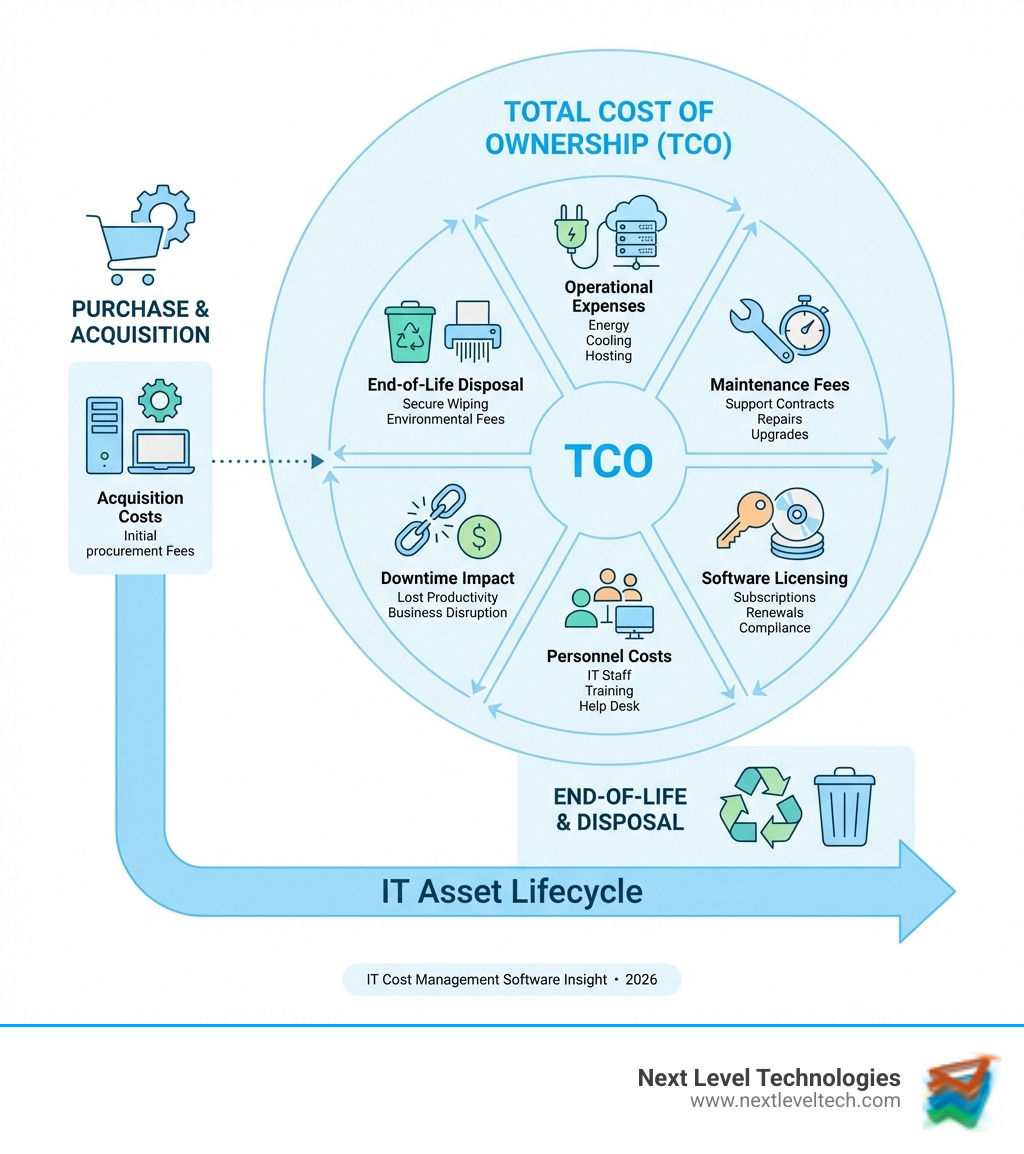
infographic showing the breakdown of Total Cost of Ownership for IT assets including acquisition costs, operational expenses, maintenance fees, software licensing, personnel costs, downtime impact, and end-of-life disposal across the full asset lifecycle - it cost management software infographic

Terms related to it cost management software:

What is IT Cost Management and Why is it Crucial?

At its core, IT cost management is the strategic process of monitoring, analyzing, and optimizing all expenses related to an organization's information technology infrastructure and services. It goes beyond simply cutting costs; it's about achieving financial transparency and ensuring every dollar spent on IT delivers maximum value. We often see businesses mistaking cost reduction for cost optimization. Cost reduction is about spending less, while cost optimization is about spending smarter – getting more value for the money you do spend.

The common challenges we encounter in this area are strikingly consistent across businesses of all sizes. Many organizations grapple with a profound lack of visibility into their IT spending. Where is the money truly going? Is it on essential infrastructure, underused software, or redundant services? This lack of clarity often leads to inefficient processes, where decisions are made based on guesswork rather than data. Furthermore, reliance on manual tracking methods, like sprawling spreadsheets, introduces errors and outdated information, making effective cost management nearly impossible.

This challenge is echoed by industry leaders, with a significant 78% of CIOs and IT leaders actively seeking ways to cut costs. They recognize that without a clear picture of their IT expenditures, they're flying blind. This is precisely where IT cost management software becomes not just beneficial, but crucial. It provides the tools to move beyond mere cost-cutting to strategic cost optimization, ensuring that IT investments align directly with business objectives. We dig deeper into strategies for this in our guide on IT Cost Reduction Strategies.

The High Cost of Inaction

Ignoring IT cost management isn't just about missing out on savings; it's about exposing your organization to significant financial risks. The "true cost" of inaction can quickly dwarf any perceived savings from avoiding investment in proper management tools.

Consider the severe financial impact of IT downtime. For a 50-person company with a $75,000 average loaded salary, just one 8-hour workday of total IT downtime costs approximately $12,000 in lost productivity. That's not even counting lost revenue if critical systems are customer-facing. These figures highlight why an ounce of prevention (or in this case, proactive management) is worth a pound of cure. You can read more about the true cost of IT downtime and its impact.

Then there's the ever-present threat of cyberattacks. The average ransomware remediation cost is a staggering $1.85 million. For every breached record in a data breach, organizations face an average of $165 in notification costs, credit monitoring, legal fees, and regulatory fines. These aren't just abstract numbers; they represent real threats to your business's financial stability and reputation.

Finally, compliance fines can be devastating. Non-compliance with regulations like HIPAA can lead to fines starting at $100 per record and reaching up to $50,000 per violation. PCI-DSS non-compliance can result in monthly fines of $5,000-$100,000, plus the potential loss of the ability to process credit cards. These penalties underscore the critical need for robust IT governance, which starts with understanding and managing IT costs effectively.

Overcoming Common IT Financial Problems

Many organizations initially try to manage IT costs with tools that aren't designed for the job. Spreadsheets, for example, are ubiquitous and flexible, but they come with significant limitations. They are prone to errors, can quickly become outdated, and offer little to no real-time visibility. Imagine trying to steer a ship by looking at a map that's a week old – that's what manual spreadsheet tracking feels like for IT costs.

Another pervasive issue is decentralized purchasing, often dubbed "shadow IT." This occurs when individual departments or employees acquire software, hardware, or cloud services without involving the central IT department. While seemingly efficient in the short term, shadow IT leads to redundant subscriptions, security vulnerabilities, and a fragmented view of overall IT spending. It’s like everyone in a household buying their own milk, only to find half of it expiring unused in the fridge.

The ultimate goal of IT cost management is to align IT spending with broader business goals. Without a clear understanding of costs and their associated value, IT can easily be perceived as a cost center rather than a strategic enabler. By gaining control over these financial aspects, we can demonstrate how technology investments directly contribute to business growth and efficiency. For a deeper dive into managing your IT assets, explore our guide on IT Asset Management.

Chaos of manual spreadsheet tracking vs. streamlined software dashboard - it cost management software

Core Functionalities and Benefits of IT Cost Management Software

Imagine having a single, clear view of all your IT expenditures, updated in real-time, with insights that help you make smarter decisions. That's the promise of IT cost management software. It transforms the chaotic landscape of IT spending into an organized, actionable dashboard.

Software interface with budget vs. actuals reporting - it cost management software

This type of software excels at automated data collection, pulling information from various sources across your IT ecosystem. This eliminates the need for manual data entry and reduces the errors that plague spreadsheet-based systems. The result is dramatically improved visibility into where every IT dollar is allocated, leading to improved budget accuracy. With precise data at your fingertips, you can make truly data-driven decisions about IT investments, rather than relying on educated guesses. This aligns closely with the principles of IT Service Management (ITSM), which focuses on delivering IT services efficiently and effectively.

Core Software Functionalities

What exactly does IT cost management software do? Here's a breakdown of its essential functions:

  • Budgeting and Forecasting: This allows us to set realistic IT budgets based on historical data and projected needs, and then forecast future spending with greater accuracy. This proactive approach helps prevent unexpected budget overruns.
  • Cost Allocation and Chargeback: A crucial feature for larger organizations, this enables us to accurately attribute IT costs to specific departments, projects, or services. This fosters accountability and helps internal "customers" understand the true cost of the IT services they consume.
  • Asset Benchmarking: We can compare our IT asset costs and performance against industry benchmarks or internal historical data. This helps identify areas where we might be overpaying or underutilizing resources.
  • Vendor and Contract Management: This functionality centralizes information about IT vendor contracts, licenses, and service level agreements (SLAs). It helps us track renewals, identify opportunities for negotiation, and ensure we're not paying for services we no longer need.
  • Reporting and Analytics: Comprehensive dashboards and customizable reports provide deep insights into IT spending patterns, trends, and anomalies. These visual tools make complex data understandable, empowering stakeholders to make informed decisions.
  • IT Asset Inventory Management: This is foundational. The software automatically finds and inventories all hardware and software assets across the organization, providing a complete picture of what you own, where it is, and who is using it. This is key for managing the entire lifecycle of assets, as explored in our guide on IT Asset Inventory Management.

Key Business Benefits

The impact of robust IT cost management software extends far beyond the IT department, delivering tangible benefits across the entire organization:

  • Increased Profitability: By optimizing spending and eliminating waste, we directly contribute to the bottom line. Every dollar saved on unnecessary IT expenditure is a dollar that can be reinvested into growth or profit.
  • Optimized Resource Allocation: With clear insights into where IT resources are being consumed, we can reallocate them more effectively, ensuring critical projects and business functions receive the support they need.
  • Stronger Negotiating Power with Vendors: Armed with data on usage, performance, and market benchmarks, we can approach vendors from a position of strength, securing better terms and pricing for software licenses, hardware, and services.
  • Improved Productivity: When IT systems are optimized and managed efficiently, employees experience fewer disruptions and have access to the tools they need to perform their jobs effectively. This leads to a smoother workflow and higher output.
  • Higher Employee Satisfaction: A smoothly running IT environment, free from frustrating bottlenecks and outdated systems, directly contributes to employee morale. A study by Evolve IP found that businesses with mature managed IT reported 23% higher employee satisfaction and 16% better productivity metrics than those relying on break-fix support. This translates into real value for your team, particularly in our service areas of Columbus, OH, and Charleston, WV.
  • Predictable IT Spend: Moving from unpredictable, reactive IT expenses to a planned, optimized budget allows for more stable financial forecasting and strategic business planning. This is a core benefit of adopting models like IT as a Service (ITaaS).

How to Leverage Software for IT Cost Optimization and Savings

Once you have IT cost management software in place, the real work begins: identifying and eliminating waste. This isn't just about cutting things; it's about streamlining and ensuring every IT resource serves a clear purpose and delivers measurable value.

Common areas where we uncover significant waste include:

  • Unused Software Licenses: Many organizations pay for licenses that are never activated or assigned to employees who no longer need them.
  • Redundant Applications: We frequently find multiple applications performing similar functions across different departments.
  • Underused Hardware: Servers sitting idle or workstations with excessive capacity represent capital tied up in underperforming assets.

By leveraging the comprehensive data provided by IT cost management software, we can pinpoint these inefficiencies and analyze the true ROI of all IT initiatives. This allows informed decisions about where to invest and where to divest, ensuring IT spending directly supports business objectives. For deeper insights, check out our guide on IT Cost Optimization Strategies.

A Practical Guide to using IT cost management software for Savings

Implementing IT cost management software is a journey, not a destination. Here's how we guide our clients through a practical path to significant savings:

  1. Conducting a Spending Audit: The first step is gaining complete visibility. The software aggregates all IT spending data for a thorough audit—identifying every piece of hardware, software license, cloud service, and IT-related contract.
  2. Setting Optimization Goals: Once we understand the current state, we work with leadership to define clear, measurable optimization goals. Specific, achievable targets provide a roadmap.
  3. Tracking Savings Over Time: The software continuously monitors spending against these goals, allowing real-time tracking of actual savings.
  4. Reinvesting Savings into Innovation: The ultimate goal is to free up capital that can be strategically reinvested into new technologies, innovative projects, or critical security improvements that drive the business forward. This proactive approach is a core element of a sound IT Strategy.

Calculating the ROI of Your IT Initiatives

Understanding the Return on Investment (ROI) of IT initiatives is paramount for strategic planning. IT cost management software helps us move beyond simple cost-cutting to sophisticated analysis:

  • Total Cost of Ownership (TCO) Analysis: This comprehensive approach considers not just the initial purchase price but all direct and indirect costs associated with an asset's entire lifecycle—including deployment, maintenance, support, training, energy consumption, and disposal.
  • Value on Investment (VOI): While ROI focuses on financial returns, VOI broadens the scope to include intangible benefits like improved customer satisfaction, employee productivity, and business agility. The software helps quantify these benefits by correlating IT investments with operational improvements.
  • Aligning Projects with Strategic Goals: The software provides data to demonstrate how each IT project contributes to organizational objectives, helping prioritize investments.
  • Forecasting Future Value: By analyzing historical data and current trends, we can model scenarios and forecast potential future value of proposed IT investments. This is critical for Enterprise IT Asset Management.

Key Features to Look for When Selecting an IT Cost Management Solution

Choosing the right IT cost management software is a critical decision. It’s not just about what it can do, but how well it fits into your organization's existing workflows and scales with your needs. When we advise clients in Columbus, OH, and Charleston, WV, we emphasize several key factors:

  • Scalability: Can the software grow with your business? As your IT infrastructure expands, will the solution be able to handle increased data volumes and complexity without a hitch?
  • Ease of Use / User Interface (UI): A powerful tool is useless if no one can figure out how to use it. A clean, intuitive UI ensures faster adoption and reduces the learning curve for your team.
  • Customer Support: Even the best software can present challenges. Responsive and knowledgeable customer support is invaluable, especially during implementation and when complex issues arise.
  • Integration Capabilities: We live in an interconnected world. Your IT cost management solution shouldn't be an island. It needs to play nicely with your existing systems. This is particularly important for broader IT service management strategies, which you can learn more about in our article on ITSM Software.

Essential Features for your IT cost management software

When evaluating specific solutions, look for these non-negotiable features:

  • Real-time Dashboards: Up-to-the-minute insights are crucial. These dashboards should provide a clear, visual overview of key IT spending metrics, budget vs. actuals, and identified savings opportunities.
  • Customizable Reporting: Every business has unique reporting needs. The ability to generate custom reports allows us to drill down into specific areas of interest and present data in a way that resonates with different stakeholders.
  • Integration Capabilities (ERP, Financial Platforms): Seamless integration with your Enterprise Resource Planning (ERP) system, accounting software, and other financial platforms is vital for a holistic view of your organization’s finances. This ensures data consistency and reduces manual effort.
  • Cloud Cost Management: With the increasing adoption of cloud services (IaaS, PaaS, SaaS), the software must be able to track and optimize cloud spending across multiple providers (AWS, Azure, Google Cloud). This includes identifying idle resources, rightsizing instances, and managing reserved instances.
  • Security and Compliance Features: Protecting sensitive financial data is paramount. The software should include robust security features like access controls, data encryption, and audit trails. Furthermore, it should assist in demonstrating compliance with relevant industry regulations. For more on this, consult our Cloud Security Best Practices.

Understanding Pricing and Integration

Understanding the pricing models and integration options is key to making an informed decision about IT cost management software.

  • Pricing Models:
    • Per-user pricing: Common for SaaS solutions, where you pay a monthly or annual fee per user who accesses the software.
    • Subscription-based pricing: Often includes different tiers based on features, number of assets, or data volume.
    • Tiered pricing: Offers various packages with different levels of features and support, catering to small, medium, and large enterprises.
  • Factors Influencing Cost: The total cost can vary significantly based on the breadth of features, the number of users or assets managed, the level of support required, and the complexity of integration with existing systems. Always ask for a clear breakdown of all potential costs, including implementation and training.
  • API and Pre-built Connectors: Modern IT cost management software should offer robust Application Programming Interfaces (APIs) for custom integrations and a library of pre-built connectors for popular business systems like ERPs, financial software, and IT service management (ITSM) platforms. This streamlines data flow and ensures all relevant financial and operational data is captured.
  • Integrating with Existing Systems: A smooth integration process is vital. We work closely with our clients to map data flows, ensure data integrity, and minimize disruption. This often involves collaborating with your internal teams and leveraging our technical expertise to connect the new IT cost management software with your current ERP, accounting software, and other critical systems. This integration is crucial not just for financial data, but also for managing relationships with your IT vendors, a topic we cover in our guide on IT Vendor Risk Management Solutions.

The Strategic Role of IT Management in Security and Growth

While optimizing spending is a primary driver, the role of IT cost management software extends far beyond mere cost-cutting. It lifts IT from a perceived cost center to a strategic enabler of business growth and resilience. By gaining profound insights into IT finances, we empower organizations to make smarter decisions, foster business agility, and mitigate significant financial risks. This proactive approach is fundamental to a comprehensive IT Risk Management Complete Guide.

At Next Level Technologies, our teams in Columbus, OH and Charleston, WV combine deep technical experience with extensive, ongoing cybersecurity training. That combination allows us to configure and use IT cost management software not just as an accounting tool, but as a strategic control system that links spend, risk, and performance across your entire environment.

Enhancing Cybersecurity and Compliance

In today's threat landscape, cybersecurity is not just an IT concern; it's a business imperative. IT cost management software plays a crucial role in strengthening your security posture:

  • Tracking Security Spending: The software allows us to clearly track and categorize all spending related to cybersecurity initiatives, from endpoint protection to security awareness training. This transparency helps us justify security investments and demonstrate their value.
  • Proving Compliance (HIPAA, PCI-DSS): For businesses in regulated industries, compliance is non-negotiable. The software can help aggregate data points needed to prove adherence to standards like HIPAA for healthcare, or PCI-DSS for credit card processing. This is especially vital for our clients in the medical and financial sectors in Columbus, OH, and Charleston, WV.
  • Risk Analysis: By correlating IT spending with identified vulnerabilities and potential risks, we can perform more accurate risk analysis, prioritizing investments in areas that offer the greatest protection against financial and reputational damage.

It is well documented that a significant portion of data breaches impact small and mid-sized businesses. This underscores that no business is too small to be a target. This is why at Next Level Technologies, our staff undergoes extensive cybersecurity training, ensuring we bring advanced expertise to our clients in Columbus, OH, and Charleston, WV. This specialized knowledge is critical for implementing and managing solutions that not only optimize costs but also provide robust protection. Learn more about our comprehensive approach to Cybersecurity Audit and Compliance Solutions.

Driving Better IT Investment Decisions

The true power of IT cost management software lies in its ability to facilitate better IT investment decisions, changing IT from a reactive function into a proactive strategic partner.

  • Aligning IT Portfolio with Business Strategy: With clear data on costs and value, we can ensure that every IT project and investment directly supports the organization's strategic goals. This eliminates "pet projects" and ensures resources are directed where they will have the most impact.
  • Scenario Modeling: The software allows us to model different investment scenarios, evaluating the potential costs and benefits of various IT initiatives before committing resources. This foresight is invaluable for strategic planning.
  • Forecasting Future Needs: By analyzing current usage, growth trends, and business objectives, we can use the software to forecast future IT needs, allowing for proactive procurement and resource planning.
  • Justifying IT Value to Leadership: Armed with compelling data and clear ROI figures, IT leaders can effectively communicate the value of their department's contributions to the executive team, securing necessary budget and support for critical initiatives.

Our technically experienced and security-focused teams in Columbus, OH and Charleston, WV use these capabilities to help clients build IT roadmaps that balance innovation, risk, and cost. This strategic partnership is what we aim to foster through our IT consulting services, as highlighted in How IT Consulting in Columbus Ohio Can Drive Business Growth.

Conclusion

We've explored how IT cost management software is far more than just a tool for cutting expenses. It's a comprehensive platform that delivers unparalleled financial transparency, enables strategic decision-making, and mitigates significant financial and security risks. From eliminating shadow IT and optimizing cloud spend to ensuring regulatory compliance and justifying IT investments with clear ROI, this software transforms how organizations perceive and manage their technology.

The journey from IT as a perceived cost center to a recognized value driver is a transformative one. By embracing robust IT cost management software, businesses gain a strategic advantage, fostering agility, innovation, and long-term financial health.

At Next Level Technologies, with our main office in Columbus, OH, and a strong presence in Charleston, WV, we pride ourselves on helping businesses achieve this change. Our team's extensive technical experience and deep cybersecurity training mean we don't just recommend software; we partner with you to implement, optimize, and manage solutions that align with your unique business goals. We believe in proactive IT management that empowers your organization to thrive.

Ready to take control of your IT spending and turn your technology into a true strategic asset? Let us help you open up the full potential of your IT budget. Take control of your IT with expert Managed IT Services.

Next Level Technologies

Our Latest Blog Posts

Don't Just Dream It, Plan It: A Guide to Your Small Business IT Strategy

Create a strategic it plan for small business success. Learn to secure data, optimize tech, and future-proof your operations.

March 5, 2026

Unlock Local Deals: Your LSN.com Classifieds Handbook

Unlock local deals on LSN.com! Learn to buy, sell, and navigate your local sales network safely. Support community commerce now.

March 4, 2026