The Top Software as a Service Companies to Try Today
July 7, 2026


Discover how a healthcare management services organization boosts practice efficiency, cuts overhead, and protects clinical autonomy.
October 3, 2026

Master denial management in medical billing with proven strategies to reduce denials, boost appeals success, and protect revenue cycle performance.
September 25, 2026

Compare the best healthcare learning management platforms for providers with Next Level Technologies, serving Columbus, Ohio and Charleston, WV.
September 19, 2026
July 7, 2026
The top software as a service companies in 2026 include:
Software has quietly changed how every business operates. Not long ago, running a payroll system or managing customer data meant buying servers, paying IT staff to maintain them, and hoping nothing broke. Today, those same functions run through a web browser — updated automatically, accessible anywhere, billed monthly.
That shift is SaaS. And it's no longer a trend — it's the default.
The SaaS market has grown fast enough that the top 10 public SaaS companies alone broke a combined $1 trillion in market value for the first time in 2020. By 2026, leading players like Salesforce are generating over $40 billion in annual revenue.
For mid-sized businesses in Columbus, OH and Charleston, WV, choosing the right SaaS tools is one of the most consequential technology decisions you'll make. The wrong stack creates security gaps, wasted spend, and the kind of downtime that costs real money.
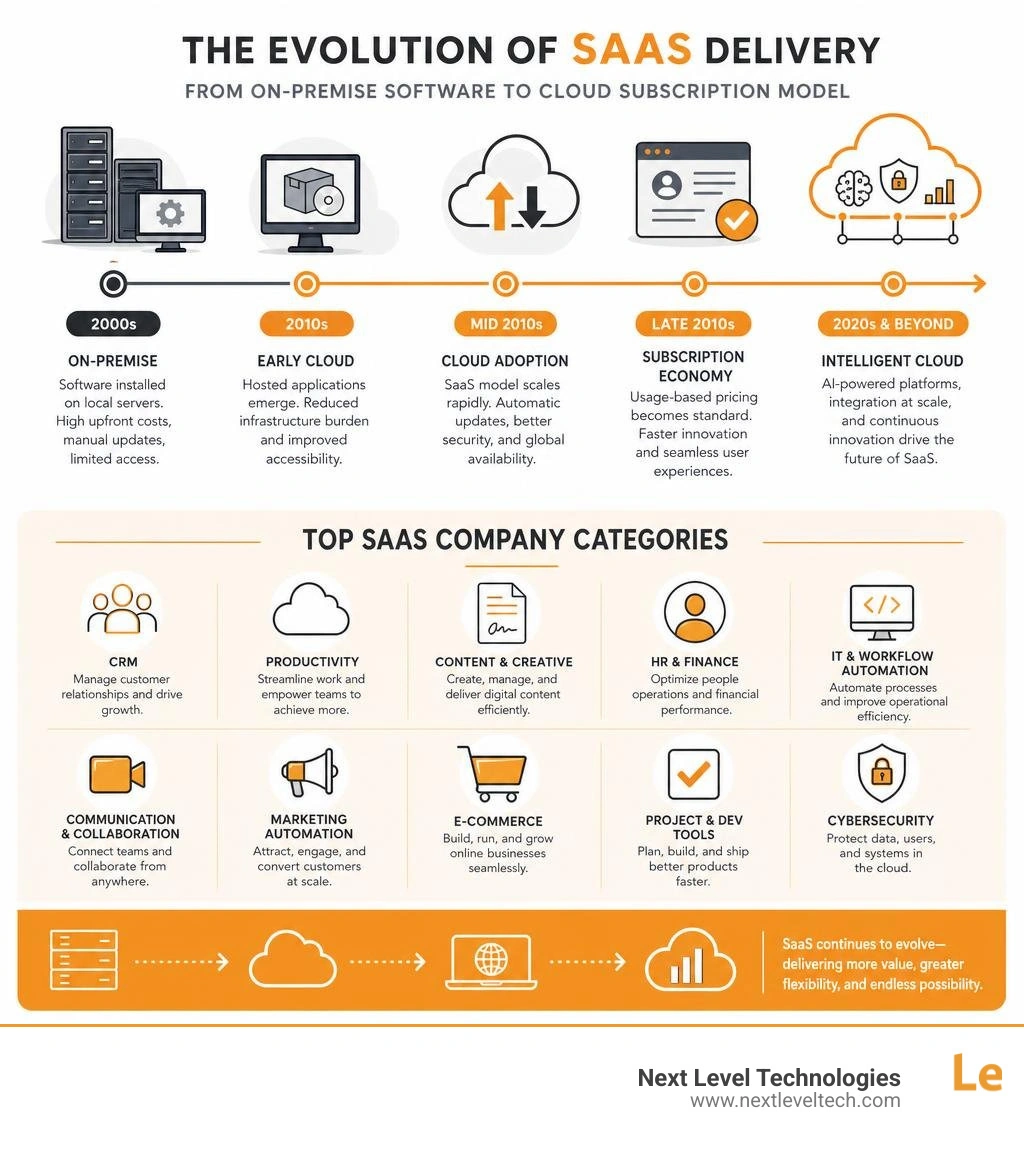
Top software as a service companies vocab explained:
When we talk about the top software as a service companies, we aren’t just talking about any business with a website. True SaaS companies operate under a highly specific business model that has fundamentally changed the economics of technology.
To separate a true cloud leader from a traditional software vendor playing dress-up, we look at how the software is delivered and how the revenue is earned. A dedicated SaaS business hosts its applications centrally in the cloud, delivers them over the internet, and bills customers on a recurring subscription basis.
Understanding these distinctions is crucial when navigating the digital landscape. If you are still fuzzy on the core definitions, you can explore our breakdown of What is a SaaS Company or dive into our comprehensive SaaS Companies Complete Guide 2026 to see how the landscape has matured.
How do we determine who actually sits at the top of the mountain? In the public markets, the ultimate yardsticks are market capitalization (the total value of a company’s outstanding shares) and Annual Recurring Revenue (ARR).
Historically, the valuation of these companies has been staggering. The median value of the top 50 largest SaaS companies previously experienced massive surges, jumping to $21.5 billion, while the average value reached $38.1 billion during peak growth cycles. In fact, the top 10 largest SaaS companies have historically commanded over 60% of the total value of the top 50, proving that the cloud market is highly top-heavy.
To evaluate the financial health of these giants, investors rely on the "Rule of 40." This metric states that a SaaS company’s combined growth rate and profit margin should exceed 40%. For example, a business growing at 30% annually with a 15% profit margin (totaling 45%) is considered highly healthy.
We can see this financial discipline in action by examining real-world enterprise filings. For a deep dive into how a market leader balances growth, research, and operating margins, check out the detailed Salesforce Financials — Revenue by Cloud, RPO, Margin History, and Agentforce-Era Growth report.
At its core, enterprise SaaS is defined by three fundamental pillars:
To understand the mechanics behind this delivery model, read our guide on How Does Software as a Service Work. If you are looking for a quick primer on the terminology itself, we also explain What Does SaaS Stand For in simple terms.
Customer Relationship Management (CRM) is the beating heart of modern sales operations, and Salesforce remains the undisputed king of this category.
Salesforce has spent more than two decades refining how businesses organize customer interactions, track sales pipelines, and forecast future revenue. By centralizing customer data into a single, unified database, sales and marketing teams can work out of the exact same playbook. To see how they are currently leading the market with AI-driven capabilities, check out Salesforce CRM: Try The World’s #1 Agentic CRM | Salesforce.
When it comes to getting daily work done, collaboration and productivity suites are the unsung heroes of the office.
Microsoft (via Microsoft 365) and Google (via Google Workspace) dominate this space. They provide the fundamental infrastructure for modern business: email, document creation, cloud storage, and team communication. Alongside them, platforms like Zoom and Slack have become essential.
These tools have shifted our understanding of the workplace. Instead of sending static documents back and forth via email, teams can co-author spreadsheets in real-time, jump into a video call with a single click, and organize project discussions into dedicated chat channels.
Managing people and money requires precision, which is why specialized HR and financial SaaS platforms are so vital.
Workday and ADP lead the charge here. These platforms automate complex back-office workflows like payroll processing, benefits administration, talent acquisition, and employee performance tracking. On the financial side, cloud-based Enterprise Resource Planning (ERP) systems allow mid-sized businesses to manage general ledgers, track inventory, and handle billing without relying on outdated, error-prone spreadsheets.
The SaaS industry in 2026 is defined by maturity, consolidation, and the rapid integration of artificial intelligence. The era of "growth at all costs" has transitioned into an era of operational efficiency.
We are seeing significant consolidation across the market. Larger tech giants are acquiring specialized, mid-sized SaaS players to build massive, all-in-one product suites. For instance, major acquisitions like Cisco acquiring Splunk for $28 billion demonstrate how the industry is consolidating to offer more unified security and data analytics platforms.
AI is no longer just a flashy chatbot add-on; it is being deeply integrated into the core architecture of the top software as a service companies.
We have entered the era of "Agentic AI." Instead of simply answering questions, modern AI agents can perform actual work across your software ecosystem. For example, Salesforce’s Agentforce can autonomously handle customer service conversations, resolve complex billing inquiries, and escalate only 2% of cases to human representatives.
By leveraging predictive analytics and machine learning, these platforms help businesses in Columbus and Charleston automate repetitive tasks, personalize customer experiences, and make data-driven decisions faster than ever before.
As businesses move more of their operations to the cloud, SaaS security has become a top priority. A single data breach can devastate a company's reputation and lead to massive regulatory fines.
Because of this, leading SaaS vendors invest heavily in:
For local healthcare organizations and professional services firms in Ohio and West Virginia, ensuring your SaaS vendors meet these high security standards is non-negotiable.
Modern SaaS platforms do not run on servers in a vendor's closet. They are built on top of global cloud infrastructure provided by hyperscalers like Amazon Web Services (AWS), Microsoft Azure, and Google Cloud Platform (GCP).
This infrastructure allows SaaS tools to scale effortlessly. Whether you are a small business with five employees in Charleston, WV, or a rapidly growing enterprise in Columbus, OH with five hundred, the software scales to meet your demands without requiring you to buy a single piece of physical hardware.
To learn more about how this underlying infrastructure supports your business applications, read about our SaaS Cloud Solutions and discover how Cloud Computing and Software as a Service work hand-in-hand.
Choosing the right software for your business can feel overwhelming. With thousands of vendors claiming to be the best, how do you make an informed decision?
The key is to align your technology choices directly with your business goals. Before looking at features, define your specific pain points, establish a clear budget, and involve the employees who will actually use the software daily. If you are trying to decide whether to buy specialized SaaS tools or outsource your entire technology footprint, our guide on ITaaS vs SaaS Which is Right for Your Business offers a practical framework for making the right choice.
A challenge businesses face today is "SaaS sprawl." This happens when different departments independently sign up for overlapping software tools without centralized oversight.
SaaS sprawl leads to:
To prevent this, look for SaaS solutions that offer robust API connectivity and pre-built integrations. Consolidating your software vendors not only saves money but also significantly reduces your cybersecurity exposure.
Never take a software vendor's word when it comes to security. When evaluating a new SaaS platform, always ask for their security documentation and verify their compliance credentials.
Ensure they have clear Service Level Agreements (SLAs) that guarantee high uptime and clearly state that you own your data—not them. Additionally, even the most secure software can be compromised by human error. That is why pairing secure SaaS tools with comprehensive, ongoing cybersecurity training for your internal staff is the best way to keep your business safe.
Cloud computing is the broad umbrella term for delivery model technologies over the internet. It includes computing power, storage, and databases (like AWS or Azure). Software as a Service (SaaS) is a specific application built on top of that cloud infrastructure and delivered directly to end-users via a web browser.
Managing vendor risk requires building a complete inventory of all SaaS tools in use, identifying which applications handle sensitive data, and reviewing the security certifications of those vendors. Many businesses partner with a managed IT provider to conduct regular security audits and set up secure access controls.
Common examples include Slack for team communication, Salesforce for tracking customers, QuickBooks Online for accounting, and monday.com for managing projects. You can find more real-world use cases in our articles on Examples of SaaS and our Software as a Service Example guide.
Navigating the top software as a service companies doesn't have to be a solo journey. While these cloud platforms offer incredible flexibility and power, setting them up, securing them, and making sure they play nice with your existing systems requires real technical experience.
At Next Level Technologies, we help small and mid-sized businesses in Columbus, OH and Charleston, WV take control of their technology. With over 20 years of experience, our local teams specialize in delivering proactive managed IT, HIPAA-compliant cybersecurity, cloud migrations, and disaster recovery.
We ensure our staff undergoes extensive cybersecurity training so we can help you eliminate SaaS sprawl, secure your cloud applications, and keep your business running smoothly with predictable monthly costs.
Ready to optimize your cloud strategy and secure your business? Partner with Next Level Technologies today, and let us help you scale with confidence.
Discover how a healthcare management services organization boosts practice efficiency, cuts overhead, and protects clinical autonomy.
October 3, 2026
Master denial management in medical billing with proven strategies to reduce denials, boost appeals success, and protect revenue cycle performance.
September 25, 2026

