Ultimate Guide to SaaS Providers
June 30, 2026


Master denial management in medical billing with proven strategies to reduce denials, boost appeals success, and protect revenue cycle performance.
September 25, 2026

Compare the best healthcare learning management platforms for providers with Next Level Technologies, serving Columbus, Ohio and Charleston, WV.
September 19, 2026

Compare cloud backup services with this guide to backup cloud database service architecture, security, and disaster recovery.
September 12, 2026
June 30, 2026
Software as a service companies have quietly taken over how businesses run their technology. From payroll to project management to customer support, the apps your team uses every day are almost certainly delivered through the cloud — not installed on a local server.
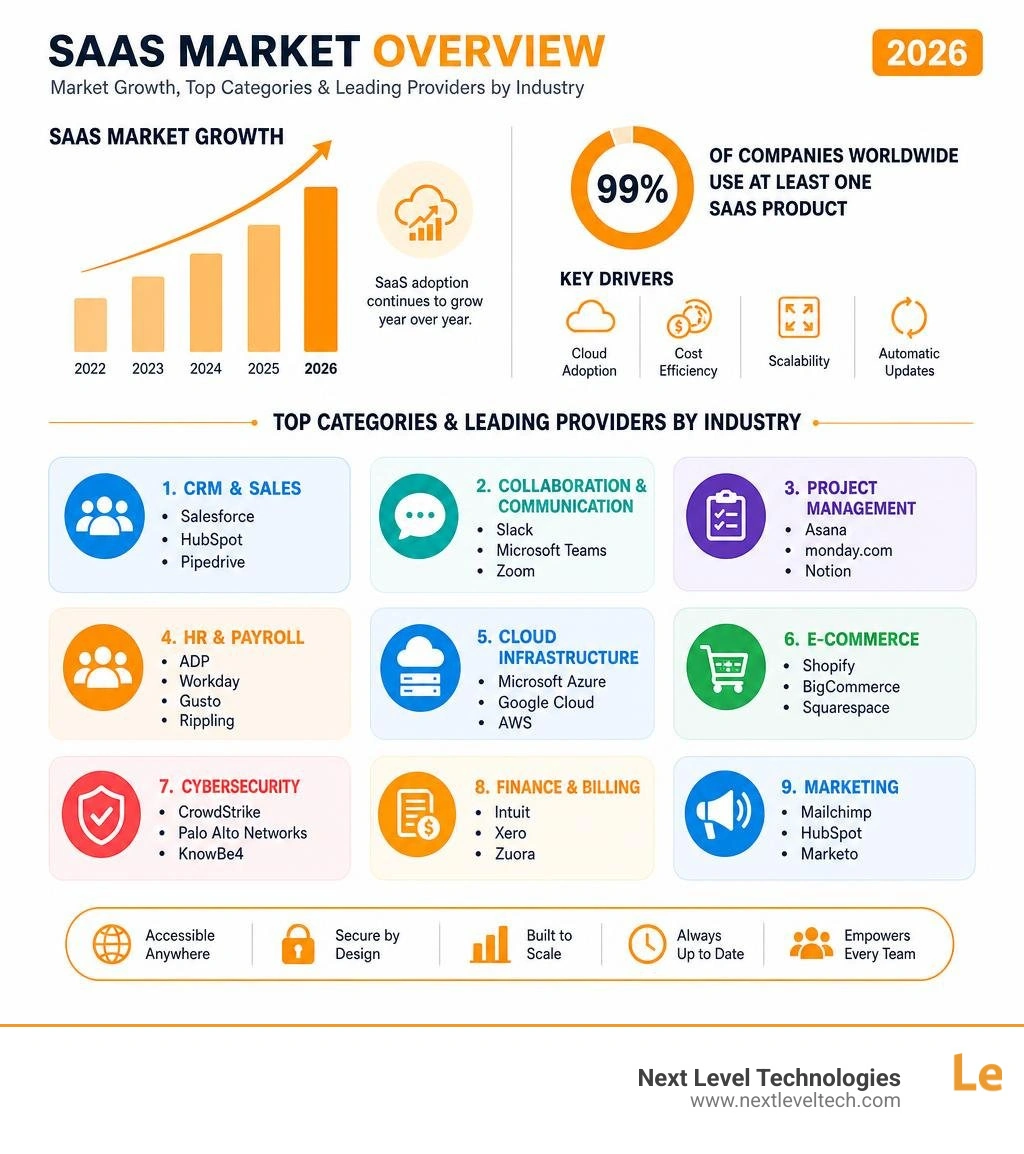
Quick answer: Here are some of the most widely used SaaS companies across key business categories:
Today, 99% of companies worldwide use at least one SaaS product. That number tells you everything about how dominant this model has become.
The shift away from traditional software — where you bought a license, installed it manually, and waited months for updates — has been fast and decisive. SaaS flipped that model. Instead of owning software, you subscribe to it. Instead of managing servers, your vendor does. Instead of waiting for IT to push updates, they happen automatically in the background.
For mid-sized businesses especially, that change has been enormous. It lowers upfront costs, supports remote teams, and makes it easier to scale without adding IT overhead.
But with hundreds of SaaS vendors now touching your business data, the stakes around security, compliance, and integration have never been higher. Choosing the right tools — and managing them safely — is where many organizations struggle.
This guide breaks down the top SaaS providers by category, what makes each one worth knowing, and what to watch out for when adopting cloud software in your organization.
Basic software as a service companies glossary:
To understand how modern businesses operate, we have to start with the fundamental definition of the cloud. When we look at what does SaaS stand for, it is simply Software as a Service. Instead of purchasing physical discs or downloading massive files to install on individual office computers, users access applications directly over the internet via a web browser or lightweight mobile app.
But how does software as a service work behind the scenes?
At its core, SaaS relies on a specialized cloud hosting environment managed entirely by the software provider. This setup is built on what is known as a multitenant architecture. Think of it like a modern apartment building. Instead of every business building its own custom house from scratch (traditional on-premises software), everyone shares the same secure building infrastructure. Each business has its own "apartment"—your data is completely isolated, private, and secure—but you share the common resources like plumbing, electricity, and structural maintenance (the underlying servers, databases, and code).

This shared approach is what makes SaaS so incredibly efficient. Because the vendor hosts the application centrally, they can implement a subscription model where businesses pay a predictable monthly or annual fee to access the tool.
Furthermore, this setup enables automatic updates. In the old days of on-premises software, upgrading your office tools meant purchasing new licenses, scheduling weekend downtime, and praying that the installation wouldn't crash your local servers. With modern SaaS, updates happen seamlessly in the cloud. You log in on a Monday morning, and the latest features, bug fixes, and security patches are already there without your team lifting a finger.
Understanding the relationship between cloud computing and software as a service helps explain why this has become the standard. Cloud computing is the broad infrastructure that allows data to be stored and processed remotely, while SaaS is the specific, user-ready software delivered over that infrastructure.
When we talk to businesses in Columbus, Ohio and Charleston, West Virginia, the conversation almost always turns to efficiency. Understanding how SaaS can benefit your business comes down to a few major operational advantages:
These advantages are precisely why software as a service companies have achieved a staggering 99% global adoption rate. By utilizing specialized SaaS cloud solutions, businesses of all sizes can access enterprise-grade tools that were once only affordable for massive corporations.
The public market value of the top 50 largest public SaaS companies has experienced historic growth, with their median market value climbing to $21.5 billion. The average market value of these top 50 giants reached $38.1 billion, with the top 10 companies accounting for a massive 61% of the total market value.
To help put this scale in perspective, let's explore what makes a business qualify under the definition of what is a SaaS company. Generally, these are organizations that generate more than 65% of their revenue from recurring, cloud-based software subscriptions. A classic software as a service example is Zoom, whose valuation grew by 420% in a single year during the height of the remote work transition, or Shopify, which added $108 billion to its market capitalization during the same period.
Let's take a closer look at the heavy hitters dominating the enterprise landscape as of June 2026.
When discussing the absolute largest SaaS companies in the world, a few household names stand out for their sheer market capitalization, continuous revenue growth, and rapid integration of advanced AI technologies.
Salesforce remains the undisputed king of CRM (Customer Relationship Management). In the United States, Salesforce has historically held a market capitalization of over $161 billion, making it nearly three times larger than its closest competitors. According to their recent financial disclosures, including the Salesforce.com, Inc. - Salesforce Announces Fourth Quarter Fiscal 2025 Results, the company brought in an annual revenue of $37.9 billion, with a total remaining performance obligation of $63.4 billion.
Salesforce has completely reimagined customer management with Salesforce CRM: Try The World’s #1 Agentic CRM | Salesforce. By transitioning from a standard database to Salesforce: The #1 Agentic AI CRM | Salesforce, they have introduced Agentforce—an autonomous AI system that can reason, plan, and execute complex workflows across sales, marketing, and customer service without requiring human intervention for basic tasks.
ServiceNow has established itself as the ultimate operational backbone for enterprise organizations, with a historical market capitalization of over $57.9 billion and an exceptional 98% customer renewal rate. Through their platform ServiceNow - Put AI to Work, they help businesses automate complex IT, HR, and customer service workflows. Their flagship AI experience, ServiceNow Otto, acts as an intelligent control tower that turns standard business data into autonomous workflows, helping companies reduce IT service costs by up to 66%.
While Google is famous for search, its cloud division has become a massive force in the SaaS space. Through AI and Cloud Computing Services | Google Cloud, businesses gain access to Google Workspace (Gmail, Docs, Drive, and Meet) alongside enterprise-grade AI infrastructure. Google's Gemini Enterprise Agent Platform allows developers to build and scale generative AI applications in minutes, backed by secure, global cloud hosting.
Beyond the massive horizontal giants that serve every type of business, there is a thriving ecosystem of specialized SaaS providers designed for specific industries, financial workflows, and regional business hubs.
If we look at examples of SaaS in the specialized financial technology space, Zuora stands out. As The Leading Quote To Cash & Subscription Management Platform, Zuora provides the underlying subscription management and billing software that other SaaS companies use to run their businesses. Their platform automates the complex quote-to-cash process, allowing finance teams to experiment with usage-based pricing models and manage recurring revenue streams while remaining audit-ready.
On a local level, the software ecosystem is incredibly active right in our own backyard. If you look at the Top Columbus, OH Software Companies 2026 | Built In, you will find a dense concentration of innovative tech firms. Columbus has quietly grown into one of the Midwest's premier technology hubs, supported by resources like B2B Software Companies in Columbus, OH - ClearlyRated and regional cloud initiatives like Software as a Service (SaaS). From fintech startups to advanced logistics and healthcare platforms, Columbus businesses are increasingly leveraging cloud software to compete on a global scale.
While the transition to cloud-based software offers undeniable benefits, it also introduces unique operational risks that businesses must actively manage. When you move your data from a local server to an external cloud database, you are trusting a third-party vendor with your most sensitive information.
Here are the primary challenges businesses face when adopting SaaS:
To combat these challenges, our team at Next Level Technologies places a massive emphasis on the extensive cybersecurity training and deep technical experience of our staff. We work closely with businesses across Ohio and West Virginia to audit their SaaS environments, implement strict zero-trust security policies, and ensure that every cloud application in their stack is fully integrated and secure.
These represent the three primary service models of cloud computing, distinguished by how much of the technology stack is managed by the vendor versus the user:
Reputable SaaS providers invest millions of dollars in enterprise-grade security measures, which often exceed what a standard business could afford on an in-house server. They protect data through:
SaaS companies typically offer flexible billing structures tailored to different business sizes:
Navigating the vast world of software as a service companies can feel overwhelming. While the cloud offers incredible opportunities to streamline your operations, cut costs, and support a modern remote workforce, it also requires a thoughtful approach to integration, data management, and cybersecurity.
At Next Level Technologies, we help small and mid-sized businesses across Columbus, Ohio and Charleston, West Virginia take control of their technology. With over 20 years of hands-on experience, our highly trained technical staff specializes in delivering proactive managed IT services, HIPAA-compliant cybersecurity, and seamless cloud solutions. Whether you are looking to secure your existing SaaS stack, migrate legacy systems to the cloud, or eliminate frustrating downtime, we are here to help you scale with complete confidence.
Ready to take your business technology to the next level? Partner with Next Level Technologies today to schedule your comprehensive technology and security assessment.
Master denial management in medical billing with proven strategies to reduce denials, boost appeals success, and protect revenue cycle performance.
September 25, 2026
Compare the best healthcare learning management platforms for providers with Next Level Technologies, serving Columbus, Ohio and Charleston, WV.
September 19, 2026

