The Definitive Guide to Cohesity Backup and Recovery
August 12, 2026


Master denial management in medical billing with proven strategies to reduce denials, boost appeals success, and protect revenue cycle performance.
September 25, 2026

Compare the best healthcare learning management platforms for providers with Next Level Technologies, serving Columbus, Ohio and Charleston, WV.
September 19, 2026

Compare cloud backup services with this guide to backup cloud database service architecture, security, and disaster recovery.
September 12, 2026
August 12, 2026
Cohesity backup and recovery is a data protection approach that helps organizations back up, secure, manage, and restore data across on-premises systems, cloud platforms, and SaaS tools such as Microsoft 365. Its goal is not simply to keep another copy of data. It is to make clean, usable data available when an outage, deletion, hardware failure, or ransomware attack occurs.
At a high level, Cohesity brings together:
For mid-sized organizations, the important question is simple: Can you restore the right data, fast enough, after a real incident? That means measuring backup plans against clear recovery point objectives (RPOs) and recovery time objectives (RTOs), then testing restores regularly.
Cohesity is designed for large, complex data environments, including databases and healthcare records that can span many terabytes. Its distributed architecture is built to reduce storage use while helping teams recover critical systems without treating backup as an afterthought.
With its main location in Columbus, Ohio and a second location in Charleston, WV, Next Level Technologies brings hands-on technical experience and extensive cybersecurity training to the planning side of backup, recovery, and resilience. The right platform matters, but so do secure configuration, monitoring, and a recovery plan your team has actually practiced.
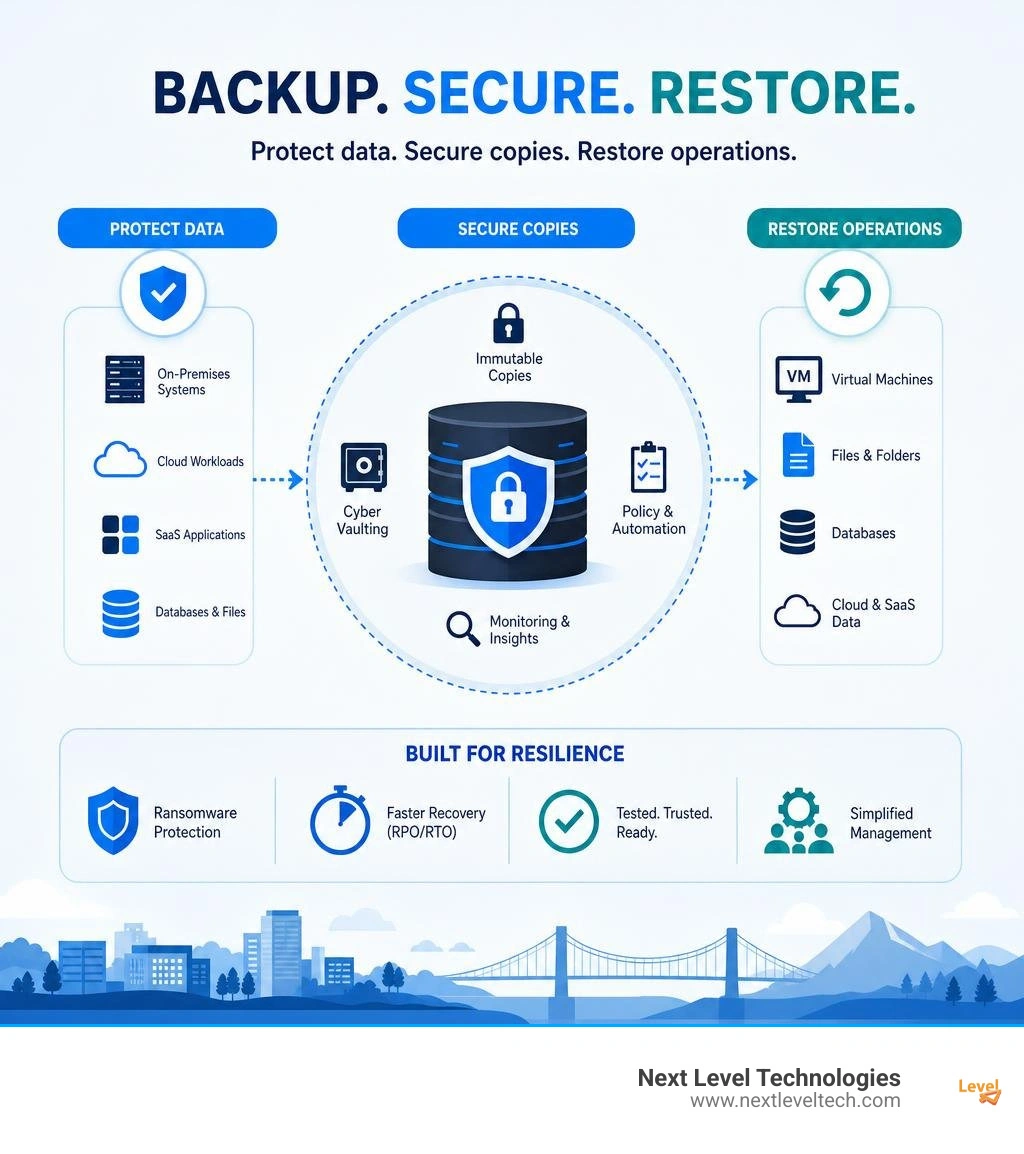
When evaluating modern enterprise backup architectures, legacy approaches often fall short because they rely on fragmented tools: separate media servers, deduplication appliances, target storage arrays, and cloud gateways. Cohesity consolidates these siloed components into a unified software-defined platform. Understanding how cohesity backup and recovery delivers high performance requires a closer look at its underlying distributed file system, parallel processing engine, and data reduction mechanisms.
By pairing modern software architecture with robust protection policies, organizations can unify their unstructured files, virtual machines, and cloud instances under a single control plane. For a deeper look at core concepts, review our guide on Data Backup And Recovery.
At the heart of the Cohesity Data Cloud is SpanFS, a proprietary, scale-out, distributed file system built specifically to handle secondary data at scale. Unlike conventional file systems that struggle with multi-terabyte files or millions of small unindexed files, SpanFS distributes compute and storage evenly across all physical or virtual nodes in a cluster.
SpanFS includes a specialized sub-engine known as MegaFile technology. Standard file backup methods attempt to stream an individual large file sequentially through a single thread or node, which creates massive network bottlenecks and extends backup windows into tens of hours. MegaFile solves this by dynamically breaking multi-terabyte database files, virtual disk files (VMDKs/VHDXs), and massive file repositories into small, distinct byte chunks.
These chunks are streamed in parallel across every available node in the Cohesity cluster. During recovery, the reverse happens: nodes assemble and write data blocks simultaneously, transforming multi-day restores into fast, parallel ingestion tasks. Additionally, SpanFS maintains global metadata indexing. Every block of data is cataloged instantly, allowing IT administrators to execute instantaneous search queries across billions of files without scanning storage volumes sequentially.
For engineers optimizing virtual environments, reviewing the official Cohesity Best Practice VMware vSphere Data Protection Guide provides deeper insight into storage snapshot integration and host payload management.
Data growth rapidly inflates storage hardware budgets if left unchecked. Cohesity mitigates footprint expansion through a combined approach to global data reduction:
Our engineers emphasize that optimizing data reduction requires careful alignment between storage target appliances and application settings. To learn more about selecting physical targets for your infrastructure, check out our guide on Hardware Backup Solutions.
Databases represent the engine of corporate applications and healthcare operations. Protecting systems like Microsoft SQL Server and Electronic Health Record (EHR) platforms requires more than standard file or crash-consistent image snapshots; it demands strict transactional consistency, minimal host impact, and proven point-in-time recovery testing.
When designing database backup policies, defining explicit recovery objectives is paramount. To structure a comprehensive continuity plan for your mission-critical applications, refer to our detailed article on Disaster Recovery Planning.
Database Administrators (DBAs) are rightfully protective of their SQL Server environments. Replacing native T-SQL backups (BACKUP DATABASE) with enterprise backup agents frequently raises concerns over host resource consumption, transaction log truncation, and point-in-time recovery.
Cohesity integrates directly with Microsoft SQL Server using custom light-weight agents that interface with Volume Shadow Copy Service (VSS) and Virtual Device Interface (VDI). Here is how key DBA considerations are addressed:
.ldf) do not fill host disk volumes.To ensure your team validates recovery viability without risking database corruption, we recommend that DBAs execute this structured verification workflow:
In healthcare IT, clinical systems cannot suffer prolonged downtime. Protecting Electronic Health Record systems such as Epic EHR requires protecting massive underlying Caché and IRIS databases alongside unstructured medical imaging and patient files.
Cohesity provides tailored integration for healthcare systems, maintaining strict Health Insurance Portability and Accountability Act (HIPAA) compliance through end-to-end encryption (FIPS 140-2 Level 2 validated), role-based access control (RBAC), and detailed audit logging.
Using SpanFS and MegaFile, healthcare organizations back up multi-terabyte Epic IRIS database files across parallel cluster streams. For example, in real-world healthcare deployments, Cohesity successfully protects massive Epic IRIS databases up to 140TB in size, achieving complete system recovery in less than 14 hours—far outpacing legacy recovery tools that often take days to stream comparable volumes.
Organizations like Riverside Healthcare achieved over 50 times data reduction using Cohesity, while cutting overall backup and restore management effort by 70 percent. Over 50 major healthcare institutions rely on Cohesity to meet vendor business continuity review guidelines and maintain round-the-clock availability for critical patient records.
To explore how healthcare IT leaders secure sensitive clinical databases, review the comprehensive guide on how to Safeguard Critical Patient Records and Medical Data with Cohesity. To contrast these specialized tools with broader enterprise strategies, explore our overview of Backup And Recovery Solutions.
Modern data protection is no longer just about recovering from power outages or accidental file deletions; it is an active defense against sophisticated ransomware attacks. Attackers routinely target primary backup systems first to destroy shadow copies, erase software catalogs, and force organizations into paying ransoms.
Building modern cyber resilience requires a layered, zero-trust framework. Learn more about evaluating business continuity risks in our core article on Disaster Recovery.
Cohesity addresses modern cyber threats through its comprehensive cyber resilience architecture, managed locally or via the unified Cohesity Helios SaaS platform. This ecosystem relies on several core security pillars:
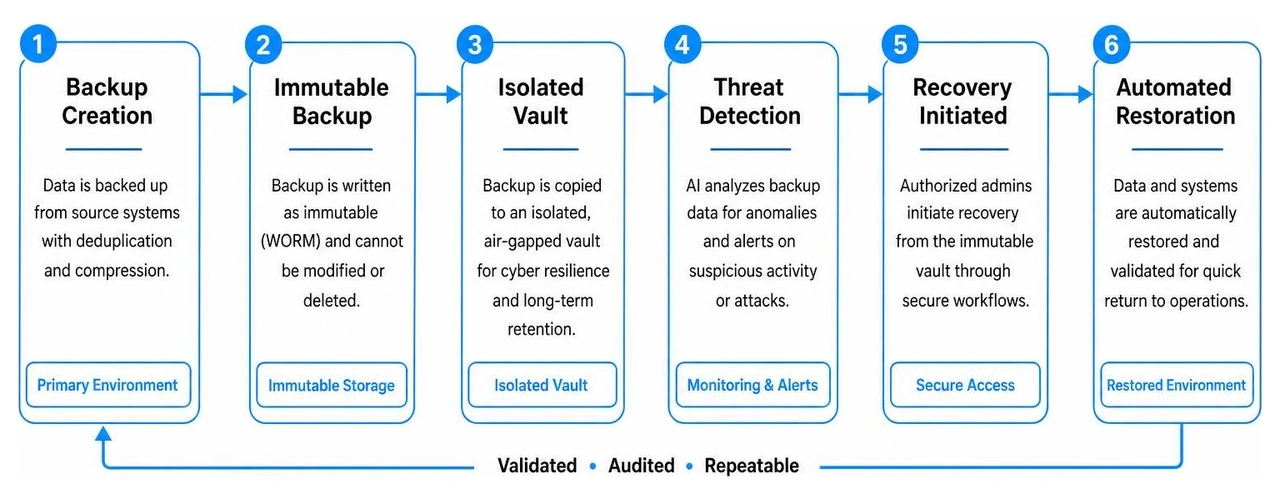
A widespread misconception among business leaders is that migrating to Microsoft 365 eliminates the need for independent backups. Microsoft operates under a Shared Responsibility Model: Microsoft ensures cloud infrastructure uptime and hardware redundancy, but the customer retains ultimate responsibility for data retention, protection against insider threats, ransomware recovery, and long-term regulatory compliance. Built-in recycle bins and soft-delete features are short-term safety nets, not a comprehensive disaster recovery platform.
Cohesity provides comprehensive protection for the entire Microsoft 365 application suite:
By leveraging a Backup as a Service (BaaS) deployment model for M365, backup traffic flows directly cloud-to-cloud. This architecture bypasses on-premises network bottlenecks and saves localized internet bandwidth.
Real-world deployment validation demonstrates this power: the California Department of Finance successfully restored 2.5 TB of Microsoft 365 data—protected by Cohesity DataProtect on Azure—in just 12 hours following an incident, completely bypassing the threat of data loss.
To understand how cloud-native data protection aligns with enterprise cloud strategy, explore Microsoft 365 Backup and Recovery Solution | Cohesity as well as our deep dive into Cloud Backup As A Service.
Flexibility in deployment allows enterprise backup tools to scale alongside evolving cloud architecture. Whether managing on-premises data centers, public cloud environments, or hybrid infrastructure, cohesity backup and recovery provides standardized policy management across all locations.
Cohesity seamlessly integrates with major public cloud platforms, including Amazon Web Services (AWS) and Microsoft Azure, offering multiple deployment models:
To review global options for cloud and enterprise backup frameworks, consult Lösungen für Datensicherung und -wiederherstellung - Cohesity or explore public professional insights on Cohesity | LinkedIn. Enterprise teams looking for specialized machine recovery options can also examine tools like CoBMR System Recovery for Cohesity - Cristie Data.
Industry analysts and independent validation confirm Cohesity's standing in the enterprise data protection sector:
To see how managed data services can simplify multi-cloud storage and infrastructure administration for your business, read our Managed Data Services Complete Guide.
Cohesity coordinates with Microsoft SQL Server VSS and VDI frameworks to execute full, differential, and frequent transaction log backups. When performing a point-in-time recovery, the administrator specifies the exact date, hour, minute, and second required.
Cohesity automatically identifies the last valid full backup, applies the appropriate differential image, and replays transaction log backups sequentially up to the selected timestamp. This process automatically handles transaction log truncation while ensuring point-in-time consistency for strict RPO targets.
Cohesity offers flexible choices across three primary deployment topologies:
Cohesity integrates with Epic EHR systems using its distributed SpanFS file system and MegaFile parallel chunking engine. Massive Epic Caché and IRIS database files are split into parallel data streams during backup, avoiding network bottlenecks and satisfying strict business continuity requirements.
To maintain HIPAA compliance, all data is encrypted in transit and at rest using FIPS 140-2 validated modules, secured via strict role-based access control (RBAC), and protected from unauthorized modification using immutable snapshot technology.
Implementing an enterprise-grade data protection strategy requires balancing architectural scale, database integration, cloud flexibility, and active cyber defense. Cohesity backup and recovery addresses these demands by consolidating secondary storage into a unified platform built for speed, security, and effortless management.
At Next Level Technologies, our local engineers in Columbus, Ohio and Charleston, West Virginia combine hands-on technical experience with rigorous cybersecurity training to help small and mid-sized businesses design, secure, and validate their data protection infrastructure. Having a powerful software platform is only half the battle—ensuring your backup environment is properly hardened, continuously monitored, and regularly tested against real-world recovery scenarios is what guarantees business continuity when disaster strikes.
If you are ready to eliminate backup complexity, harden your organization against ransomware threats, and verify your true RPO and RTO readiness, our team is here to guide you. Contact Next Level Technologies today to request a comprehensive backup security assessment or set up a trial of our managed Data Backup and disaster recovery solutions.
Master denial management in medical billing with proven strategies to reduce denials, boost appeals success, and protect revenue cycle performance.
September 25, 2026
Compare the best healthcare learning management platforms for providers with Next Level Technologies, serving Columbus, Ohio and Charleston, WV.
September 19, 2026

