Your Guide to Enterprise SaaS: Understanding Cloud-Based Software
January 16, 2026


Upgrade your healthcare claims management for maximum accuracy with Next Level Technologies, serving Columbus, Ohio and Charleston, WV.
October 10, 2026

Discover how a healthcare management services organization boosts practice efficiency, cuts overhead, and protects clinical autonomy.
October 3, 2026

Master denial management in medical billing with proven strategies to reduce denials, boost appeals success, and protect revenue cycle performance.
September 25, 2026
January 16, 2026
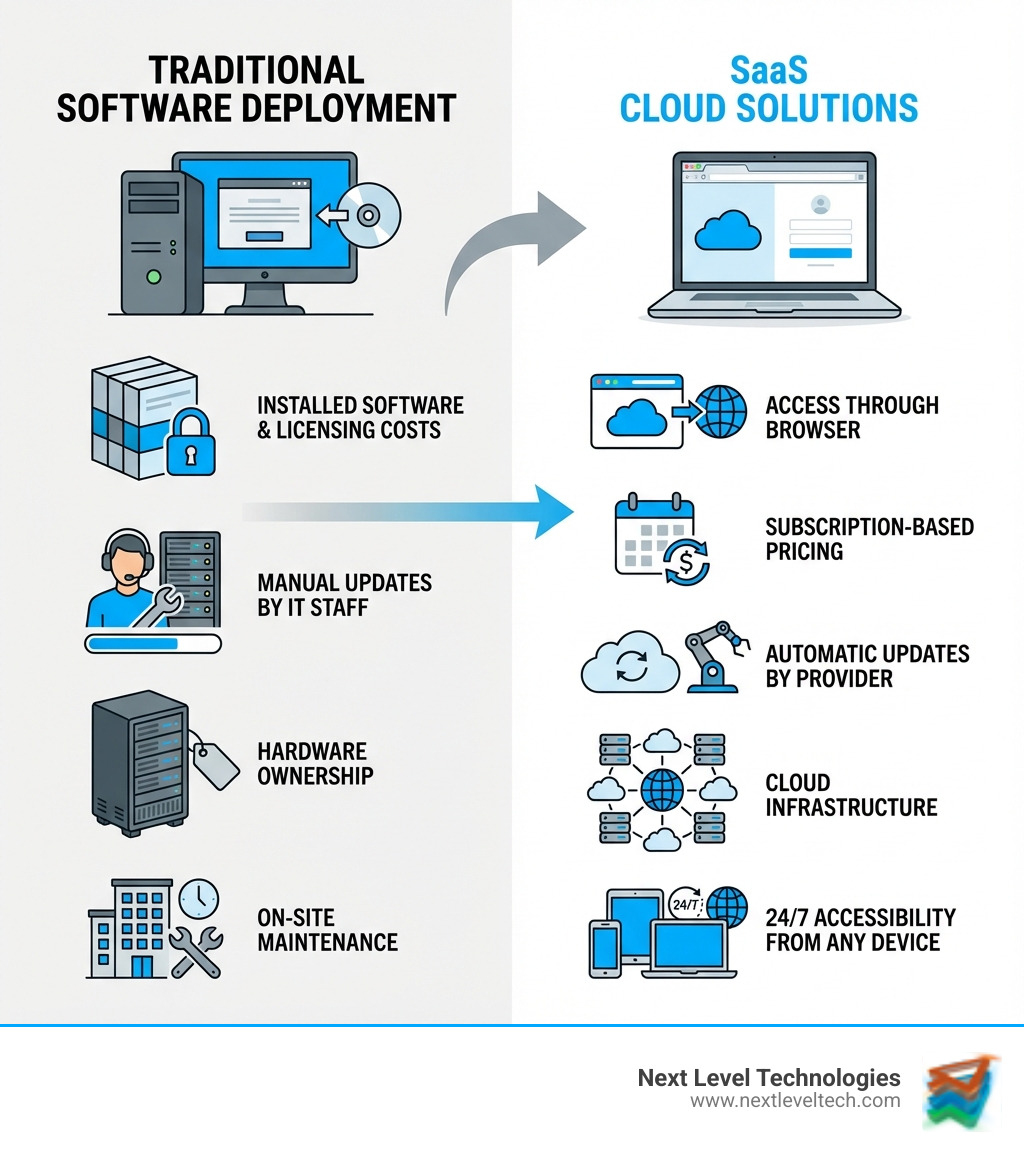
SaaS cloud solutions are software applications hosted by a service provider and accessed over the internet through a subscription model. Instead of purchasing and installing software on your company's computers or servers, you simply log in through a web browser from any device, anywhere. The provider handles all maintenance, updates, security patches, and infrastructure management.
Key characteristics of SaaS cloud solutions:
This model represents a fundamental shift from traditional software ownership. Rather than buying DVDs or licenses and managing your own servers, you're essentially renting access to powerful enterprise-grade applications. The cloud provider owns the software, runs it on their servers, and you pay only for what you use.
Why this matters for mid-sized businesses: The playing field has never been more level. SaaS gives smaller organizations access to the same enterprise-grade tools, security measures, and computing power that Fortune 500 companies use—without the massive upfront investment in hardware, software licenses, or dedicated IT staff to maintain it all.
The numbers tell the story: 99% of organizations now use at least one SaaS application, and the average company uses 130 different SaaS tools. The market is projected to reach $300 billion by 2026, growing at 13.2% annually. This isn't a trend—it's how modern business operates.
For businesses dealing with outdated technology and frequent system downtimes, SaaS offers a path to reliability. Many cloud providers guarantee 99.98% uptime, meaning their servers are down less than 0.02% of the time. When your on-premise equipment fails, your entire operation stops until it's fixed. With SaaS, the provider handles redundancy, failover, and disaster recovery across multiple data centers.
I'm Steve Payerle, and I've spent over 15 years helping businesses in Columbus, Ohio and Charleston, WV steer their transition to SaaS cloud solutions through Next Level Technologies. Our team's extensive cybersecurity training and technical expertise have guided hundreds of companies through successful cloud migrations that improved both security and operational efficiency.
Learn more about saas cloud solutions:
When we talk about SaaS cloud solutions, we're not just discussing a different way to access software; we're talking about a fundamental shift in how businesses operate. The advantages extend far beyond simple cost reduction, though the financial benefits alone can be transformative. For our clients in Columbus, Ohio, and Charleston, WV, these solutions provide a robust framework for growth and efficiency.
One of the most compelling drivers for cloud adoption is cost efficiency. Traditional IT infrastructure demands significant capital investment in servers, software licenses, and ongoing maintenance contracts. With SaaS, this shifts from a capital expenditure (CapEx) to an operational expenditure (OpEx). Instead of a large upfront payment, you pay a predictable monthly or annual subscription fee. This frees up capital that can be reinvested in core business activities, allowing you to confidently plan your software costs.
On-demand scalability is another cornerstone benefit. Imagine your business experiences a sudden surge in demand, perhaps during a busy season or a successful marketing campaign. With traditional software, scaling up means purchasing more hardware, licenses, and potentially hiring more IT staff—a slow and costly process. SaaS cloud solutions allow you to easily add more users, services, or storage as needed, without incurring the costs of upgrading your infrastructure. This flexibility is perfect for growing businesses, enabling them to adapt quickly to market changes. Conversely, if demand decreases, you can scale down, preventing unnecessary expenses.
The accessibility and remote work capabilities offered by SaaS are simply unparalleled. You can access your applications from any device with an internet connection, whether you're in the office, at home, or on the go. This has become increasingly vital in today's hybrid and remote work environments, allowing our clients to maintain productivity and collaboration regardless of physical location. Our team often sees how this transforms workflows for businesses in Worthington, Ohio, enabling seamless operations.
Forget about those dreaded software update nights! Automatic updates and maintenance are handled entirely by the SaaS provider. This means your applications are always running the latest version, complete with the newest features and, crucially, the most recent security patches. This not only saves your internal IT team countless hours but also ensures your systems are continuously protected against emerging threats.
Finally, reliability and uptime are paramount. SaaS providers invest heavily in robust infrastructure, rigorous cybersecurity protocols, and comprehensive disaster recovery capabilities. Many promise impressive uptime guarantees, often 99% or even 99.9%. This level of redundancy and protection against data loss or service interruption would require substantial investment to replicate with on-premise solutions. Cloud platforms replicate data across multiple data centers, ensuring your critical business data remains accessible even during local disasters or equipment failures.
To truly appreciate the power of SaaS cloud solutions, it helps to contrast them with the traditional software deployment model many businesses grew up with. It's like the difference between owning a car and using a ride-sharing service—both get you where you need to go, but the responsibilities and costs are vastly different.
| Feature | Traditional Software Deployment | SaaS Cloud Solutions |
|---|---|---|
| Cost Model | Large upfront capital expenditure (CapEx) for licenses, hardware, and infrastructure. Ongoing maintenance costs. | Subscription-based operational expenditure (OpEx). Predictable monthly/annual fees. |
| Deployment | Installed, configured, and managed on-site by the customer's IT team. Lengthy setup process. | Accessed via web browser or mobile app. No installation required on local devices. Rapid deployment. |
| Maintenance | Customer is responsible for all updates, patches, server maintenance, and security. | Provider manages all updates, patches, server infrastructure, and security. |
| Scalability | Requires purchasing and installing more hardware/licenses to scale up. Slow and costly. | Easily scale users and resources up or down on demand. Quick and flexible. |
| Accessibility | Limited to specific devices or network environments where software is installed. | Accessible from any device, anywhere with an internet connection. Supports remote work. |
| Security | Customer is solely responsible for implementing and maintaining security measures. | Provider implements enterprise-grade security, data encryption, and compliance. Shared responsibility model for data. |
| Disaster Recovery | Requires significant investment in on-site backup and recovery infrastructure. | Provider handles data replication, backups, and disaster recovery across redundant data centers. |
In today's business environment, agility isn't just a buzzword—it's a necessity. SaaS cloud solutions are a primary enabler of this agility, allowing businesses to pivot quickly, innovate faster, and maintain a competitive edge.
One of the most significant contributors to business agility is rapid deployment. Unlike traditional software that can take weeks or months to install and configure across an organization, SaaS applications can be rolled out almost instantly. Once your subscription begins, users can access the software immediately, meaning your teams can start leveraging new tools and functionalities without delay. This ability to move from idea to implementation at lightning speed is invaluable.
This rapid deployment fuels faster innovation. With SaaS, businesses can experiment with new tools and technologies without the heavy upfront investment or the commitment to long-term infrastructure. Want to try a new CRM, project management tool, or analytics platform? You can sign up, test it out, and if it doesn't meet your needs, you can move on with minimal loss. This low-risk experimentation encourages a culture of innovation, helping businesses in Columbus, Ohio, and Charleston, WV remain competitive and responsive to market demands.
By offloading the burdens of software management and infrastructure maintenance to SaaS providers, your internal IT team can focus on core business functions. Instead of spending countless hours on updates, troubleshooting, and capacity planning, they can dedicate their expertise to strategic initiatives that directly impact your bottom line. This reduction in IT overhead allows your specialized staff, often with extensive cybersecurity training, to concentrate on enhancing security postures, optimizing existing systems, and driving digital change. Our technical experience at Next Level Technologies often involves helping clients reallocate their IT resources more strategically once they accept SaaS.
To fully grasp the landscape of SaaS cloud solutions, it's helpful to understand where they fit within the broader cloud computing ecosystem. Think of it as a spectrum of services, each offering different levels of control and management. We often explain this using a simple analogy: building a house versus renting an apartment.
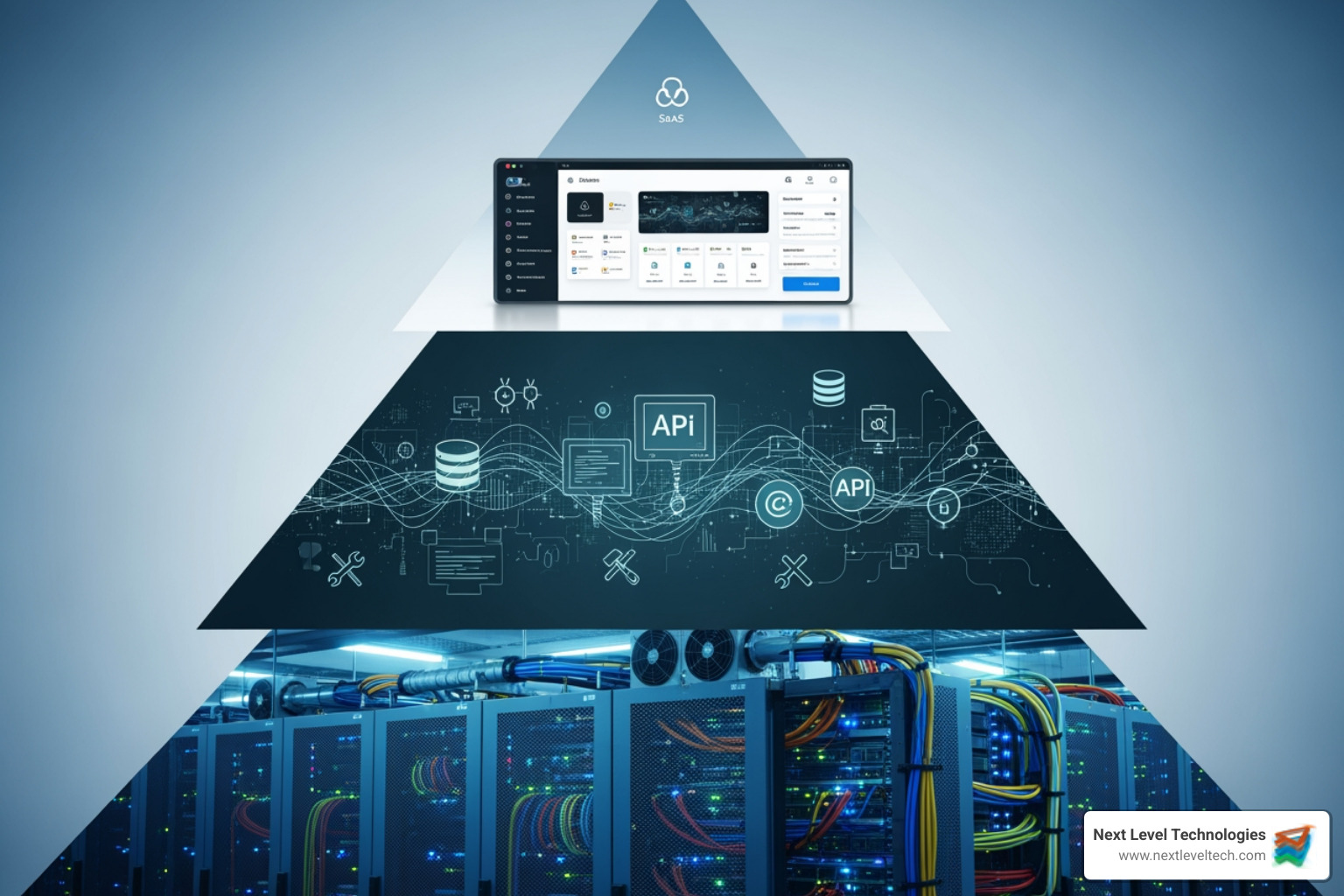
At the foundation, we have Infrastructure as a Service (IaaS). This is like renting the land and raw materials for your house. With IaaS, you get access to fundamental computing resources—servers (virtual or physical), storage, networking, and virtualization. You manage your operating systems, applications, and data, but the cloud provider handles the underlying infrastructure. This gives you the most flexibility and control, but also the most responsibility. It's an excellent choice if you need to migrate existing applications, host websites, or develop custom solutions where you want fine-grained control over your environment.
Next up is Platform as a Service (PaaS). This is akin to renting an apartment with built-in plumbing, electricity, and basic kitchen appliances. PaaS provides a complete development and deployment environment in the cloud, with all the hardware and software tools needed to build, run, and manage applications. The provider manages the operating system, server software, and database, while you focus on your application code and data. PaaS is ideal for developers who want to accelerate application development without worrying about the underlying infrastructure.
Finally, at the top, we find Software as a Service (SaaS). This is like renting a fully furnished apartment—you just move in and use it. With SaaS, the cloud provider manages everything: the applications, data, runtime, operating system, virtualization, servers, storage, and networking. You simply subscribe to the software and access it over the internet. This model offers the least control but the highest level of convenience and ease of use. Most of the saas cloud solutions we discuss fall into this category.
It's important to recognize the shared responsibility model inherent in cloud computing. While cloud providers handle the security of the cloud (the underlying infrastructure), customers are responsible for security in the cloud (their data, applications, and configurations). This distinction is crucial, and our team at Next Level Technologies, with our extensive cybersecurity training, helps our clients understand and manage their part of this responsibility. To dig deeper into these models, you can explore Types of Cloud Computing. If you're weighing your options, our insights on ITaaS vs SaaS: Which is Right for Your Business can provide further clarity.
Deciding which cloud service model is right for your business depends heavily on your specific needs, existing infrastructure, and desired level of control. There's no one-size-fits-all answer, and sometimes, a combination of models works best.
Use case for IaaS: If your business requires complete control over your operating systems, middleware, and applications, or if you need to migrate existing on-premise applications to the cloud without significant re-architecture, IaaS is a strong contender. It's often chosen for custom application hosting, big data analysis, and dev/test environments where flexibility is key.
Use case for PaaS: For development teams looking to build, deploy, and manage web applications and APIs quickly, PaaS offers a streamlined environment. It abstracts away much of the infrastructure management, allowing developers to focus purely on coding. This can accelerate time-to-market for new products and features.
Use case for SaaS: For most standard business functions—CRM, ERP, email, collaboration, project management, accounting, and HR—SaaS cloud solutions are the go-to choice. They require minimal IT overhead, are quick to deploy, and offer immediate value. If you need a ready-to-use application without the hassle of managing any infrastructure, SaaS is your best bet. Our clients in Columbus, Ohio, and Charleston, WV often leverage SaaS for their core business operations.
It's also common for models to be combined in a hybrid or multi-cloud strategy. For instance, a business might use SaaS for its CRM (e.g., Salesforce), PaaS for custom application development, and IaaS for hosting legacy applications. Understanding What is a SaaS Company can help you identify providers specializing in these various models. Our technical experience allows us to guide you through these choices, ensuring you select the optimal blend for your operations.
While SaaS cloud solutions offer a plethora of benefits, a thoughtful approach is essential for successful adoption. Before diving headfirst, businesses in Columbus, Ohio, and Charleston, WV should carefully consider several critical factors, including data security, regulatory compliance, potential vendor lock-in, and integration with existing systems.
Data security is, without a doubt, a top concern. While SaaS providers invest heavily in securing their infrastructure, the responsibility for your data remains shared. You need to ensure the provider's security measures align with your needs and that you understand your role in protecting your data. This includes robust access controls, encryption, and data governance policies. Our team, with its extensive cybersecurity training, assists clients in evaluating provider security and implementing best practices for their end. For more on this, check out our insights on Cloud IT Security.
Regulatory compliance is another non-negotiable. Depending on your industry, you might be subject to regulations like HIPAA (healthcare), GDPR (data privacy), or PCI-DSS (payment card industry). You must ensure that your chosen SaaS provider meets these specific compliance requirements. This often involves reviewing their certifications, audit reports, and data handling policies. We regularly help businesses steer these complex compliance landscapes. Our article on IT Compliance can provide a deeper dive.
The specter of vendor lock-in is a real concern. Once you've invested significant time and resources into a particular SaaS platform, migrating to another can be challenging and costly. Before committing, evaluate the ease of data export, API availability for integration, and the provider's track record. It's like choosing a long-term partner—you want to ensure they're a good fit and that you won't be trapped if things don't work out.
Lastly, consider integration with existing systems. Most businesses don't operate in a vacuum. Your new saas cloud solutions will likely need to communicate with other applications, whether they are other SaaS tools, on-premise legacy systems, or custom-built solutions. Look for providers with open APIs and robust integration capabilities to ensure a seamless flow of data across your entire technology stack.
When it comes to saas cloud solutions, security and reliability aren't just features; they're foundational pillars. For businesses in Charleston, WV, and Columbus, OH, trusting a provider with your critical data means understanding how they uphold these standards.
SaaS provider security measures are typically far more advanced than what most individual businesses can afford or manage on their own. These providers deploy multiple layers of security, including physical security for their data centers, network security, application security, and data security. They employ dedicated security teams who work 24/7 to monitor for threats and implement defenses.
Data encryption is a standard practice, protecting your sensitive information both in transit (as it moves between your device and the cloud) and at rest (when stored on the provider's servers). This makes your data unreadable to unauthorized parties, even if they somehow gain access.
Business continuity and disaster recovery are inherent strengths of SaaS. Providers build their infrastructure with redundancy, often replicating data across multiple geographically dispersed data centers. This means if one data center experiences an outage, your service can seamlessly failover to another, ensuring minimal downtime. Many cloud-based ERP options, for instance, offer 99.98% uptime, significantly higher than what most companies can achieve with their own servers. This level of protection, combined with reliable backup solutions, is crucial for maintaining operations during unforeseen events. You can learn more about this vital aspect through Business continuity and disaster recovery.
Multi-factor authentication (MFA) is a critical security layer that most saas cloud solutions offer and should always be enabled. It adds an extra step to the login process, typically requiring something you know (password) and something you have (phone or token). This dramatically reduces the risk of unauthorized access, even if a password is stolen. Implementing MFA is a best practice we advocate for all our clients, and you can explore more about Cloud-Based Multi-Factor Authentication.
The role of a managed services provider (MSP) like Next Level Technologies in this ecosystem is to act as your trusted advisor and extension of your IT team. We help you vet SaaS providers, ensure proper configuration, implement strong security policies, and manage your overall cloud environment. Our staff's extensive cybersecurity training means we're equipped to handle the complexities of securing your data in the cloud, offering businesses in Columbus, Ohio, and Charleston, WV peace of mind.
As businesses increasingly adopt saas cloud solutions, managing this growing portfolio can become a challenge. The average organization uses 130 SaaS applications, and without proper management, this can lead to application sprawl, inefficiencies, and unexpected costs.
Application sprawl occurs when different departments or teams independently adopt SaaS applications without central oversight. This can lead to duplicate functionalities, redundant subscriptions, and a fragmented view of your data. It's like having twenty different tools in your toolbox that all do roughly the same thing—inefficient and confusing!
Effective cost optimization is crucial. While SaaS offers predictable OpEx, without careful monitoring, costs can escalate as users or features are added. This requires ongoing attention and management. Cloud resources can scale automatically, which is beneficial for handling demand spikes but can lead to unexpected expenses without proper monitoring and control. We help our clients implement governance policies and use cloud management tools to track usage and control spending, ensuring they maintain cost efficiency while ensuring adequate performance and security.
Vendor management becomes a continuous process. You're not just buying software; you're entering into a service agreement. This involves regularly reviewing Service Level Agreements (SLAs), assessing vendor performance, and staying informed about their security practices and roadmap. Our technical experience includes helping businesses manage these vendor relationships effectively.
Centralized IT management is key to success. This means having a clear strategy for acquiring, integrating, and managing all your saas cloud solutions. A comprehensive approach ensures that applications work together seamlessly, data flows efficiently, and security policies are consistently applied across your entire environment. Our team provides Managed Cloud Applications services and Cloud Migration Consulting Services to help businesses streamline their SaaS portfolios and maximize their investment.
The world of SaaS cloud solutions is constantly evolving, and the next frontier is undoubtedly the integration of Artificial Intelligence (AI) and Machine Learning (ML). This isn't just about adding a fancy new feature; it's about fundamentally changing how software works, making it smarter, more proactive, and incredibly personalized.
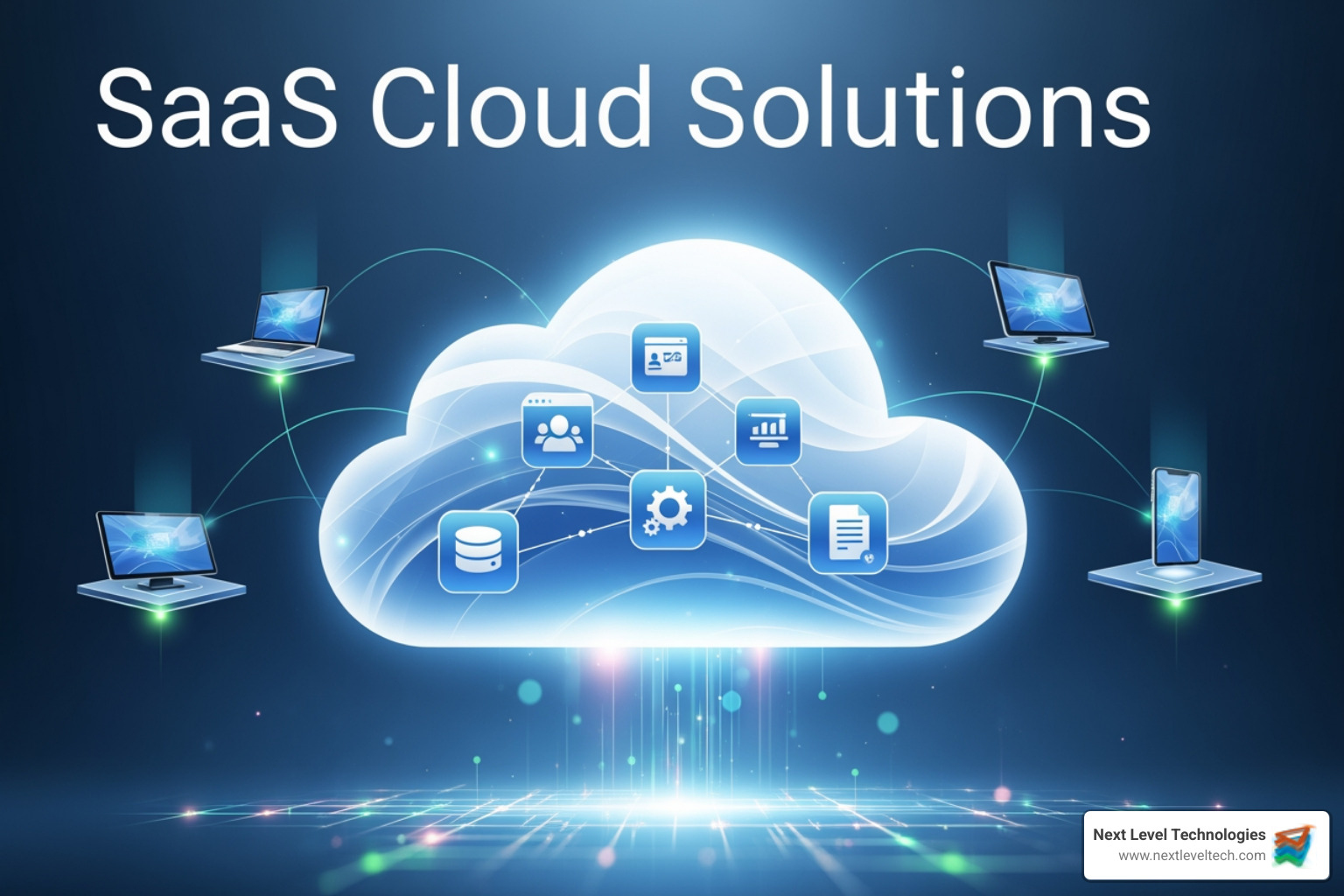
AI-powered SaaS represents the next evolution, embedding intelligence directly into cloud-based applications. AI is rapidly becoming a defining characteristic of leading SaaS solutions, moving beyond simple automation to enable advanced capabilities.
Consider Artificial Intelligence (AI) integration and Machine Learning (ML). These technologies allow SaaS applications to learn from data, identify patterns, and make intelligent predictions. For instance, a CRM system might use AI to predict which leads are most likely to convert, or an ERP system could use ML to optimize inventory levels based on historical sales data and external factors. This proactive intelligence helps businesses make better decisions and anticipate needs.
This intelligence drives improved automation. AI can automate complex tasks that previously required human intervention, freeing up your team to focus on more strategic work. Imagine your customer service platform automatically routing inquiries to the best-suited agent, or your marketing automation tool dynamically adjusting campaigns based on real-time user engagement.
Personalization is another huge win. AI-powered SaaS can tailor user experiences, content, and recommendations based on individual preferences and behaviors. This leads to more engaging interactions and more effective outcomes, whether for your customers or your employees.
The ability to generate predictive insights is perhaps one of the most powerful aspects. Instead of just reacting to past data, AI allows SaaS applications to forecast future trends, identify potential risks, and recommend optimal actions. This empowers businesses to stay ahead of the curve, optimize operations, and seize new opportunities.
For our clients in Columbus, Ohio, and Charleston, WV, this means accessing tools that not only manage their operations but actively help them improve. Microsoft, for example, is heavily invested in this space, redefining what's possible for businesses with its AI offerings. You can explore how they are leading this charge with Redefine what’s possible for your business with Microsoft AI. We've seen how these intelligent capabilities transform everything from sales forecasting to operational efficiency. For a deeper understanding of how these solutions operate, our article on Software as a Service Example provides additional context.
Embracing SaaS cloud solutions is no longer just an option—it's a strategic imperative for businesses looking to stay competitive, agile, and secure. From cost savings and unparalleled scalability to improved accessibility and the transformative power of AI, SaaS offers a robust foundation for modern operations. We've seen how businesses in Columbus, Ohio, and Charleston, WV, can thrive by adopting these innovative technologies.
However, navigating the complexities of SaaS adoption, ensuring data security, managing compliance, and optimizing your application portfolio requires more than just signing up for a service. It demands a clear adoption strategy and the need for expert management. This is where Next Level Technologies comes in.
Our team, armed with extensive cybersecurity expertise and deep technical experience, acts as your trusted partner. We understand the unique challenges faced by businesses in our communities, from the busy enterprises of Columbus, Ohio, to the growing companies in Charleston, WV. We don't just provide IT support; we craft custom strategies that align your technology with your business goals.
We help you:
With Next Level Technologies, you gain a partner dedicated to your success. We empower your business to harness the full potential of SaaS cloud solutions, allowing you to focus on what you do best while we handle the complexities of your IT environment. Our commitment is to lift your business to the next level, ensuring your technology is an asset, not a hindrance.
Ready to explore how SaaS cloud solutions can transform your business? Let's talk.
Upgrade your healthcare claims management for maximum accuracy with Next Level Technologies, serving Columbus, Ohio and Charleston, WV.
October 10, 2026
Discover how a healthcare management services organization boosts practice efficiency, cuts overhead, and protects clinical autonomy.
October 3, 2026
