Why B2B IT Support is the Foundation of Modern Business Success
B2b it support is the comprehensive management and maintenance of technology systems for business clients, encompassing everything from helpdesk services to strategic IT planning, cybersecurity, and infrastructure optimization. Unlike consumer-focused support, B2B IT support handles complex multi-user environments, ensures business continuity, and aligns technology strategy with organizational goals.
Key aspects of B2B IT support include:
- Proactive monitoring and maintenance to prevent issues before they impact operations
- Multi-tiered support structure (Tier 1, 2, and 3) matching expertise to problem complexity
- Strategic partnership approach focused on long-term business outcomes
- Improved security measures including 24/7 threat detection and compliance management
- Predictable cost models that transform IT from unpredictable expense to strategic investment
For many business owners, technology represents a paradox. When it works, it's an invisible engine driving productivity and profit. When it fails, it becomes a suffocating bottleneck that costs money, frustrates employees, and damages customer relationships.
The reality is stark: Gartner estimates the average cost of IT downtime is £4,200 per minute. For a mid-sized business experiencing frequent system failures, this adds up to devastating losses. Yet many organizations still approach IT support reactively—waiting for problems to occur rather than preventing them.
Modern b2b it support has evolved far beyond the "break-fix" model. Today's leading businesses view IT support as a strategic asset that drives competitive advantage. Companies that implement proactive, managed IT services report 60-70% reductions in downtime within the first year, while also achieving 25-45% cost savings compared to maintaining in-house teams.
The shift matters because technology now touches every aspect of business operations. From securing remote work environments to protecting against increasingly sophisticated cyber threats, quality IT support determines whether businesses thrive or merely survive.
I'm Steve Payerle, President of Next Level Technologies, and I've spent over 15 years helping businesses in Columbus, Ohio and Charleston, WV transform their technology from a cost center into a growth driver through comprehensive b2b it support solutions. Our team's extensive cybersecurity training and technical expertise has enabled hundreds of organizations to operate at peak efficiency while staying protected from evolving threats.
Handy b2b it support terms:
What is B2B IT Support and How Does It Differ from B2C?
At its core, b2b it support is about providing technical assistance and strategic guidance to other businesses. This differs significantly from Business-to-Consumer (B2C) support, which focuses on individual end-users. Think of it this way: when your home internet goes out, you call B2C support. When your entire office network goes down, you need b2b it support.
For us, the distinction is crucial. Our focus isn't just on fixing a single problem; it's on ensuring the entire technological ecosystem of your business in Columbus, Ohio, Charleston, WV, or Worthington, Ohio, operates seamlessly, securely, and efficiently.
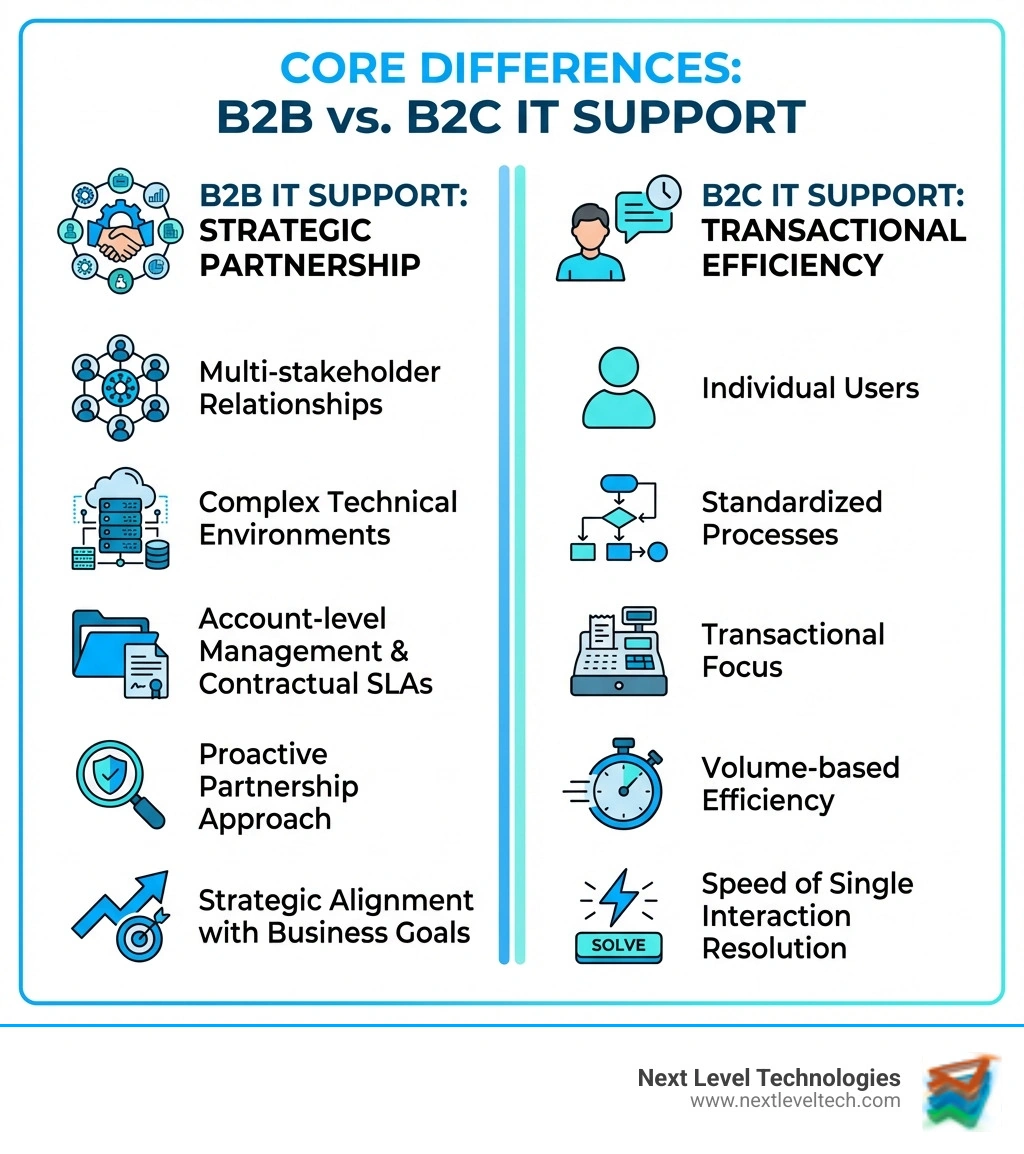
The Core Differences Explained
The differences between B2B and B2C support run deep:
- Relationship Focus vs. Transactional Focus: B2B support builds long-term partnerships, understanding your business goals and aligning technology to achieve them. B2C is often a one-off transaction to resolve a specific, isolated issue.
- Multiple Stakeholders: In a B2B environment, we're not just dealing with one user. We're supporting multiple departments, decision-makers, and employees, each with unique needs and access levels. This means managing complex account hierarchies, not just individual tickets.
- Complex Technical Environments: B2B systems involve intricate networks, servers, specialized software, cloud integrations, and often proprietary applications. Troubleshooting these requires a much deeper level of expertise than, say, helping someone reset their email password.
- Longer Resolution Cycles & Business Impact: While B2C aims for quick, single-interaction resolutions, B2B issues can be complex, requiring in-depth investigation and coordination, leading to longer resolution cycles. The impact of downtime is also far greater in B2B – it can halt operations, cost revenue, and damage reputation. This is why we prioritize proactive monitoring and rapid response.
- Contractual SLAs & Custom Solutions: B2B relationships are typically governed by Service Level Agreements (SLAs) that define response times, uptime guarantees, and performance metrics. We often provide custom-custom solutions, unlike the standardized processes common in B2C.
- Proactive Partnership: We don't just react to problems; we work proactively to prevent them. This involves strategic planning, regular maintenance, and continuous security assessments to keep your business ahead of potential issues.
Why a B2C Approach Fails in a Business Context
Applying a B2C support model to a business environment is like using a band-aid for a broken leg – it simply won't work. Here's why:
- Lack of Strategic Overview: A B2C approach lacks the holistic view necessary to understand how IT issues impact your overall business strategy. We, as your B2B partner, aim to align technology investments with your business goals, reducing risks and supporting future growth.
- Inability to Handle Complex Hierarchies: B2C tools and processes aren't designed to manage multiple users within an organization, different access permissions, or complex inter-departmental dependencies. This often leads to fragmented support and inefficient problem-solving.
- Security Protocol Gaps: Consumer-grade security is insufficient for businesses. A B2C approach often overlooks the layered protection, compliance requirements, and advanced threat detection crucial for safeguarding sensitive business data.
- Misaligned Business Goals: B2C support is about user satisfaction; B2B support is about business continuity, productivity, and profitability. A B2C model won't understand or prioritize the critical business functions affected by IT issues.
- Poor Service Impact on Revenue: For businesses, customer retention is paramount. According to research by Frederick Reichheld of Bain & Company, increasing customer retention rates by just 5% can boost profits by 25-95%. When your internal IT systems are constantly failing due to inadequate support, it directly impacts your ability to serve your customers, leading to reduced spending and potential loss of business. In fact, 51% of customers reduce spending after negative experiences, and U.S. businesses risk losing $856 billion annually due to poor customer service. We make sure your IT is a contributor to your success, not a hindrance.
The Structure of Modern B2B IT Support
To handle the complexity and critical nature of business technology, modern b2b it support is typically organized into a tiered system. This structure ensures that issues are routed to the appropriate level of expertise, leading to more efficient problem resolution and less downtime for your operations.
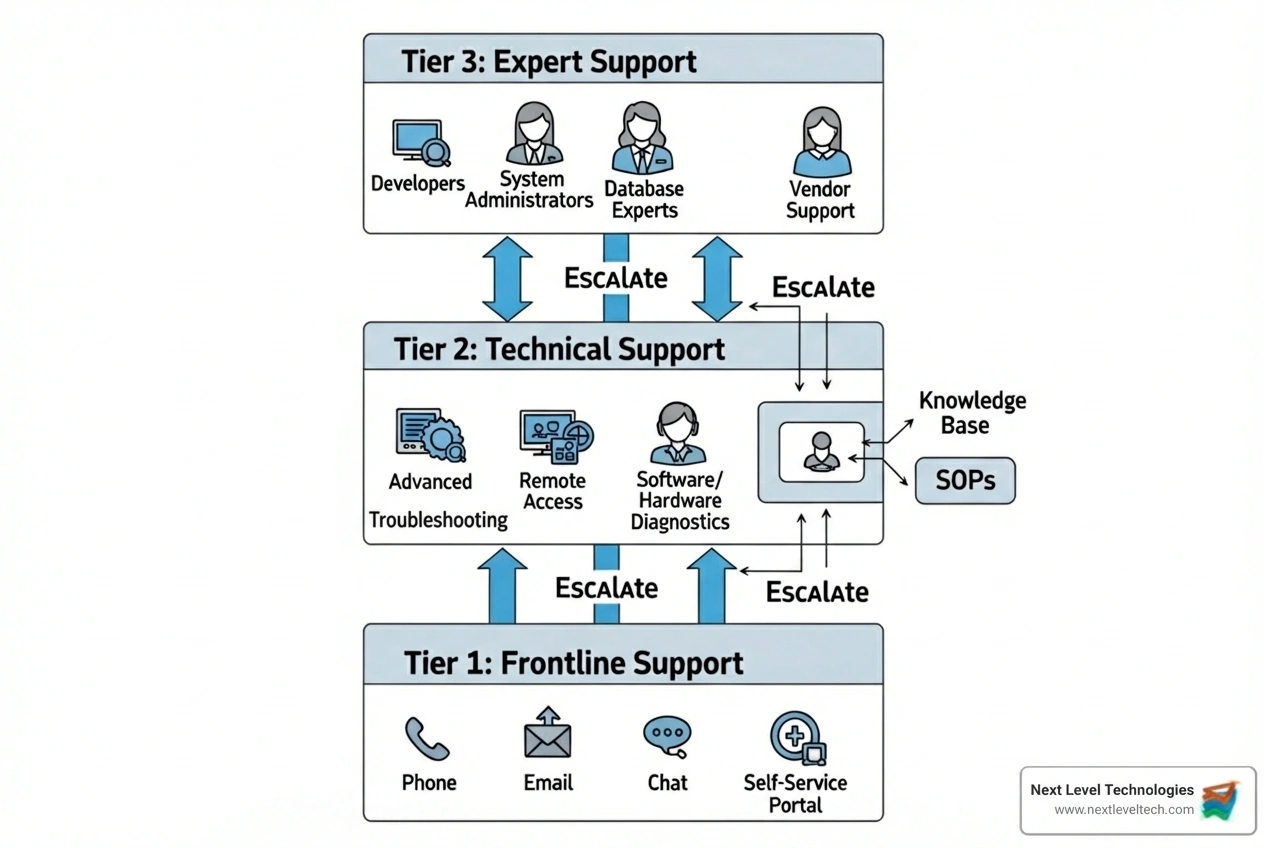
This tiered model allows us to align the right resources to the right issue, ensuring better outcomes and more strategic use of our technical talent. It's about getting you back to business faster, whether you're in Columbus, Ohio, Charleston, WV, or Worthington, Ohio.
Tier 1: The Front Line of Support
Tier 1 is the first point of contact for most IT issues. Think of these as our friendly IT troubleshooters who are ready to jump into action for common problems.
- Responsibilities: They handle basic requests like password resets, printer issues, software installation guidance, and minor connectivity problems. Their primary goal is to gather information, perform initial diagnostics using established scripts, and resolve routine problems quickly.
- Key Role: Our Tier 1 team acts as a filter, resolving a high percentage of issues on the first call or interaction. If they can't resolve it, they escalate the problem to the next level, ensuring all necessary information is captured. This cost-effective approach means you're not paying for a senior engineer's time for a simple fix.
Tier 2: Deep Technical Troubleshooting
When an issue proves to be more complex than a quick fix, it moves up to Tier 2. Our Tier 2 specialists possess a deeper level of technical knowledge and experience.
- Responsibilities: They tackle system-level problems such as server errors, network troubleshooting, persistent application bugs, and more intricate hardware issues. They often use remote access tools to diagnose and resolve problems that require more in-depth investigation.
- Expertise: Our Tier 2 team includes specialists in networking, server infrastructure, and key business applications. They work closely with Tier 1, providing guidance and taking over when advanced troubleshooting is required.
Tier 3: Expert and Strategic Intervention
This is where the big guns come out! Tier 3 is the highest level of technical expertise, typically involving engineers and architects with extensive, specialized knowledge.
- Responsibilities: Our Tier 3 experts handle the most complex and critical issues, such as major infrastructure failures, high-level cybersecurity threats, data recovery, and system design problems. They may also work directly with software vendors for highly specialized solutions or bugs.
- Strategic Role: Beyond immediate problem-solving, our Tier 3 team plays a strategic role in system architecture, focusing on scalability, security, and ensuring that your IT infrastructure aligns with best practices and your long-term business goals. Their expertise is crucial for proactive system improvements and preventing future crises.
Fully Outsourced vs. Co-Managed IT: What's the Right Model?
Deciding how to staff your IT department is a big decision. We offer flexible solutions to fit your unique needs.
Fully outsourced IT means an external provider manages your entire IT environment. That includes day-to-day support, systems management, cybersecurity, maintenance, and strategic recommendations. It gives your business a predictable operating expense, access to a broad team of specialists, and the ability to scale services up or down as needs change. It also lets your internal team stay focused on core business operations instead of IT issues.
Co-managed IT is a shared model. Your internal IT team keeps control over key decisions, while an outside provider fills gaps in skills, capacity, tools, or coverage. This works well when you already have IT staff but need help with areas like cybersecurity, help desk overflow, cloud management, or after-hours support. It also lets you scale specific functions without hiring full-time employees.
Approximately 66% of US companies outsource at least one business function, and IT services are among the most popular. Why? Because it offers significant advantages.
- In-house IT Limitations: Building and maintaining a robust in-house IT department with all the necessary expertise (networking, cybersecurity, cloud, helpdesk, etc.) is incredibly expensive and challenging, especially for small to mid-sized businesses. It requires significant capital investment in salaries, training, and tools. While outsourcing IT is often seen as a cost-saving measure, its true value lies in empowering your in-house team to accomplish more each day. However, this is only possible if the IT services you select deliver on their promises and provide real, tangible value.
- Scalability: With a fully outsourced model, we become your entire IT department, providing comprehensive support and strategic guidance. This is ideal for businesses without any internal IT staff or those looking to completely offload the burden.
- Co-Managed IT: If you have an existing internal IT team, but they're stretched thin, lack specialized skills (like advanced cybersecurity), or simply need an extra pair of hands for routine tasks, co-managed IT is a fantastic solution. We work alongside your team, taking on specific responsibilities like patching, monitoring, or providing Tier 2/3 escalation, allowing your internal staff to focus on strategic projects. This model helps fill critical skill gaps and prevents your team from being overwhelmed.
For businesses in Columbus, Ohio, Charleston, WV, or Worthington, Ohio, choosing the right model means assessing your current resources, budget, and strategic goals. We're here to help you steer that decision.
The Strategic Benefits of Investing in Quality B2B IT Support
Investing in high-quality b2b it support isn't just about fixing broken computers; it's a strategic move that directly impacts your bottom line, productivity, and competitive edge. It’s about changing IT from a reactive cost center into a proactive growth engine.
Improved Cybersecurity and Proactive Protection
In today's digital landscape, cybersecurity isn't optional—it's essential for survival. 82% of executives report that IT complexities are impeding their organization’s ability to succeed, and cybersecurity is a major part of that complexity. Our staff in Columbus, Ohio and Charleston, WV have extensive cybersecurity training, enabling us to offer superior protection.
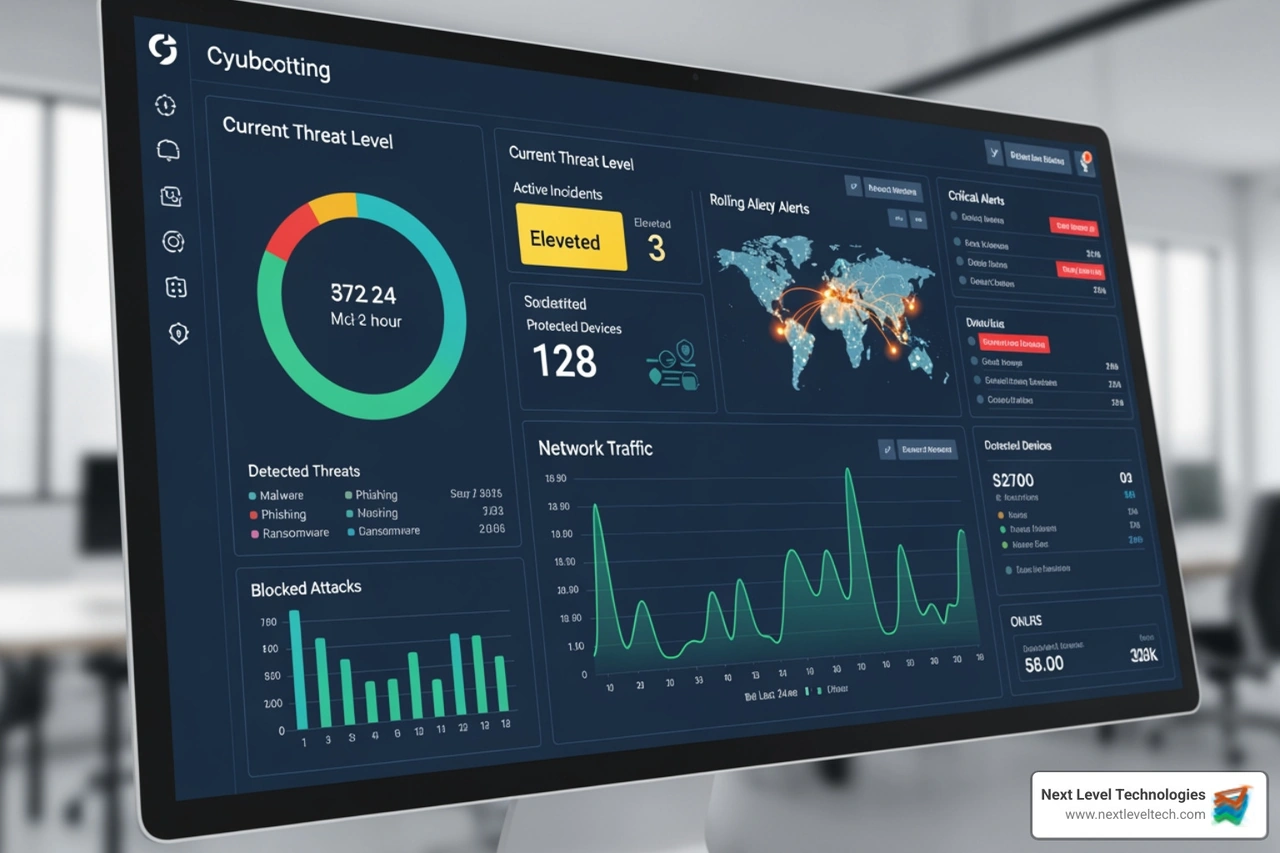
- 24/7 Monitoring and Threat Detection: We provide continuous oversight of your systems, identifying and neutralizing threats before they can cause damage. This includes AI-powered threat detection and automated response systems.
- Patch Management: We ensure all your software and systems are up-to-date with the latest security patches, closing vulnerabilities that cybercriminals often exploit.
- Data Breach Prevention: Through layered security, robust firewalls, endpoint protection, and employee training, we drastically reduce the risk of data breaches.
- Compliance Management: For industries with specific regulatory requirements (like HIPAA or PCI-DSS), we help ensure your IT infrastructure meets these stringent standards, avoiding costly fines and reputational damage.
- Staff Cybersecurity Training: Human error accounts for a significant portion of security incidents. We offer training to empower your employees to be your first line of defense against phishing, malware, and other cyber threats.
- Proactive Monitoring Prevents Downtime: The average employee loses 15.3 minutes of work time to IT issues per day. Proactive monitoring and maintenance prevent small technical issues from turning into major outages, saving you countless hours of lost productivity.
Driving Revenue and Measuring ROI
The true value of robust b2b it support can be measured in tangible business outcomes.
- Experience-Led Growth: McKinsey research shows that experience-led growth companies achieve 5-10% revenue gains within two years. Superior IT support contributes to a better overall business experience, for both your employees and your customers.
- Customer Retention: Increasing customer retention rates by just 5% can boost profits by 25-95%. When your systems are reliable, your team is productive, and your data is secure, you can deliver exceptional service, which directly impacts customer loyalty.
- Service-Driven Revenue: Salesforce's 2024 State of Service Report reveals that 91% of organizations now track service-driven revenue, up from 51% in 2018. This highlights how critical IT support is to the sales and growth process.
- Impressive ROI: Forrester research demonstrates that modern customer service platforms deliver 315% ROI over three years with less than 6-month payback periods. This shows that investing in the right tools and partnerships pays dividends.
- Calculating Cost Savings vs. Downtime: Consider that agent interactions cost $8 on average while self-service costs only $0.10 per interaction. By implementing efficient IT support and proactive maintenance, we help you shift towards self-service where appropriate and reduce the frequency of costly agent interactions and, more importantly, costly downtime. The ROI is clear: faster responses lead to happier customers, better retention, and ultimately, more revenue.
The Role of AI in Modernizing B2B IT Support
Artificial Intelligence (AI) is rapidly changing the landscape of b2b it support, making our services even more efficient and effective. We leverage AI to augment our human experts, ensuring faster, smarter, and more proactive support for our clients in Columbus, Ohio, Charleston, WV, and Worthington, Ohio.
Here's how AI plays a role and its benefits:
- Automated Ticket Routing: AI can analyze incoming support requests and automatically route them to the correct Tier 1, 2, or 3 specialist based on keywords, urgency, and issue type. This drastically reduces response times and ensures your problem gets to the right person immediately.
- AI-Powered Response Suggestions: Our support agents can use AI to quickly draft accurate and consistent responses based on our knowledge base, speeding up resolution times and ensuring high-quality communication.
- Predictive Issue Detection: AI can monitor system logs and performance data to identify patterns that indicate a potential problem before it even occurs. This allows us to proactively intervene and prevent downtime, often before you even notice an issue.
- Knowledge Gap Identification: AI can analyze support interactions to identify common questions or recurring issues that aren't adequately covered in our knowledge base, helping us to continuously improve our self-service resources and agent training.
- Faster Response Times: HubSpot's 2024 State of Service Report shows 92% of CRM leaders report AI has improved response times, with 77% believing AI will handle most tickets by 2025. This underscores AI's immediate and future impact on service efficiency.
- Augmenting Human Experts: We view AI not as a replacement for our skilled technicians, but as a powerful tool that makes them faster, more informed, and more effective. It allows our experts to focus on complex problem-solving and strategic initiatives, while AI handles repetitive tasks.
How to Choose the Right B2B IT Support Partner
Choosing the right b2b it support partner for your business in Columbus, Ohio, Charleston, WV, or Worthington, Ohio, is a critical decision. It's about finding a team that not only understands technology but also understands your business.
Here's a checklist and some key considerations:
- Industry Experience: Does the provider understand the unique challenges and compliance requirements of your industry? We pride ourselves on catering to businesses in often-overlooked industries.
- Local Presence: While remote support is powerful, having a local presence means faster on-site response when needed and a team that understands the local business landscape.
- Scalability: Can the provider grow with your business? You need a partner who can adapt their services as your needs evolve, whether you're expanding or streamlining operations.
- Proactive vs. Reactive: Look for a partner that emphasizes proactive monitoring and preventative maintenance, not just fixing things after they break.
- Cybersecurity Expertise: Given the ever-increasing threat landscape, ensure their team has extensive cybersecurity training and offers comprehensive protection strategies.
- Clear Communication: Do they communicate in plain language, explaining complex technical issues simply?
- Service Level Agreements (SLAs): Insist on clear, measurable SLAs that define response times, resolution times, and uptime guarantees.
Essential Features of B2B IT Support Software
The tools your b2b it support partner uses are as important as their expertise. Modern B2B customer support software is designed to handle the unique complexities of business relationships.
- Omnichannel Communication: Your customers and employees communicate through various channels (email, chat, Slack, Teams, Discord). The software should unify these into a single platform, ensuring no request gets lost.
- Account Management Tools: Unlike B2C, B2B support needs to manage relationships at the account level, not just individual tickets. This means seeing all interactions related to a specific company, its multiple contacts, and its history.
- Developer-Friendly APIs: For seamless integration with your existing business tools (CRM, ERP, project management), robust APIs are crucial. This allows for custom workflows and data synchronization.
- Team Collaboration Features: B2B issues often require multiple specialists. The software should facilitate easy internal collaboration, ensuring quick handoffs and comprehensive solutions.
- Advanced Reporting: To measure ROI and continuously improve service, the software must provide detailed analytics on response times, resolution rates, customer satisfaction, and agent performance.
- Security Compliance (SOC2, GDPR): Given the sensitive nature of business data, the support software itself must adhere to stringent security and privacy standards.
Overcoming Common Challenges
Even with great support, challenges can arise. We help our clients in Columbus, Ohio, Charleston, WV, and Worthington, Ohio overcome these common problems:
- Slow Response Times: This is often a symptom of a reactive "break-fix" model or inefficient processes. Our tiered support and AI-powered routing are designed for rapid response.
- Recurring Issues: If the same problem keeps popping up, it indicates a lack of root cause analysis. Our strategic approach focuses on identifying and fixing underlying issues, not just symptoms.
- Lack of Strategic Guidance: Many businesses feel their IT provider is just a "fix-it" shop. We aim to be a strategic partner, offering vCIO services and aligning technology with your business goals.
- Hidden Costs: Unpredictable IT expenses can derail budgets. Our managed services model offers predictable monthly costs, changing IT into an operational expense (OpEx).
- Finding a Provider for Overlooked Industries: We specialize in providing comprehensive IT solutions that particularly benefit industries often overlooked by larger providers.
- The Cost of Poor Support: The financial ramifications of inadequate support are substantial. 51% of customers reduce spending after negative experiences, and U.S. businesses risk losing $856 billion annually due to poor customer service. By providing clear Service Level Agreements (SLAs) and proactive management, we ensure your IT support contributes positively to your business.
Frequently Asked Questions about B2B IT Support
What is the difference between managed IT services and break-fix support?
Managed IT services represent a proactive partnership where an external provider takes on the ongoing management, maintenance, and monitoring of your IT infrastructure for a predictable monthly fee. The focus is on preventing issues, ensuring optimal performance, and aligning IT with your business strategy. Break-fix support, on the other hand, is a reactive model where you only call (and pay) when something breaks. While it might seem cheaper upfront, it often leads to more frequent downtime, higher unpredictable costs, and a lack of strategic IT planning. For businesses in Columbus, Ohio, and Charleston, WV, managed services typically offer 25-45% cost savings compared to in-house IT and significantly reduce downtime.
How fast should I expect a response from my IT support?
Response times should always be clearly defined in your Service Level Agreement (SLA) with your IT provider. For critical issues that impact multiple users or halt business operations, you should expect a response within 15-30 minutes. For high-priority issues affecting a single user, a response within 1-2 hours is common. For low-priority issues or general inquiries, a 4-8 hour response time is generally acceptable. We prioritize rapid response and resolution, understanding that every minute of downtime costs your business.
Can a smaller business afford comprehensive B2B IT support?
Absolutely! In many cases, outsourcing b2b it support through a managed services model is significantly more cost-effective for small to mid-sized businesses than hiring and maintaining an in-house IT team. An internal IT manager's salary, benefits, training, and tools can be a substantial overhead. By partnering with a managed service provider like us, you gain access to a full team of experts across various specializations (cybersecurity, networking, cloud, helpdesk) for a predictable monthly fee. This allows you to leverage enterprise-grade expertise and technology without the high overhead, often resulting in overall IT cost reductions of 25-45%. This model empowers smaller businesses in Columbus, Ohio, Charleston, WV, and Worthington, Ohio, to compete on a level playing field with larger enterprises.
Conclusion: Your Partner in Technological Growth
In an era where technology is the backbone of every successful enterprise, robust b2b it support is no longer a luxury—it's a fundamental necessity. We've seen how the shift from reactive "break-fix" to proactive, strategic IT management can transform businesses, driving growth, enhancing security, and boosting productivity.
For us, it's about being more than just a vendor; we aim to be your trusted technology partner. Our expertise in Columbus, Ohio, Charleston, WV, and Worthington, Ohio, combined with our team's extensive cybersecurity training and commitment to understanding your unique business needs, allows us to deliver custom solutions that truly make a difference. We ensure your technology is an invisible engine of profit, not a suffocating bottleneck.
Don't let IT complexities impede your success or expose your business to unnecessary risks. Accept the strategic value of modern b2b it support and empower your team to achieve more.
Find out more about our managed IT services and IT support.