IT Support Blog

Insights
From Zero to Hero: Navigating the Challenges of an IT Support Career

From Zero to Hero: Navigating the Challenges of an IT Support Career

February 26, 2026

Written by

Why IT Support IT Matters More Than Ever for Your Business

IT support professionals working together - it support it

IT support IT is the backbone of modern business, yet it's an often-misunderstood career path. Here's what you need to know about navigating an IT support career:

Quick Overview: IT Support Career Path

  • Entry Point: Start as Tier 1 support for password resets and basic troubleshooting.
  • Mid-Level: Progress to Tier 2 for complex system and network issues.
  • Advanced: Move to Tier 3 as an expert on critical failures and infrastructure.
  • Specialization: Branch into cybersecurity, cloud computing, or IT management.
  • Education: High school diploma minimum; 52% have bachelor's degrees, 22% have associate degrees.
  • Key Certifications: CompTIA A+, Network+, ITIL Foundation.
  • Average Salary: $70,000 annually for IT support specialists.

Without reliable IT support IT, small tech problems cause significant productivity losses. In fact, IT outages can cost businesses more than $14,000 per minute.

IT support professionals are the unsung heroes keeping businesses running. They prevent disasters, protect data, and enable growth. From setting up new employee accounts to stopping cyberattacks, they handle the critical work that keeps technology humming.

More than just a fix-it role, IT support is an incredible launching pad for a tech career. It's where you learn how systems work, how businesses use technology, and how to solve real problems under pressure. This foundation is essential whether you aim to become a cybersecurity analyst, cloud engineer, or IT manager.

The demand for skilled IT support professionals is higher than ever. Companies struggle with outdated technology, system downtime, and cybersecurity threats. They need people who can fix problems and think strategically.

I'm Steve Payerle, President of Next Level Technologies. For over a decade, I've helped businesses in Columbus, Ohio, and Charleston, WV, build robust IT support IT teams and implement managed IT services. Our focus on extensive technical experience and cybersecurity training has shown me how a strong IT support foundation can launch incredible careers.
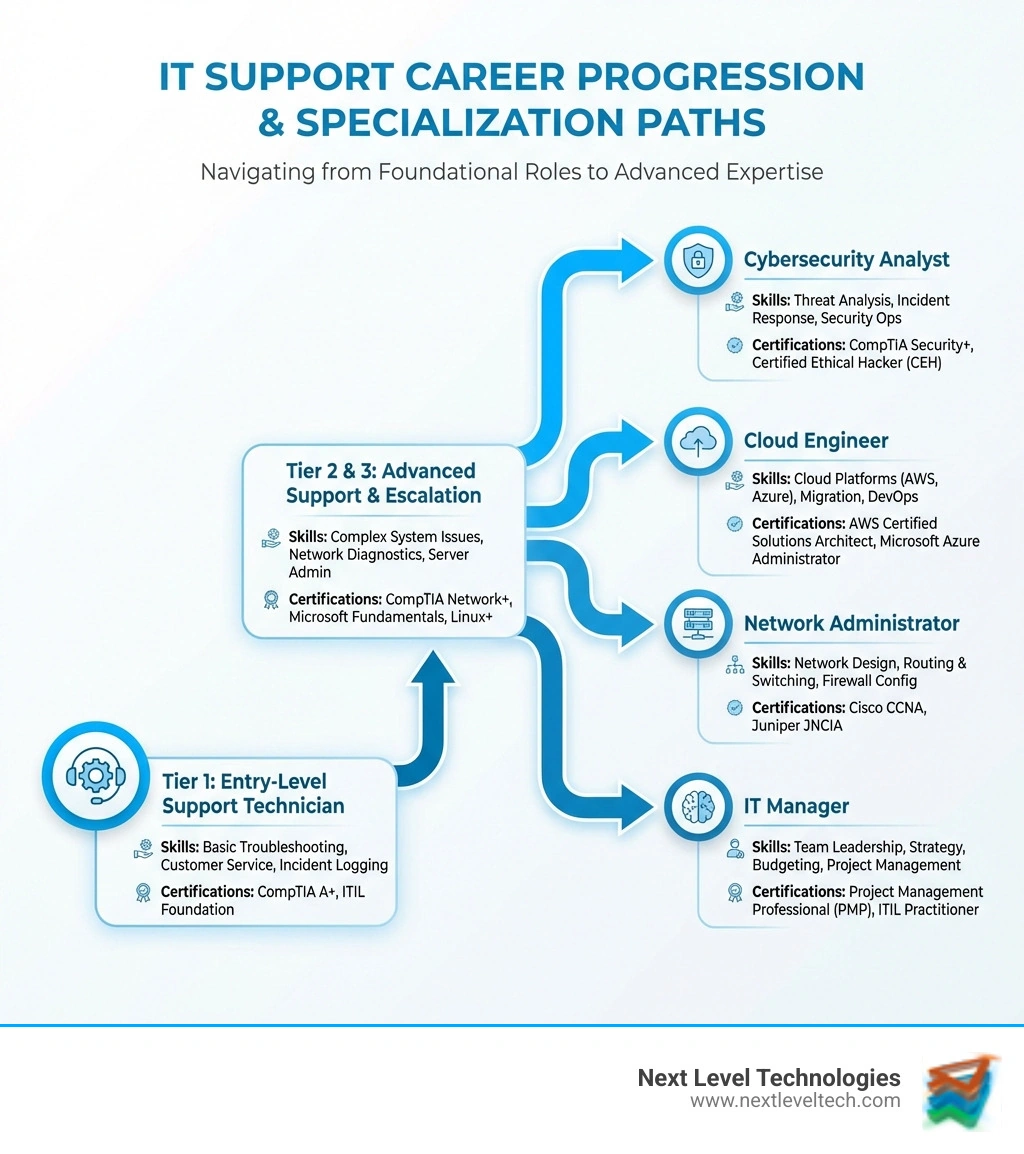
Infographic showing IT support career progression from Tier 1 support technician to specialized roles like cybersecurity analyst, cloud engineer, network administrator, and IT manager, with key certifications and skills needed at each level - it support it infographic

It support it terms you need:

What is an IT Support Specialist? The Unsung Hero of Modern Business

An IT support IT specialist provides technical assistance for computer systems, software, and hardware. They are frontline responders ensuring a business's technology operates seamlessly, which is critical for business continuity, efficiency, and productivity.

Every minute an employee struggles with a tech issue is a minute of lost productivity. Minimizing downtime is paramount, and that's where IT support specialists shine. They prevent small glitches from becoming costly crises. For businesses in Columbus, Ohio, and Charleston, WV, reliable IT Support for Small Businesses is a necessity. The impact is profound, as IT outages can cost businesses more than $14,000 per minute. An IT support IT specialist mitigates these risks, ensuring employees can focus on their core tasks.

What does an IT support specialist actually do?

The daily life of an IT support IT specialist is dynamic. They are problem-solvers, educators, and troubleshooters. Core responsibilities include:

IT support specialist helping an employee at their desk - it support it

  • Troubleshooting Hardware and Software: Diagnosing and resolving a wide array of issues, from malfunctioning printers to crashing business applications. As Coursera notes, an IT Support Specialist: Responsibilities, Skills, and How to Get Started assists users with common computer errors.
  • Software Installation and Configuration: Ensuring all software is correctly installed, updated, and configured to maintain compatibility and security.
  • Network Issues: Diagnosing and resolving connectivity problems to ensure stable and secure network access.
  • System Maintenance and Upgrades: Performing routine checks, applying patches, and upgrading systems to prevent future issues. This proactive approach is key to Comprehensive IT Support.
  • User Account Management: Setting up new user accounts, managing permissions, and handling password resets.
  • Onboarding New Employees: Ensuring new hires have the necessary hardware, software, and access to be productive from day one.

Help Desk vs. Service Desk: What's the Difference?

While often used interchangeably, "help desk" and "service desk" represent distinct approaches to IT support IT.

A Help Desk is typically reactive and incident-focused. Its primary goal is to fix things when they break (a "break-fix" mentality). It focuses on resolving immediate, individual user problems like a non-working printer or a login issue.

In contrast, an IT Service Desk is more strategic and service-focused. Built around the ITIL (Information Technology Infrastructure Library) framework, it acts as a single point of contact (SPOC) for all IT-related communications. It's user-centric and proactive, covering the entire IT service lifecycle to deliver value to the business.

Here's a table to highlight the key differences:

FeatureIT Help DeskIT Service Desk
Primary GoalFix incidents, restore service rapidlyProvide comprehensive IT services, improve UX
FocusReactive, incident managementProactive, service management, user-centric
ScopeIndividual issues, troubleshootingAll IT services, requests, problems, changes
ApproachBreak-fixStrategic, ITIL-aligned
ValueMinimizes immediate disruptionOptimizes IT operations, supports business goals
ExamplePassword resets, "my computer is frozen"Onboarding new employee, software deployment

Understanding this distinction helps businesses in Columbus, OH, and Charleston, WV, optimize their Help Desk vs Service Desk vs ITSM strategies for better service delivery and happier employees.

Your Roadmap: How to Become an IT Support Specialist

Starting a career in IT support IT is an exciting journey with significant growth potential. The path to becoming an IT Support Specialist is accessible and rewarding, whether you're a recent graduate or changing careers. Here are the essential steps.

Step 1: Get the Right Education and Training

Formal education and training provide a solid foundation for an IT support IT career.

  • High School Diploma: The basic requirement for most entry-level IT positions.
  • Associate Degree: An Associate's degree in IT or a related field is held by 22 percent of specialists, according to Zippia. These programs cover networking, operating systems, and more.
  • Bachelor's Degree: A Bachelor's degree can open doors to advanced roles. Zippia reports that 52 percent of specialists have one. A degree in a tech-related field and relevant certifications are often required.
  • Bootcamps and Online Courses: These offer a faster, more focused path into the field, providing practical, hands-on training in specific IT domains.

The goal is to gain a foundational understanding of hardware, software, and network principles.

Step 2: Master the Essential Hard and Soft Skills

An exceptional IT support IT specialist needs a blend of technical and interpersonal skills. At Next Level Technologies, we emphasize that our staff in Columbus, OH, and Charleston, WV, possess both deep technical knowledge and strong communication skills.

split screen showing technical code on one side and a person communicating empathetically on the other - it support it

Hard Skills (Technical Expertise):

  • Operating Systems: Proficiency in Windows, macOS, and Linux.
  • Networking Fundamentals: Understanding TCP/IP, DNS, DHCP, and wireless technologies.
  • Hardware Repair: Troubleshooting and replacing components in desktops, laptops, and servers.
  • Software Applications: Familiarity with business applications like Microsoft 365.
  • Cybersecurity Principles: Basic knowledge of threats, data protection, and secure remote access solutions.
  • Cloud Computing: Basic knowledge of platforms like AWS, Azure, and Google Cloud.

Soft Skills (Interpersonal Abilities):

  • Problem-Solving: Logically diagnosing issues and finding effective solutions under pressure.
  • Communication: Clearly explaining technical concepts to non-technical users.
  • Patience and Empathy: Maintaining a calm and understanding demeanor with frustrated users.
  • Customer Service: Providing a positive and supportive user experience.
  • Active Listening: Fully understanding the user's issue before acting.
  • Adaptability: A willingness to learn new tools and techniques as technology evolves.

Step 3: Earn Key Certifications to Validate Your Expertise

Certifications are industry-recognized proof of your skills. According to CompTIA, 79% of HR professionals rely on them during hiring. They can be vendor-neutral (foundational) or vendor-specific (specialized).

Here are some of the most impactful certifications for an IT support IT career:

  • CompTIA A+: The industry standard for entry-level roles, this vendor-neutral certification covers hardware, operating systems, networking, security, and troubleshooting.
  • CompTIA Network+: Validates the skills needed to establish, maintain, and troubleshoot networks on any platform.
  • ITIL Foundation: Focuses on best practices for IT service management (ITSM). An article by CIO explains how ITIL helps businesses manage risk and establish cost-effective practices. It's about how to deliver IT services effectively.
  • Other Certifications: Depending on your goals, consider CompTIA Security+, Microsoft Certified: Azure Fundamentals, or Cisco Certified Network Associate (CCNA).

For more options, explore the Best IT Support and Help Desk Certifications for 2024 and resources on IT Compliance Certifications.

Level Up: Understanding the Tiers of an "it support it" Career

The world of IT support IT is a structured hierarchy designed to handle technical issues efficiently. This tiered system is crucial for problem resolution and your career development in IT Careers.

Tier 1: Your Entry into the World of 'it support it'

Tier 1 (or Level 1) is the frontline of IT support IT and the typical starting point for aspiring professionals. It provides invaluable exposure to common user problems.

  • Frontline Support: Tier 1 technicians are the first point of contact for users, handling inquiries via phone, email, or chat.
  • Basic Issues: They resolve routine problems like password resets, basic software troubleshooting, and printer issues, often using a knowledge base.
  • Ticket Creation: They create and document issues in an ITSM Ticketing System, gathering crucial data for tracking and escalation.
  • Escalation: If an issue is too complex, they gather information and escalate it to the next support level.

Starting at Tier 1 hones your customer service skills and builds a foundational understanding of IT challenges.

Tier 2: The Technical Detective

Tier 2 (or Level 2) support involves more in-depth technical investigation. This is where the real detective work begins in IT support IT.

  • In-depth Troubleshooting: Tier 2 technicians tackle complex hardware, software, and network issues that Tier 1 couldn't resolve, using advanced diagnostic tools.
  • System-Level Problems: They often address problems affecting multiple users or critical systems, such as server errors or database connectivity.
  • Backend Support: They may analyze server logs and network configurations to find root causes.
  • Escalation Point from Tier 1: They serve as the escalation point for Tier 1, reviewing previous troubleshooting steps to continue the investigation.

Becoming a Tier 2 technician requires strong technical and analytical skills. As CompTIA notes, this role is about becoming a "technical detective." For businesses in Columbus, OH, and Charleston, WV, capable Tier 2 personnel are essential for effective Business Computer Support Columbus.

Tier 3 & Beyond: The Expert and Strategist

Tier 3 (or Level 3) represents the pinnacle of technical expertise within the IT support IT structure. Level 4 roles often involve external vendors for highly specialized issues.

  • Highest Level of Expertise: Tier 3 technicians are subject matter experts—senior engineers or architects with deep knowledge in domains like cybersecurity or cloud infrastructure. They handle the most critical problems.
  • Code-Level Analysis: For software issues, Tier 3 may involve reviewing code or engaging with development teams.
  • New Problem Resolution: They solve problems with no existing solutions, creating new processes for lower tiers.
  • Vendor Collaboration: They liaise directly with third-party vendors to resolve product-specific issues.
  • Strategic Role: Tier 3 professionals contribute to strategic planning, system design, and implementing new technologies, helping maintain the organization's IT Infrastructure and Security.

Advancing to Tier 3 signifies a mastery of technical skills and a strategic mindset, making these roles critical for an organization's long-term health.

The Modern IT Landscape: Specializations and Career Advancement

The field of IT support IT is evolving, offering diverse specializations. As businesses in Columbus, OH, and Charleston, WV, adopt complex technologies, the demand for specialized expertise grows.

  • In-house IT Teams: Dedicated departments providing support exclusively to their company's employees.
  • Outsourced IT Services: Businesses hire providers like Next Level Technologies to access a broad range of expertise. Our Outsourced IT Services offer comprehensive support.
  • Remote vs. On-site Support: While on-site support is vital for hardware, remote support offers flexibility and efficiency for resolving many issues.
  • Managed IT Services: A proactive approach where a provider like us manages a client's IT infrastructure for a subscription fee. Unlike "break-fix" models, Managed IT Services aim to prevent problems, which is ideal for IT Services for SMBs.

The Critical Role of IT Support in Cybersecurity

Every IT role is now a cybersecurity role. IT support IT professionals are the first line of defense against cyber threats. At Next Level Technologies, our teams in Columbus, OH, and Charleston, WV, receive extensive cybersecurity training because we know the stakes are high.

  • First Line of Defense: IT support is often the first to spot suspicious activity, like phishing attempts, preventing major breaches.
  • Phishing Detection and Education: They educate users on identifying social engineering tactics.
  • Patch Management: They ensure all systems and software are updated with security patches to close vulnerabilities.
  • Access Control: They manage user permissions to ensure only authorized personnel access sensitive data.
  • Incident Response: During a security incident, they help isolate systems and assist with recovery, a key part of any Cybersecurity for Business Complete Guide.

For businesses in Columbus, OH, and Charleston, WV, strong Cybersecurity Services Columbus begins with vigilant IT support IT professionals.

Career Paths and Earning Potential in 'it support it'

An IT support IT role is a launching pad for a rewarding tech career. The foundational skills you build are transferable to numerous specialized fields.

From an entry-level position, you can branch out into roles like:

  • Network Administrator: Managing an organization's network infrastructure.
  • Systems Engineer: Designing and managing complex IT systems and servers.
  • Cloud Specialist: Focusing on cloud platforms like AWS, Azure, or Google Cloud.
  • Cybersecurity Analyst: Specializing in protecting systems from cyber threats. Our staff's extensive cybersecurity training highlights this growing field.
  • IT Manager: Leading IT teams and aligning technology with business goals.
  • IT Consultant: Providing expert advice to businesses, as highlighted by IT Consulting in Columbus Ohio Can Drive Business Growth.

The earning potential is attractive. According to Glassdoor, the average salary for an IT support specialist is $70,000 annually, including additional compensation. This figure increases significantly with specialization and advancement.

Frequently Asked Questions about IT Support Careers

We often get questions from those looking to enter or advance in the IT support IT field. Here are answers to common inquiries, based on our experience helping businesses in Columbus, OH, and Charleston, WV.

What's the most challenging part of being in IT support?

The biggest challenges in IT support IT often involve:

  • Balancing Technical Tasks with Customer Service: IT support requires being both technically proficient and an empathetic communicator, especially when helping frustrated users.
  • Keeping Up with Rapidly Changing Technology: The tech landscape evolves quickly, demanding a commitment to continuous learning.
  • Time Management and Prioritization: Juggling multiple tickets and urgent requests requires effective prioritization under pressure.
  • Solving Ambiguous Problems: Diagnosing intermittent or poorly described issues requires persistence and keen detective skills.

Despite these challenges, resolving a complex issue is incredibly satisfying.

How important is cybersecurity knowledge for an entry-level role?

Extremely important. Every IT role is a security role. For anyone entering IT support IT, a foundational understanding of cybersecurity is a necessity, not a bonus.

  • Pervasive Threats: Entry-level specialists are the first to encounter common threats like phishing and malware.
  • First Line of Defense: Knowing how to spot a suspicious email or unusual system behavior can prevent a major data breach.
  • Compliance: IT support helps businesses in Columbus, OH, and Charleston, WV, adhere to compliance standards like HIPAA by following secure protocols.
  • Career Advancement: A strong cybersecurity foundation, like that provided by our extensive training at Next Level Technologies, creates a clear path to specialized security roles.

Can I get into IT support without a college degree?

Yes, absolutely. While a college degree is beneficial, it's not a strict prerequisite for an IT support IT career.

  • Certifications and Skills are Key: Industry certifications like CompTIA A+ and Network+ are highly valued and prove you have job-ready skills.
  • Experience Matters: Hands-on experience from internships, volunteer work, or personal projects demonstrates your passion and problem-solving abilities.
  • Practical Knowledge is Prioritized: Many companies, including Next Level Technologies, often prioritize practical knowledge and a problem-solving mindset over a formal degree for entry-level roles.

The key is to proactively acquire skills, earn certifications, and showcase your passion for technology.

Conclusion: Start Your IT Support Journey Today

The journey in IT support IT is a rewarding one, filled with continuous learning and the satisfaction of empowering businesses through technology. This career path offers stable employment and serves as a foundational stepping stone to nearly every other specialization in the tech industry.

The demand for skilled IT support IT professionals is consistently high. Companies like Next Level Technologies, serving businesses across Columbus, OH, and Charleston, WV, understand the invaluable contribution of these tech heroes. We pride ourselves on our skilled professionals, who possess extensive technical experience and a deep commitment to cybersecurity training.

Accept the challenge, cultivate your skills, and never stop learning. The world of IT support IT is waiting. A career in this field isn't just about fixing computers—it's about building the future.

Let us help you steer the complexities of modern business technology. Find out how our Managed IT Services and IT Support can transform your business and perhaps inspire your own IT career journey.

Next Level Technologies

Our Latest Blog Posts

The Best Security Compliance Services for Beginners

Master cybersecurity compliance. Explore top Security Compliance Services for beginners to secure data, build trust, and prevent penalties.

February 25, 2026

Don't Get Drilled by Downtime: Choosing the Best IT for Your Dental Office

Secure your dental practice from downtime & breaches. Discover expert IT services for dentists specializing in HIPAA, cybersecurity & dental software.

February 24, 2026