APM Explained Optimizing Your IT Application Portfolio
December 4, 2025


Learn how Healthcare Management Administrators Inc optimizes self-funded plans, provider networks, and clinical quality for employers.
October 17, 2026

Upgrade your healthcare claims management for maximum accuracy with Next Level Technologies, serving Columbus, Ohio and Charleston, WV.
October 10, 2026

Discover how a healthcare management services organization boosts practice efficiency, cuts overhead, and protects clinical autonomy.
October 3, 2026
December 4, 2025
IT application portfolio management is a framework that helps organizations identify, organize, and strategically manage all their software applications through a structured evaluation process. At its core, APM treats your business applications like a financial portfolio--continuously assessing their value, cost, risk, and alignment with your business goals to make informed decisions about which apps to invest in, maintain, or retire.
Key aspects of IT application portfolio management:
Many mid-sized businesses face a common challenge: their application landscape has grown chaotic over time. You might have multiple systems doing the same job, shadow IT that bypasses your security protocols, or legacy applications consuming budget without delivering value. Research shows that organizations now use an average of 130 SaaS applications, and over 20% of applications are completely unused yet still costing money.
The business case for APM is compelling. Organizations implementing structured application portfolio management have achieved cost savings exceeding $2 million through application rationalization alone. License optimization typically yields 30% savings on licensing costs, while infrastructure costs can be reduced by 45%. Beyond cost reduction, APM helps you mitigate security vulnerabilities, ensure regulatory compliance, and position your IT infrastructure to support digital change initiatives.
I'm Steve Payerle, President of Next Level Technologies, and over 15 years of leading managed IT services for businesses across Ohio and West Virginia, I've helped dozens of mid-sized companies untangle complex application landscapes and implement effective IT application portfolio management strategies that reduce costs and security risks. Our team's extensive cybersecurity training and technical expertise have been crucial in helping businesses gain control of their technology investments and align them with strategic goals.
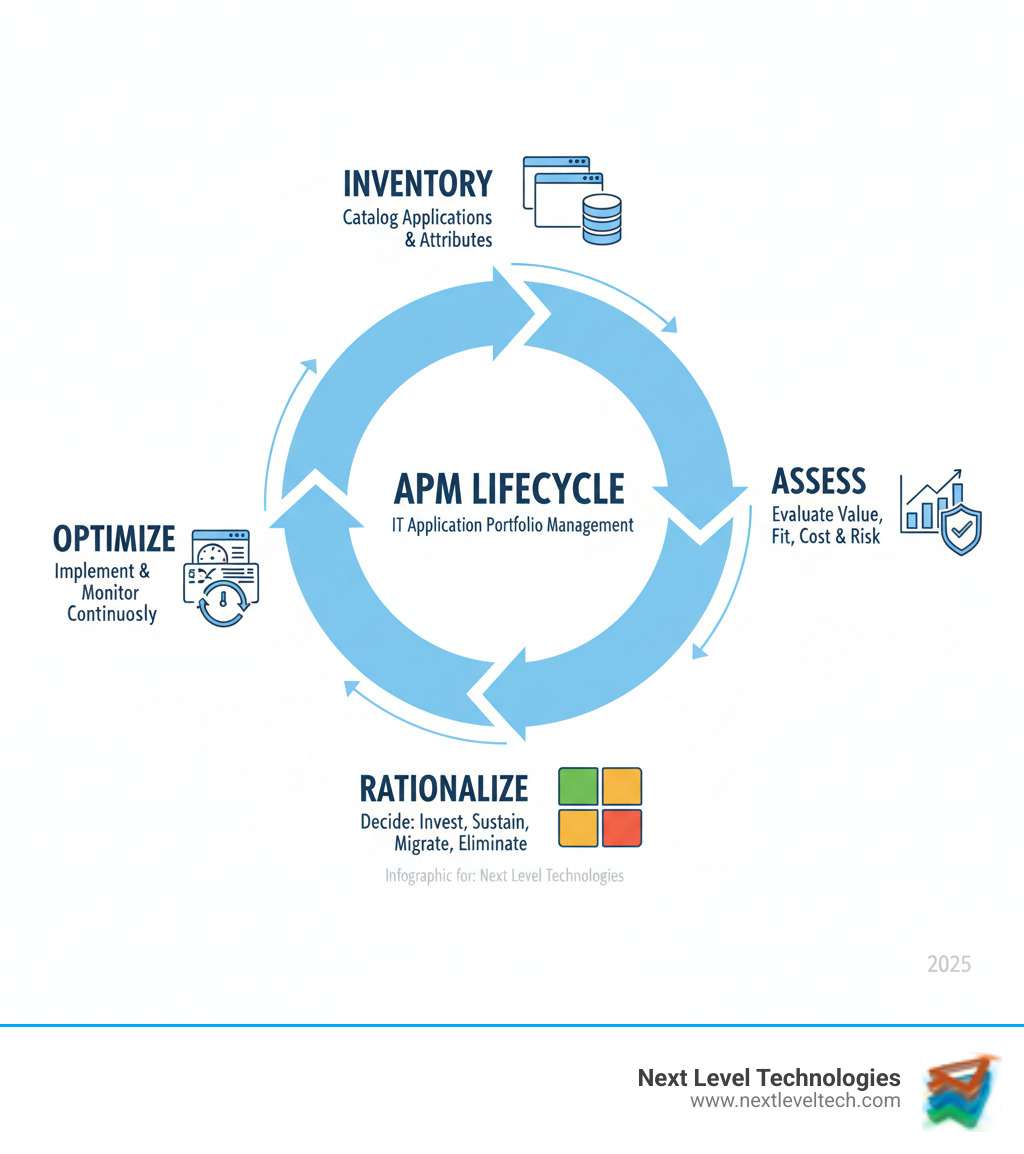
Let me paint you a picture. Imagine you're managing a financial investment portfolio--you've got stocks, bonds, maybe some mutual funds. You don't just buy them and forget about them, right? You regularly check which investments are performing well, which ones are dragging down your returns, and whether your overall portfolio still matches your financial goals.
IT application portfolio management works exactly the same way, except instead of stocks and bonds, you're managing all the software applications your business uses. APM is a strategic framework that helps you identify, organize, and continuously evaluate every application in your organization. You're asking the tough questions: Which apps are delivering real value? Which ones are costing more than they're worth? Which applications support where your business is heading, and which ones are holding you back?
Here's another way to think about it. Remember cleaning out your closet? Over the years, you've accumulated clothes--some are your go-to favorites, some looked great in the store but you've never worn, some don't fit anymore, and some are just plain outdated. Without regular cleanouts, your closet becomes cluttered. You can't find what you need when you need it, and you might even be paying for extra storage space filled with things you'll never use again.
Your application landscape works the same way. Applications accumulate over time through different projects, departmental purchases, mergers, and that one solution someone thought would solve everything three years ago. Without a structured approach to managing them, you end up with a cluttered, expensive mess that makes it harder to get work done.
The business case for APM is straightforward: an unmanaged application environment drains your budget, creates security vulnerabilities, and blocks innovation. When you implement IT application portfolio management, you gain transparency into what you actually have and what it's costing you. You can spot redundancies--like paying for three different tools that do the same job. You can identify which applications are critical to your business and which are just taking up space and budget.
APM helps you reduce IT complexity, gain visibility into your technology investments, and ensure every application actively supports your business capabilities. Our team at Next Level Technologies has seen this with clients across Columbus, Ohio, and Charleston, WV--businesses that thought they had 50 applications actually had 150, with significant overlap and waste. For a deeper look at the theoretical framework behind APM, check out this academic framework for APM.
So what are you actually trying to achieve with IT application portfolio management? Let's break down the four main goals.
Optimizing IT Investments and Reducing Costs is usually what gets leadership's attention first. Every application costs money--not just the license fees, but also maintenance, infrastructure, training, and support. APM helps you ensure every dollar spent delivers real value. You'll identify duplicate applications where three departments are paying for different tools that do the same thing. You'll find those applications nobody uses anymore but that are still auto-renewing every year. The goal is making smarter investment decisions and eliminating waste.
Aligning IT with Business Objectives is where APM becomes truly strategic. Your technology isn't just about keeping the lights on--it should actively support where your business is going. If you're planning to expand into new markets, APM helps you identify which applications will enable that growth and which legacy systems might hold you back. If you're focusing on improving customer experience, APM shows you which customer-facing applications need investment and which back-office systems can wait. It's about making sure your technology roadmap and business roadmap are heading in the same direction.
Mitigating Security and Compliance Risks is critical in today's threat landscape. When you don't know what applications you have, you can't protect them. APM gives you that clear, comprehensive view of your entire application ecosystem. You can identify outdated applications that no longer receive security patches, spot shadow IT that bypasses your security controls, and ensure you meet regulatory requirements. Our team's extensive cybersecurity training has shown us time and again that APM is foundational to a strong security posture. You can't defend what you don't know exists.
Fueling Digital Change and Innovation is the forward-looking goal. Digital change, cloud migration, modernization initiatives--all of these depend on understanding your current application landscape. APM helps you assess whether your legacy systems are ready for the cloud, identify capability gaps that new technology could fill, and plan your modernization journey strategically. It gives you the insights you need to calculate the ROI of new initiatives and reduce complexity before undertaking major changes.
Let's clear up some confusion. People often use IT application portfolio management, Application Rationalization, and CMDB interchangeably, but they're actually different tools that work together.
| Feature | Application Portfolio Management (APM) | Application Rationalization | Configuration Management Database (CMDB) |
|---|---|---|---|
| Primary Focus | Strategic oversight and continuous governance of the entire application landscape | Tactical project to analyze and optimize the portfolio at a specific point in time | Operational repository of IT assets and their relationships |
| Scope | Ongoing process covering business value, cost, risk, and alignment | Focused initiative to eliminate redundancy and reduce complexity | Technical inventory of configuration items and dependencies |
| Timeframe | Continuous, with regular reviews and updates | Time-bound project with defined start and end | Continuously updated operational database |
| Key Activities | Assessment, planning, governance, decision-making framework | Analysis, consolidation decisions, retirement, migration | Data collection, relationship mapping, change tracking |
| Primary Users | Business and IT leadership, enterprise architects, portfolio managers | IT leadership, project teams, business analysts | IT operations, service desk, change management teams |
| Outcome | Strategic roadmap and governance framework for applications | Rationalized portfolio with fewer, more effective applications | Accurate technical inventory supporting operations and change |
Think of it this way: APM is the ongoing strategic framework--the big-picture approach to managing your applications over time. Application Rationalization is a specific project you undertake as part of APM, where you dive deep to eliminate redundancies and optimize what you have. And CMDB is your operational database--the technical inventory that tracks the details of your IT assets and how they connect.
They work together beautifully. Your CMDB feeds data into your APM process, and your APM insights drive rationalization projects. At Next Level Technologies, we help businesses across Ohio and West Virginia implement all three effectively, because they each play an important role in managing your technology investments wisely.
Learn how Healthcare Management Administrators Inc optimizes self-funded plans, provider networks, and clinical quality for employers.
October 17, 2026
Upgrade your healthcare claims management for maximum accuracy with Next Level Technologies, serving Columbus, Ohio and Charleston, WV.
October 10, 2026
