The IT Support Startup Handbook: Your Blueprint for Success
December 26, 2025


Compare the best healthcare learning management platforms for providers with Next Level Technologies, serving Columbus, Ohio and Charleston, WV.
September 19, 2026

Compare cloud backup services with this guide to backup cloud database service architecture, security, and disaster recovery.
September 12, 2026

Compare cloud based backup services with our ultimate checklist covering encryption, recovery, and compliance for your business.
September 5, 2026
December 26, 2025
IT support for business is a booming industry, with over 90% of companies outsourcing their IT needs. For tech professionals, this presents a massive opportunity. Small businesses need reliable partners to manage everything from network security and help desk support to cloud services and cybersecurity—often at a fraction of the cost of an in-house team.
The need is urgent: nearly 40% of small businesses have faced a cyber attack, yet few are prepared. They need experts to protect their data, minimize downtime, and let them focus on their core operations.
To succeed, you'll need to:
I'm Steve Payerle, President of Next Level Technologies. Since 2009, I've built a trusted managed IT support for business operation serving companies across Columbus, Ohio, and Charleston, WV. Our team's extensive cybersecurity training and technical expertise have helped hundreds of businesses turn IT from a headache into a strategic advantage.
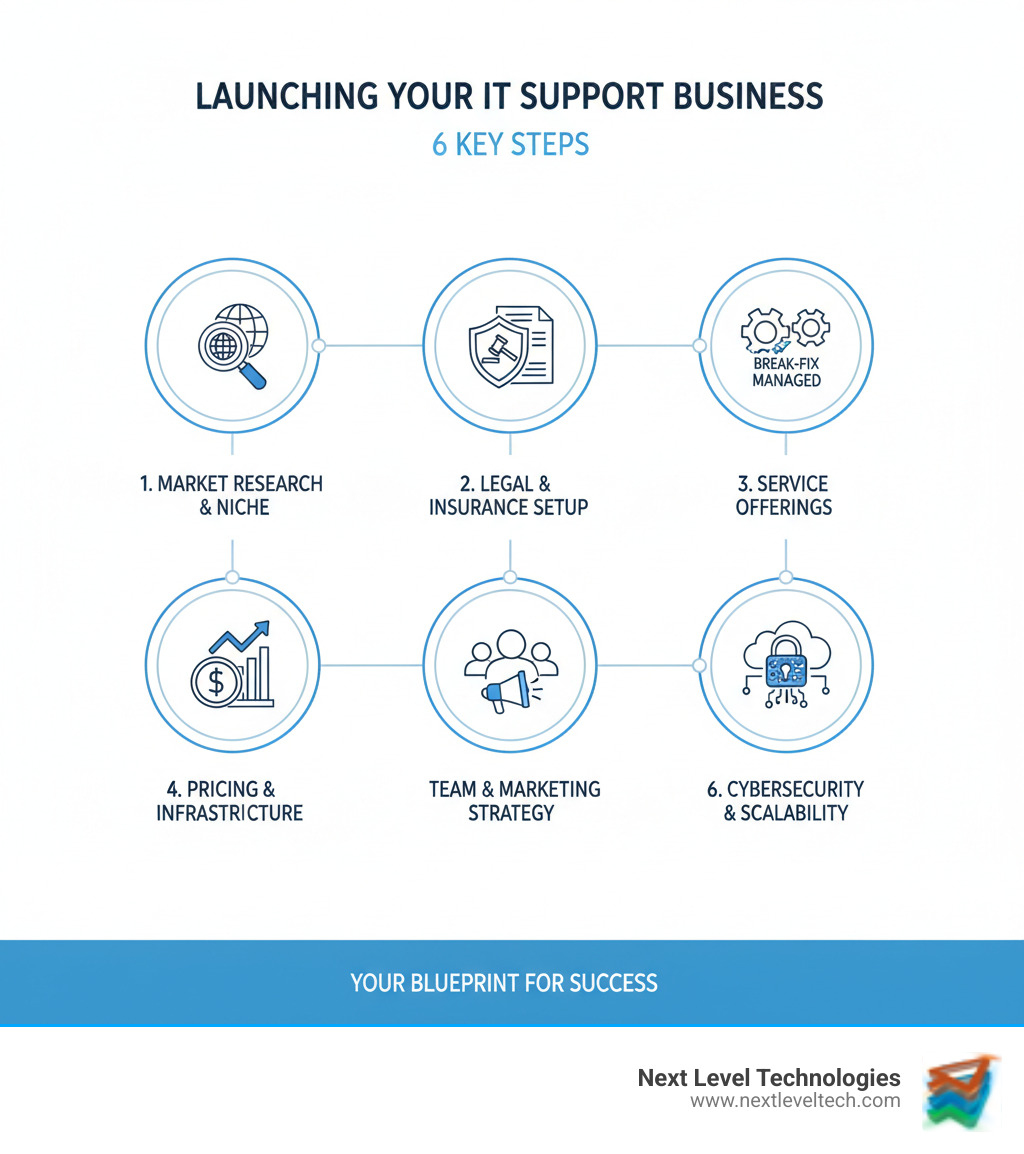
Before providing IT support for business, you need a solid foundation. This means understanding your target market, their specific needs, and completing the legal setup to protect yourself and your clients. The market opportunity is massive, with over 90% of companies outsourcing IT services. Small businesses, in particular, are vulnerable to cybersecurity threats and lack the resources for full-time IT staff, creating a significant opening for expert providers.
The key is to identify who you want to serve. Are you targeting IT Solutions for Startups or established companies needing IT Consulting Services for Small Business? Understanding their pain points allows you to create services that solve real problems.
Specialization sets you apart. Focusing on a specific industry or geographic area allows you to develop deep expertise that generalists can't match.
Getting your legal house in order is non-negotiable.
With a solid foundation, it's time to design your service offerings. This is about creating a menu of solutions that solve real business problems and support sustainable growth.
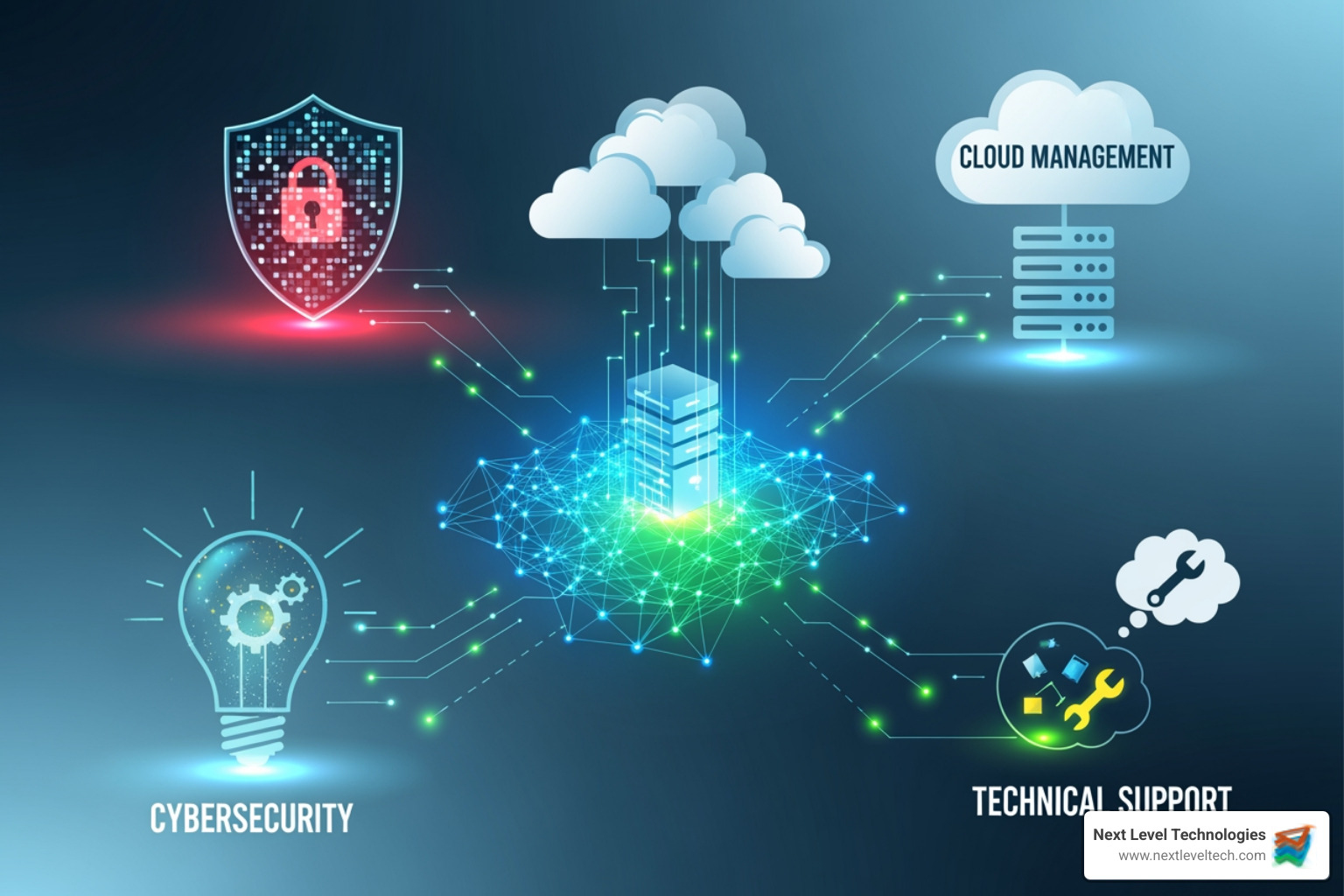
Most businesses providing IT support for business will need a core set of services to keep clients running smoothly.
These services are unified under a structured IT Service Management (ITSM) approach, aligning IT with business goals.
This is a critical decision for your business model.
The managed model transforms you into a strategic partner. Clients get predictable budgeting and minimal downtime, while you build long-term relationships with recurring revenue. What Can Managed IT Services Do For Your Business is to turn IT into an advantage. At Next Level Technologies, we've found this approach benefits everyone, allowing us to invest in the tools and training needed for exceptional Managed IT Services.
A modern IT support for business operation must be flexible, combining remote speed with hands-on capability.
Remote support allows for fast, cost-effective resolution of most software issues and configuration changes. Remote IT Support for Small Businesses is a game-changer, but it requires Secure Remote Access Solutions to protect client systems.
However, on-site support remains essential for hardware installations, complex network setups, and physical repairs. A hybrid model that leverages both remote efficiency and on-site presence is the winning strategy, ensuring you can tackle any challenge. Our team's technical experience allows us to handle both scenarios effectively.
Correct pricing is crucial for a sustainable IT support for business venture. You must be competitive enough to attract clients while charging enough to be profitable.
There is no one-size-fits-all approach. Consider these common models:
You can also price services individually. For example, Data Backup Solutions for Small Business might cost $50 to $150 per server per month. The key is to create packages that align with client needs and help them with IT Cost Optimization Strategies and IT Cost Reduction Strategies without sacrificing quality.
You can't support other businesses effectively if your own house isn't in order. Invest in the right tools from day one.
Building this IT Infrastructure for Small Business is a crucial upfront investment that enables you to deliver professional service and scale your business effectively.
Technology alone doesn't build a successful IT support for business—people do. Your team transforms technical solutions into valuable partnerships, and a smart marketing strategy gets those clients in the door.
When hiring technicians, look for more than just technical proficiency. The best technicians can explain complex issues in plain English and remain calm under pressure. Communication skills are just as critical as configuring a firewall. At Next Level Technologies, we pride ourselves on our team's extensive and ongoing cybersecurity training. This deep expertise is one of the key 7 Factors to Consider When Choosing an IT Support Company and is what allows us to keep clients safe from constantly evolving threats.
If nobody knows you exist, you can't grow. Effective marketing ensures businesses that need your help can find you.
A smooth onboarding process proves you were the right choice and sets the stage for a long-term partnership.
A great onboarding process feels like the beginning of a true partnership, not just a transaction.
Cybersecurity isn't just another service—it's the foundation of providing IT support for business. Protecting clients from threats while ensuring smooth operations is what makes you a strategic partner.

Small businesses are prime targets for attackers who know they often lack enterprise-level security. This is where we step in. With our team's extensive cybersecurity training and deep technical experience, we build resilient systems that proactively prevent problems, minimize downtime, and protect sensitive data.
As a partner, you become the client's cybersecurity team. This means constant monitoring, testing, and education to keep them safe.
Businesses evolve, and their technology needs grow with them. A scalable IT support for business provider grows alongside its clients.
We achieve this through flexible service plans that can be upgraded as a company expands. Our own scalable infrastructure in our Columbus and Charleston offices is built to handle growth, ensuring consistent service whether we're managing ten clients or a hundred.
Regular client reviews serve as strategic planning sessions where we discuss technology roadmaps and upcoming challenges. This advisory role is where our technical experience and extensive cybersecurity training provide immense value. We help clients make smart investments, manage their IT Asset Life Cycle, and handle vendor management to ensure all systems work together seamlessly. Our guide on How to Manage IT Vendors shows how this saves clients time and frustration.
By offering specialized services like Managed Cybersecurity Services and anticipating client needs, we build lasting partnerships. That's the difference between being a vendor and a trusted partner.
While profitability can vary, certain services consistently offer higher margins and recurring revenue potential. Managed services are typically the most profitable due to their recurring nature and proactive approach, leading to more stable client relationships. Cybersecurity consulting, especially given the rising threat landscape, is also highly lucrative. Cloud migration and management services, as businesses increasingly move to the cloud, offer significant opportunities. Finally, industry-specific compliance services (e.g., HIPAA for healthcare, SOC 2 for finance) can command premium pricing due to their specialized nature. Offering Managed Cybersecurity Services can be a strong differentiator.
Getting that first client is often the hardest step! Start by leveraging your personal and professional network. Inform friends, family, and former colleagues about your new venture. Join local business groups and chambers of commerce in Columbus, Ohio, and Charleston, WV, to network with potential clients face-to-face. Consider offering a free initial IT assessment or a limited-time introductory service to demonstrate your value. Partnering with complementary businesses, such as web design firms or business consultants, can also provide valuable referrals. Finally, ensure your online presence is solid, as many small businesses start their search for IT support for business online.
While not always legally required, certifications are incredibly valuable for building credibility and trust. They demonstrate a proven level of expertise and commitment to the industry. Common certifications like CompTIA A+, Network+, Security+, Cisco (CCNA), and Microsoft Certified: Azure Administrator, or specific cybersecurity certifications, can significantly improve your team's profile. Clients, especially those entrusting you with their critical IT infrastructure and sensitive data, will feel more confident knowing they're working with certified professionals. Our team's continuous training and certifications are a testament to our commitment to expertise.
Starting an IT support for business is an exciting and rewarding journey. We've covered the essential steps, from laying your foundation and defining your niche to structuring your services, setting prices, building your team, and excelling in critical areas like cybersecurity. The market demand is undeniable, and with the right approach, we can build a thriving business that makes a real difference for small and medium-sized enterprises.
Success in this field boils down to delivering exceptional value, fostering strong client relationships, and committing to continuous learning and adaptation. For businesses seeking a reliable partner with deep expertise in cybersecurity and managed services, providers like Next Level Technologies offer a blueprint for what a successful IT partnership looks like. We believe in changing IT from a challenge into a strategic advantage for businesses in Columbus, Ohio, and Charleston, WV.
Ready to take the next step in securing and optimizing your business's technology? Explore comprehensive Managed IT Services and IT Support with us today. We're here to help you achieve your next level of technological success.
Compare the best healthcare learning management platforms for providers with Next Level Technologies, serving Columbus, Ohio and Charleston, WV.
September 19, 2026
Compare cloud backup services with this guide to backup cloud database service architecture, security, and disaster recovery.
September 12, 2026

