Step-by-Step Guide to Finding a Remote IT Support Business
February 6, 2026


Compare the best healthcare learning management platforms for providers with Next Level Technologies, serving Columbus, Ohio and Charleston, WV.
September 19, 2026

Compare cloud backup services with this guide to backup cloud database service architecture, security, and disaster recovery.
September 12, 2026

Compare cloud based backup services with our ultimate checklist covering encryption, recovery, and compliance for your business.
September 5, 2026
February 6, 2026
A Remote IT Support Business provides technical assistance and IT management services to your organization remotely. Using secure internet connections, these specialized providers monitor, manage, and troubleshoot your IT infrastructure, offering a modern alternative to on-site support. Core services typically include 24/7 help desk, network security, data backup, cloud management, and proactive system monitoring. The key benefits are significant: lower costs compared to in-house teams, access to specialized expertise, reduced downtime, and scalability.
The demand for remote IT support has skyrocketed, with over 60% of businesses now outsourcing at least one IT function. As remote work becomes standard, companies need IT support that can resolve issues quickly, no matter where employees are. However, not all providers are equal. The wrong choice can lead to downtime and security risks, while the right partner acts as an extension of your team, protecting your data and keeping systems running smoothly so you can focus on growth.
I'm Steve Payerle, President of Next Level Technologies, and I've spent over 15 years helping businesses in Columbus, Ohio and Charleston, WV find the right Remote IT Support Business solutions to protect their operations and drive growth. Our team's extensive technical certifications and cybersecurity training have helped hundreds of organizations transition from reactive, break-fix IT to proactive, strategic technology partnerships.

Before searching for a Remote IT Support Business, it's crucial to understand your own needs and the benefits a partner can provide. This clarity ensures you find a solution that is a perfect fit for your business.
For growing businesses in Columbus, Ohio, and Charleston, WV, one of the biggest draws is cost savings. Hiring an in-house IT team is expensive, with the average salary for just one IT help desk operator exceeding $48,154, plus benefits and training. A remote partner provides a full team of specialists for a fraction of that cost.
Beyond savings, a great remote IT partner boosts productivity by minimizing downtime. System crashes and software issues are among the biggest productivity killers, grinding business to a halt. With quick responses and proactive monitoring, a Remote IT Support Business drastically reduces these interruptions. You also gain immediate access to a wide range of expertise, from cybersecurity to cloud management, ensuring complex problems are solved quickly. As your business evolves, your IT support can easily scale with you.
Finally, a skilled partner provides proactive maintenance, working to prevent problems before they start. Through constant monitoring and system checks, they keep your IT running smoothly, shifting your operations from a reactive to a strategic "always-on" model.
Want to learn more about how outsourcing can transform your IT operations? Dive into our guide on the Top 7 Benefits of Outsourcing IT Support.
Understanding a provider's core services is key to finding the right fit. These are the essentials:
These services ensure your IT not only functions but actively contributes to your success. For a closer look, check out our insights on IT Services for Small Businesses.
Partnering with a Remote IT Support Business offers transformative advantages for companies in Columbus, Ohio, and Charleston, WV.
To truly understand how much a complete IT partnership can do for you, check out what Managed IT Services can do for your business.

Now that you know why you need a Remote IT Support Business, let's cover how to find the right one. This is about building a relationship based on trust and proven expertise.
A provider's online presence is your first clue. Since 75% of people judge a company's credibility by its website design, look for a professional, modern site that clearly outlines their services, certifications, and experience. A strong local presence in areas like Columbus, OH, and Charleston, WV, is also a plus. Check for a Google Business Profile, as businesses with a listing are often seen as more trustworthy.
For more insights into how strategic IT planning can benefit your business, consider our expertise in IT Consulting for Small Businesses.
A provider's digital footprint reveals their professionalism and reliability. Start with their website—it should be easy to steer and clearly explain their services. Next, check their Google Business Profile and LinkedIn for recent activity and professional engagement.
Most importantly, read online reviews and testimonials. Since roughly 84% of people trust peer recommendations, the collective voice of past clients is a powerful indicator of quality. Look for consistent praise regarding their responsiveness, technical skill, and communication. While a few negative reviews are normal, pay attention to how the company responds, as it shows their commitment to customer service.
Once you've vetted their reputation, dig into their technical capabilities. Look for providers whose staff hold relevant industry certifications, as this demonstrates a commitment to staying current.
Crucially, a partner must have extensive cybersecurity training. At Next Level Technologies, our team undergoes continuous, specialized cybersecurity training to protect our clients from the latest threats. This level of dedication is non-negotiable when evaluating a potential partner.
Technical skills aren't enough; great IT professionals are also great communicators. During initial conversations, assess their ability to explain complex issues clearly and without jargon. A well-defined support process, including ticketing systems and escalation procedures, is another sign of expertise. This ensures your issues are tracked and resolved efficiently.
For those in Columbus, OH, Charleston, WV, and Worthington, OH, verifying these details is vital for a positive long-term IT support experience. Learn more about effective IT Support for Small Businesses.
Now it's time to look at the tools and processes a Remote IT Support Business uses to keep your operations secure and efficient. Their infrastructure is an extension of your own, so its robustness is critical.
Key technologies include Remote Monitoring and Management (RMM) tools, which allow them to proactively watch over your network 24/7 and flag issues before they become crises. This is paired with Ticketing/Helpdesk software to ensure every support request is tracked and resolved efficiently.
We also scrutinize their secure remote access tools. Since support is delivered remotely, these connections must be encrypted, use multi-factor authentication, and follow strict security principles. Finally, their knowledge of compliance frameworks (like HIPAA or PCI DSS) and internal data protection policies are non-negotiable. Our team at Next Level Technologies, with its extensive technical and cybersecurity expertise, understands these critical needs deeply.
For more on securing remote access, check out our insights on Secure Remote Access Best Practices.
The effectiveness of a Remote IT Support Business depends on its toolset.
This modern tech stack, managed by a team with extensive technical experience and rigorous cybersecurity training, ensures your IT environment in Columbus, OH, or Charleston, WV is actively protected.
For further reading on how to keep your remote operations secure, explore our Remote Work Security Solutions Guide.
When you grant a provider access to your systems, you're also sharing legal and compliance responsibilities. Your partner must understand and adhere to the regulations relevant to your business.
This includes data privacy regulations like HIPAA (for healthcare) or PCI DSS (for credit card data). Your partner must have policies in place to ensure compliance. Service Level Agreements (SLAs) are the legal backbone of the relationship, defining response times, uptime guarantees, and resolution targets. We'll cover these next. See also Service-level agreement.
Finally, ensure the provider carries adequate liability insurance and that you have a confidentiality agreement in place. These legal safeguards are a priority at Next Level Technologies, giving our clients in Columbus, OH and Charleston, WV complete peace of mind.
For a deeper understanding of digital threats, read our article on 5 Common Cybersecurity Threats to Small Businesses.
Now, let's discuss pricing. Understanding the models offered by a Remote IT Support Business is key to finding the right value-cost balance for your needs in Columbus, OH, or Charleston, WV. The goal is a transparent, predictable model that scales with your business.
The trend toward outsourcing IT has led to a variety of pricing structures. It's your job to analyze each one against your budget and growth plans, watching for hidden fees or inflexible terms.
For a comprehensive look at how outsourcing can benefit your business, explore our insights on Outsourced IT Services for Small Business.
Common pricing models for remote IT support include:
Per-user: You pay a fixed monthly fee for each employee who needs support. This is easy to budget for and scales well as your team grows. The downside: it may cost more than necessary if some users rarely need help.
Per-device: You pay based on the number of desktops, laptops, servers, or network devices being managed. This makes costs predictable based on your IT assets. But it can get expensive if your business has multiple devices per employee or unused devices still under management.
Tiered: The provider offers packages with different support levels, features, and response times. This gives you flexibility to choose a plan that fits your needs and budget. Just watch for plans that include services you do not need, or leave out services you do.
Flat-rate: You pay one all-inclusive monthly fee for IT management and support, usually within agreed limits. This is common with managed IT services. It offers predictable costs and encourages proactive maintenance, though it may look more expensive at first.
Per-incident: You pay for each individual support request. This can work for businesses with very few IT issues. But costs are harder to predict, and it does not encourage ongoing maintenance.
Hourly: You pay for the technician’s time. This can be useful for one-off projects or occasional support needs. However, costs can rise quickly, especially if problems take longer than expected to resolve.
The break-fix model is a reactive, "pay as you go" approach. While it seems economical, it discourages proactive maintenance and often leads to more downtime and higher long-term costs.
In contrast, the managed services model, which we at Next Level Technologies advocate, uses a fixed monthly fee for a comprehensive suite of proactive services. This includes monitoring, maintenance, and robust cybersecurity. This model aligns our goals with yours: we're motivated to keep your systems running smoothly to minimize issues. It provides predictable costs and peace of mind, knowing your infrastructure is actively managed by professionals with extensive technical and cybersecurity training. Always ask for a clear breakdown of what is and isn't included in any plan to avoid hidden costs.
The Service Level Agreement (SLA) is your guarantee of service quality. Don't just skim it—read it carefully. A strong SLA is the foundation of a successful partnership and should clearly define the following:
A transparent SLA protects both parties by setting clear expectations. At Next Level Technologies, our SLAs reflect our commitment to reliable, honest IT support for our clients in Columbus, OH, Charleston, WV, and beyond.
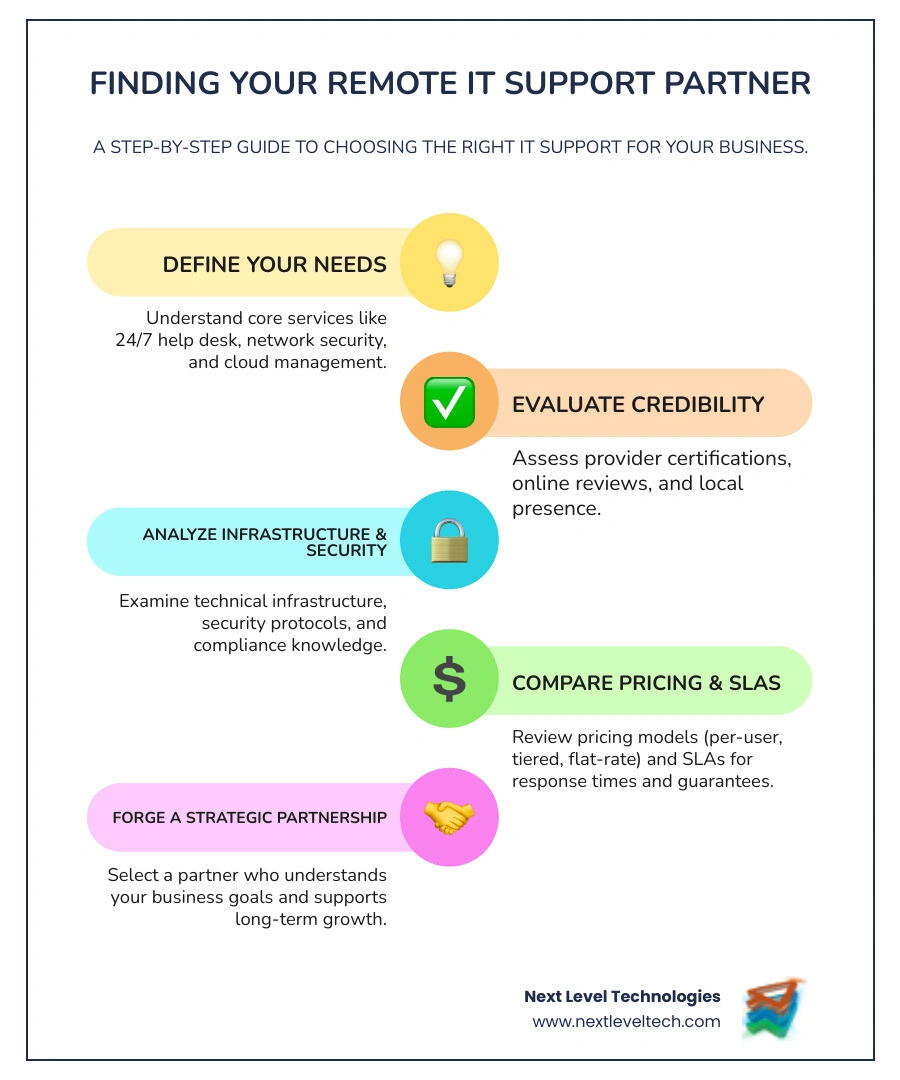
Finding the right Remote IT Support Business is a strategic decision. By following these steps—defining your needs, evaluating credibility, analyzing technical protocols, and understanding pricing—you can make an informed choice.
This isn't just about technology; it's about finding a partner you trust to protect your business and support your goals. For businesses in Columbus, OH, and Charleston, WV, a partner who understands the local landscape and invests in your success is invaluable.
At Next Level Technologies, this partnership approach is our foundation. For over 15 years, we've helped hundreds of organizations by providing proactive solutions. Our team's extensive technical certifications and rigorous cybersecurity training mean we stay ahead of evolving threats, building IT infrastructure that scales with your business.
The right partner delivers reduced downtime, improved security, and predictable costs, giving you the freedom to focus on what you do best. These are the competitive advantages that help businesses thrive.
Ready to experience what a true IT partnership feels like? Learn more about our Managed IT Services and IT Support and find how Next Level Technologies can help your business thrive in today's digital landscape.
Compare the best healthcare learning management platforms for providers with Next Level Technologies, serving Columbus, Ohio and Charleston, WV.
September 19, 2026
Compare cloud backup services with this guide to backup cloud database service architecture, security, and disaster recovery.
September 12, 2026
