Everything You Need to Know About Network Security IT Services
April 3, 2026


Discover how a healthcare management services organization boosts practice efficiency, cuts overhead, and protects clinical autonomy.
October 3, 2026

Master denial management in medical billing with proven strategies to reduce denials, boost appeals success, and protect revenue cycle performance.
September 25, 2026

Compare the best healthcare learning management platforms for providers with Next Level Technologies, serving Columbus, Ohio and Charleston, WV.
September 19, 2026
April 3, 2026
Network security IT services are the technologies, tools, and expert-managed practices that protect your business's internal networks, data, users, and applications from unauthorized access and cyberattacks.
Here's a quick summary of what these services typically include:
Every business with a network faces real risk. It only takes one weak password, one misconfigured firewall, or one wrong click to open the door to a breach. In fact, firewall misconfigurations alone are responsible for 99% of firewall-related breaches — a startling reminder that complexity without oversight is dangerous.
For mid-sized businesses especially, the challenge isn't just the threats themselves. It's managing an expanding network with limited IT staff, aging tools, and growing compliance demands — all at the same time.
I'm Steve Payerle, President of Next Level Technologies, and I've spent over 15 years helping businesses in Columbus, Ohio and Charleston, WV build resilient IT infrastructure through comprehensive network security IT services. Our certified team works hands-on with businesses every day to close security gaps, reduce downtime, and keep operations running safely.
Handy Network security IT services terms:
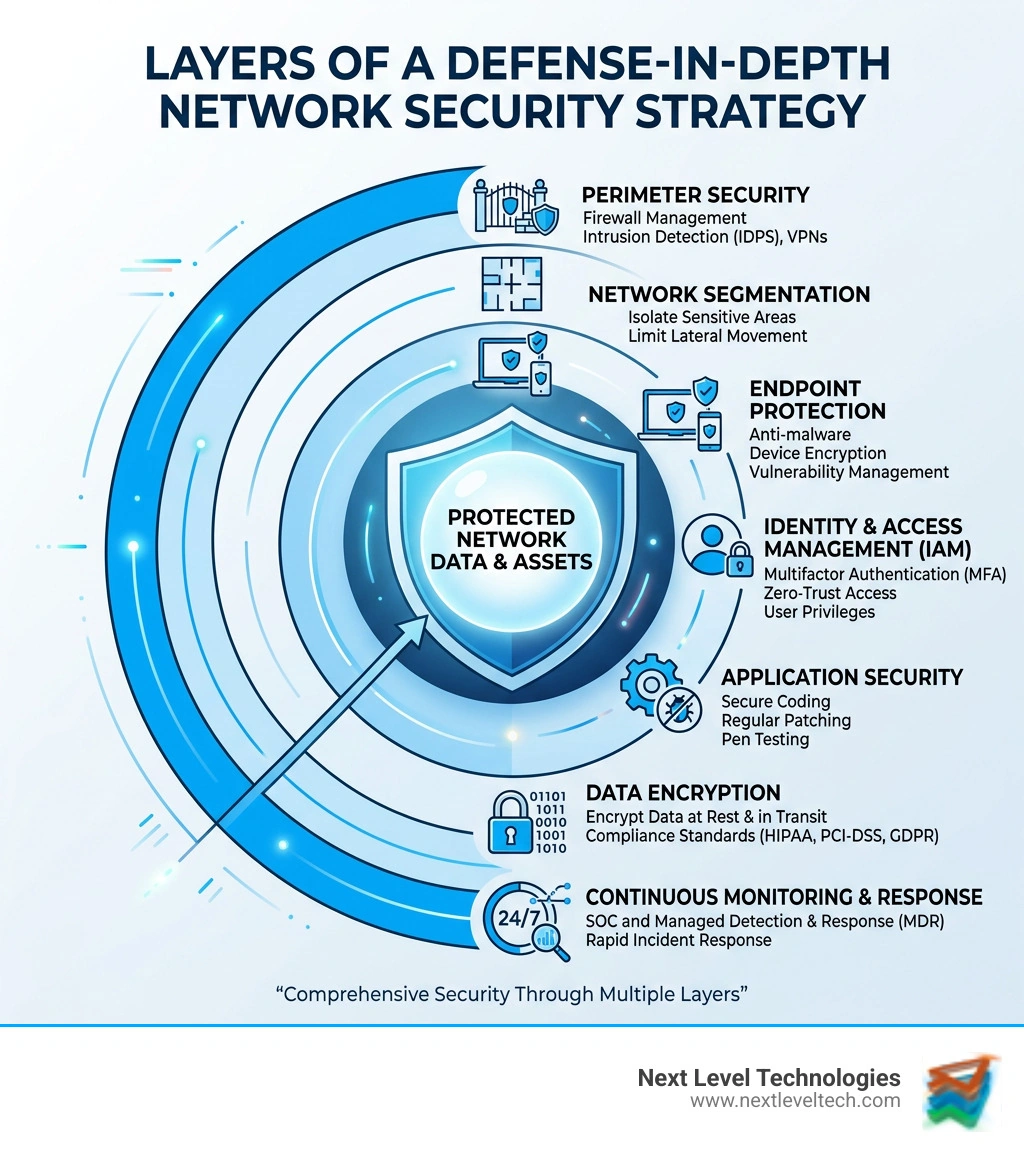
Building a secure network isn't about buying a single "magic" piece of software. It’s about building layers. Think of your network like a secure building: you need a perimeter fence, a front door lock, security cameras, and internal badges for different rooms.
A firewall is your network’s gatekeeper. It inspects incoming and outgoing traffic based on a set of security rules. Modern Next-Generation Firewalls (NGFWs) do more than just block ports; they perform deep packet inspection to catch malware hidden inside seemingly "safe" traffic. However, as we mentioned earlier, a firewall is only as good as its configuration. We often see businesses in Columbus and Charleston with powerful hardware that is essentially "wide open" because of a simple setup error.
If the firewall is the gatekeeper, the IDPS is the security guard walking the halls. Intrusion Detection Systems (IDS) watch for suspicious patterns, while Intrusion Prevention Systems (IPS) can actually take action to block an attack in progress. These tools are vital for stopping "living off the land" attacks where hackers use legitimate administrative tools for malicious purposes.
In the era of hybrid work, the "office" is everywhere. Whether your team is working from a coffee shop in Worthington or a home office in Charleston, they need a secure tunnel back to your data. The Basics and Benefits of Network Security show that a properly configured VPN ensures that sensitive data isn't intercepted over public Wi-Fi.
Not everyone in your company needs access to everything. A marketing intern shouldn't be able to browse the HR payroll server. Network Access Control (NAC) ensures that only authorized devices can connect, while network segmentation breaks your network into smaller "zones." If a hacker breaches one zone, segmentation prevents them from moving laterally through your entire system. For more details, check out our more info about security IT solutions.
Encryption turns your data into an unreadable code for anyone without the "key." While SSL/TLS is most commonly associated with web browsing (the "HTTPS" in your browser bar), it is a fundamental part of securing internal communications and file transfers.
Hardware firewalls are best for perimeter defense in physical offices, especially when protecting on-premise servers and local users. They can be effective, but scalability is limited by hardware capacity, and management often requires manual updates and physical maintenance.
Cloud-based security layers are better suited for remote users, SaaS tools, cloud-first environments, and hybrid workforces. They are more flexible, easier to scale, and typically managed through centralized consoles with automated updates.
When we talk about the deep technical "guts" of network security, we have to mention Network Security Services (NSS). This isn't just a generic term; it refers to a specific set of open-source libraries used to build secure applications.
NSS provides a complete implementation of security standards like TLS/SSL and S/MIME. It is the engine under the hood for many major applications, including Firefox. One of the reasons NSS is so widely trusted is its history of rigorous testing. For example, the NSS software crypto module has been validated five times for FIPS 140 conformance (in 1997, 1999, 2002, 2007, and 2010). It even passed the NISCC test suites, which involved running 1.6 million test cases of invalid input data to ensure the system wouldn't crash or leak data.
For businesses developing their own applications or using high-level enterprise tools, understanding these NSS release notes and documentation is essential for maintaining cross-platform interoperability and meeting PKCS standards. It ensures that your cryptographic protection is "military-grade" and compliant with federal standards.
Most small and mid-sized businesses don't have a 24/7 internal security team. That’s where managed network security IT services become a game-changer. Instead of just reacting when things break, we take a proactive approach.
For a deeper dive into how these pieces fit together, read our guide to cybersecurity for business.
The threats businesses face today are more sophisticated than the "Nigerian Prince" emails of the past. Today’s cybercriminals operate like professional businesses, often with their own help desks and R&D departments.
Ransomware is the "boogeyman" of the IT world. It encrypts your files and demands payment (usually in Bitcoin) for the key. Our approach to ransomware is multi-layered: we use AI-powered endpoint protection to stop the execution of ransomware and maintain "immutable" backups so that if the worst happens, we can restore your data without paying a cent.
Distributed Denial of Service (DDoS) attacks overwhelm your network with "garbage" traffic, knocking your website or servers offline. Modern network security IT services include filtering that can distinguish between a spike in real customers and a botnet attack.
A "Zero-Day" is a flaw in software that the manufacturer doesn't know about yet. Because there is no patch, you need behavioral monitoring to stop the attack. Meanwhile, phishing remains the #1 way hackers get in. We provide security IT solutions for small and mid-sized companies that include email filtering and employee training to spot these scams.
Sometimes the threat is inside the building. Whether it’s a disgruntled employee or just someone being tricked into giving away their password (social engineering), we use identity management and "least-privilege" access models to limit the potential damage.
If there is one statistic that should keep business owners up at night, it's this: firewall misconfigurations cause 99% of firewall breaches.
Modern networks are incredibly complex. Managing different rules for remote workers, cloud apps, and on-premise hardware is a recipe for human error. One small typo in a policy can leave a "backdoor" open.
To combat this, we utilize centralized management consoles and automated configuration tools. This gives us "global visibility"—the ability to see every rule on every device from a single screen. By reducing operational complexity and enforcing strict audit logging, we ensure that your security policy is actually being followed. For more on this, check out our cloud IT security best practices.
We are entering the "AI era" of cybersecurity. While hackers are using AI to write better phishing emails and faster malware, we are using AI to defend your network at "agentic speed."
The old model of security was "Trust, but Verify." The new model is Zero-Trust: "Never Trust, Always Verify."
In a Zero-Trust architecture, just because you are "inside" the office doesn't mean you are trusted. Every time a user tries to access a file or an application, the system checks their identity, their device health, and their location. This involves:
By integrating IT infrastructure and security, we create a digital resilience that can adapt to threats in real-time. AI-driven tools can observe 750 billion+ security events daily across global networks, allowing us to spot an "anomaly" (like a user in Columbus suddenly logging in from an IP address in another country) and block it instantly.
For many of our clients in Charleston, WV and Columbus, OH, security isn't just a good idea—it's the law. Different industries have different "rulebooks" they have to follow.
Maintaining these standards requires more than just a firewall; it requires constant documentation, data privacy governance, and regular cybersecurity services in Columbus to ensure nothing slips through the cracks.
Outsourcing to a Managed Service Provider (MSP) like Next Level Technologies gives you access to a team of experts that would be too expensive to hire in-house. You get 24/7 monitoring, a lower Total Cost of Ownership (TCO), and access to enterprise-grade tools (like AI-powered detection) that are usually only available to Fortune 500 companies. Plus, it allows your local team to focus on growing the business instead of fighting fires.
As mentioned, 99% of firewall breaches are due to misconfigurations. A misconfigured firewall is like having a $1,000 deadbolt on your front door but leaving the window next to it wide open. It leads to unauthorized access, compliance failures, and data exfiltration. Managed network security IT services ensure that policies are audited and updated regularly to prevent these gaps.
If you suspect a breach, every second counts.
At Next Level Technologies, we believe that high-level security shouldn't be reserved for the giant corporations. Whether you are a law firm in Columbus, a healthcare provider in Worthington, or a manufacturing plant in Charleston, WV, your data is your most valuable asset.
Our team prides itself on technical experience and extensive cybersecurity training. We don't just "set it and forget it." We partner with you to provide Managed IT Services (ITaaS) that evolve as the threat landscape changes. From AI-powered monitoring to Zero-Trust architecture, we make sure your network is a fortress, not a liability.
Ready to see where your network stands? Secure your business with managed IT support and let’s start a conversation about protecting your future.
Discover how a healthcare management services organization boosts practice efficiency, cuts overhead, and protects clinical autonomy.
October 3, 2026
Master denial management in medical billing with proven strategies to reduce denials, boost appeals success, and protect revenue cycle performance.
September 25, 2026
