IT Support Blog

Insights
All About IT Demand Management Tools: Compare Top Options

All About IT Demand Management Tools: Compare Top Options

July 25, 2026

Written by

The Fastest Way to Compare IT Demand Management Tools

IT demand management tools help organizations collect, prioritize, and act on technology requests — before they pile up, burn out your team, or derail your budget.

Here is a quick look at the top options covered in this guide:

  • ServiceNow Demand Management - Best for large enterprises needing deep integration with ITSM and Strategic Portfolio Management
  • Triskell Software - Best for organizations that need flexible PPM with strong resource capacity planning and global scalability
  • cplace IT Demand Management - Best for enterprises mapping IT demands directly to business capabilities and application portfolios
  • edison365 - Best for teams combining innovation management with IT demand tracking in a single platform

Keep reading for a full breakdown of features, use cases, and how to choose the right fit for your organization.

IT is no longer just a support function. It sits at the center of nearly every business decision. And as technology complexity grows, so does the volume of requests hitting your IT team — new projects, software upgrades, compliance needs, and infrastructure changes all competing for the same limited resources.

Without a structured system, strategic requests get lost. Priorities get set by whoever shouts loudest. Teams get overloaded. And leadership has no clear picture of where IT investment is actually going.

That is exactly the problem IT demand management tools are built to solve.

According to ITIL — the widely adopted IT service management framework — the purpose of IT demand management is to understand, anticipate, and influence customer demand for services. In practice, that means giving your IT team a structured way to receive, evaluate, and act on every incoming request before it becomes a bottleneck or a blind spot.

The challenge? Most IT departments are still managing this process through email threads, spreadsheets, and informal conversations. As one industry perspective puts it, without a centralized demand management tool, strategic requests inevitably fall into a "black hole" — creating a communication gap between the business and IT that is hard to recover from.
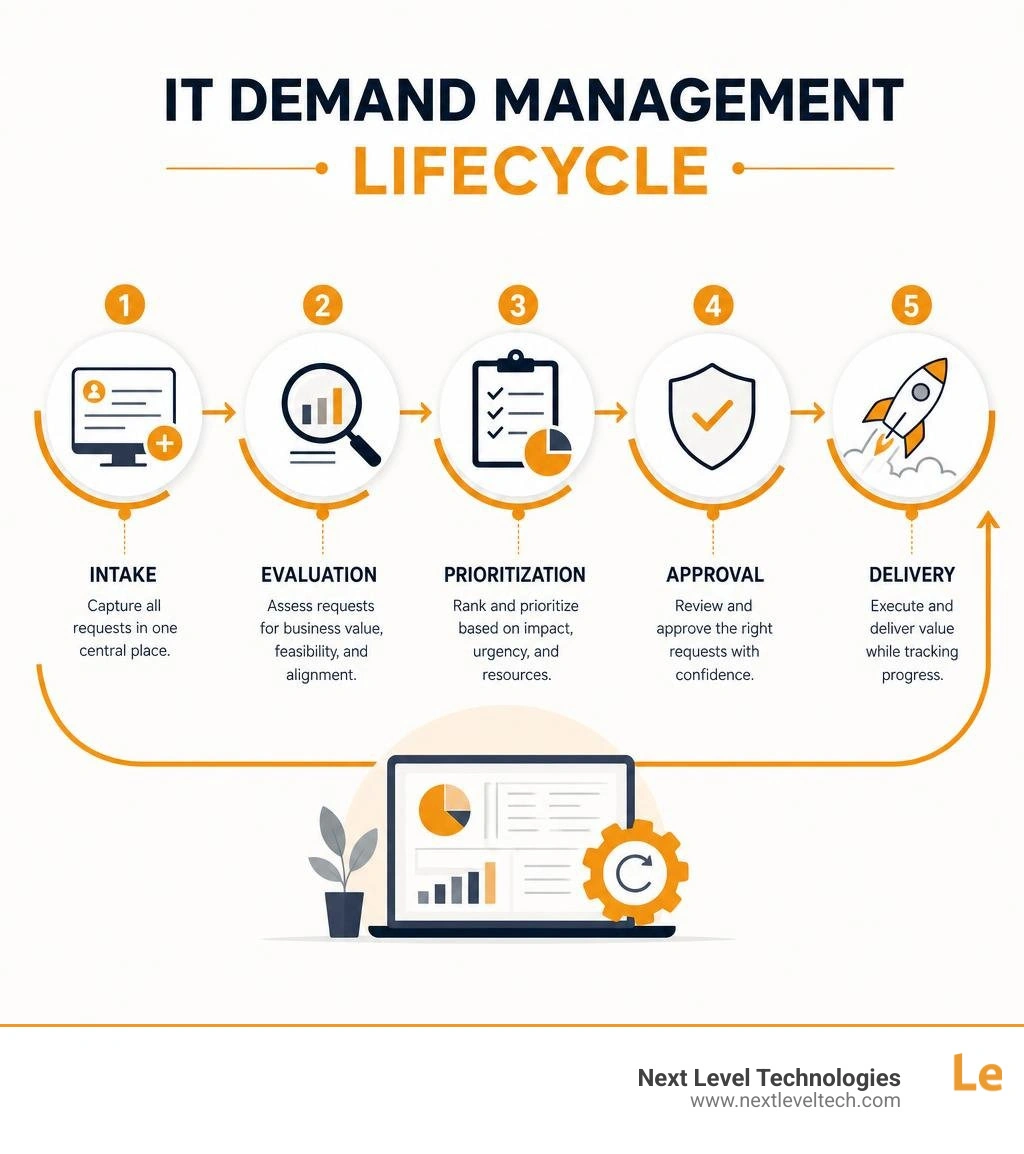
IT demand management lifecycle: intake, evaluation, prioritization, approval, delivery infographic

Simple guide to it demand management tools:

What is IT Demand Management and Why Does It Matter?

At its core, IT demand management is the process an organization uses to capture, evaluate, and prioritize all incoming technology requests. Instead of treating every request as an immediate "must-do," demand management introduces a layer of strategic evaluation. It helps you determine whether a request aligns with your business goals, what resources it will require, and whether you actually have the capacity to deliver it.

Without this process, IT departments face a constant barrage of competing priorities. This usually leads to several common operational headaches:

  • Resource Bottlenecks: Committing to too many projects at once, leaving your technical team overworked and projects stalled.
  • Shadow IT: When departments get frustrated by slow or unclear IT approval processes, they often go rogue, purchasing software and cloud services on their own. This introduces massive security risks and unmanaged costs.
  • Inconsistent Processes: Evaluating requests based on "gut feeling" or political influence rather than objective business value.

To manage this effectively, we categorize IT demand into four distinct buckets:

  1. Strategic Demand: Large-scale initiatives that drive long-term business growth, such as migrating core systems to the cloud or deploying a new enterprise platform.
  2. Tactical Demand: Medium-sized projects designed to improve specific business functions, like integrating a new marketing automation tool.
  3. Application Enhancements: Minor updates, new features, or modifications requested for existing software applications.
  4. Operational Demand: The day-to-day maintenance, security patching, and troubleshooting required to keep the lights on and systems secure.

By categorizing and centralizing these demands, you can balance the cost of a service against the strategic value it supports. This helps you transition from a reactive "firefighting" IT model to a proactive, value-driven strategy. For a deeper look at how this fits into your broader tech ecosystem, check out our IT Service Management Tools Ultimate Guide.

Industries and Roles That Benefit Most

While any technology-reliant business needs to manage demand, certain highly regulated and industries gain the most from deploying dedicated it demand management tools:

  • Healthcare IT: With strict HIPAA compliance standards and patient-care software updates constantly in demand, healthcare organizations must carefully vet every software request. They need to ensure that new tools do not compromise patient data security or disrupt critical workflows.
  • Professional Services: These firms rely on high operational efficiency. They use demand management to align software purchases and custom integrations with client-facing billable goals.
  • Non-Profits: Operating with tight budgets means every dollar must count. Non-profits use demand tools to justify technology spending, prevent software license leakage, and ensure their limited administrative staff is supported by the right systems.

Within these organizations, several key roles interact with demand management software daily:

  • IT Requirements Managers: Responsible for gathering request details, analyzing technical feasibility, and routing demands to the right stakeholders.
  • Business Relationship Managers (BRMs): Act as the bridge between business units and the IT department, helping departments articulate their needs and tracking request progress.
  • PMO Executives: Use portfolio dashboards to monitor budgets, resource allocations, and overall project health to report back to leadership.

Building an IT Demand Management Center

Implementing a successful demand management process is about more than just buying software; it requires setting up a virtual or physical IT Demand Management Center (ITDM Center). This center acts as the single "front door" for all technology requests across the organization.

To build an effective ITDM Center, we recommend focusing on several essential components:

  • A Unified Request Portal: This is the number one missing component in most organizations. Without a single portal, requests scatter across emails, chat messages, and hallway conversations. A unified portal ensures every request is captured with standard, required details (who, why, budget, timeline, and security implications) before any work begins.
  • An ITDM Service Desk: A dedicated team or role to study, analyze, and prioritize incoming demands, ensuring they are complete and feasible.
  • Data Cleansing and Standardization: Before importing your existing project pipelines into a new tool, clean up your data. Standardize how you define project sizes, risks, and strategic impact.
  • A Phased Rollout: Do not try to move the entire organization to a new demand system overnight. Start with a single department or request type, refine the workflow, and then scale it out.
  • Clear ROI Metrics: Measure success by tracking metrics like Mean Time to Resolution (MTTR) for requests, project delivery success rates, and the reduction of duplicate software licenses.

To learn more about setting up these user-friendly portals, explore our Service Management Software Complete Guide.

Key Features to Look For in IT Demand Management Tools

When evaluating it demand management tools, it is easy to get distracted by flashy interfaces. However, the right tool must solve your core operational challenges: predicting resource requirements, eliminating inconsistent processes, and aligning technology investments with business strategy.

A robust tool should provide a centralized demand workbench where stakeholders can visualize, evaluate, and track requests from intake to execution. Here are the key strategic features you should look for:

  • Resource Capacity Planning: The tool must give you real-time visibility into your team's current workloads and skills. This prevents resource overload and helps you proactively identify potential bottlenecks before approving new projects.
  • Scenario Modeling: What happens if a major compliance project suddenly takes priority? A good tool allows you to run "what-if" scenarios to see how shifting project timelines will impact your budgets and resource availability.
  • Customization and Workflows: Your tool should adapt to your business, not the other way around. Look for platforms that allow you to customize intake forms, approval routings, and user interfaces to match your existing workflows.

For more details on integrating these features with your daily operations, view our guide on ITSM Software.

Core Capabilities of IT Demand Management Tools

At a functional level, the software must automate the administrative burden of managing requests. Look for these core capabilities:

  • Intake Portals: Easy-to-use, wizard-based submission forms that guide business users to provide complete information up front.
  • Automated Routing: Pre-defined workflows that automatically send requests to the correct technical, security, financial, or department owners for review.
  • T-Shirt Sizing: A simplified way to estimate effort and cost (Small, Medium, Large, Extra Large) during the initial evaluation phase, keeping complex technical reviews from stalling early-stage ideas.
  • Scoring Matrices: Multi-dimensional scoring models that evaluate requests based on risk, business value, effort, and strategic contribution. This helps you objectively compare a security patch against a new software feature.

To see how these capabilities tie directly into managing your active software assets, check out our resource on IT Application Portfolio Management.

Integration Ecosystems for IT Demand Management Tools

An IT demand management tool cannot exist in a vacuum. To be truly effective, it must integrate seamlessly with your existing operational systems:

  • Project Portfolio Management (PPM): Once a demand is approved, it should transition smoothly into your PPM system as an active project, carrying over all historical notes, estimates, and stakeholder approvals.
  • IT Service Management (ITSM): Integrating demand with your ITSM service catalog ensures that routine operational requests (like hardware replacements) are handled efficiently, while larger strategic demands are routed to the PMO.
  • Financial Planning and CAPEX Governance: Linking your demand tool to financial planning software allows you to track capital expenditure (CAPEX) and operational expenditure (OpEx) in real time, ensuring projects remain within their approved financial envelopes.

Discover how to align these integrations with your technology budgets in our article on IT Cost Management Software.

Comparing the Top IT Demand Management Tools

Choosing the right software depends on your organization's size, technical maturity, and existing platform ecosystem.
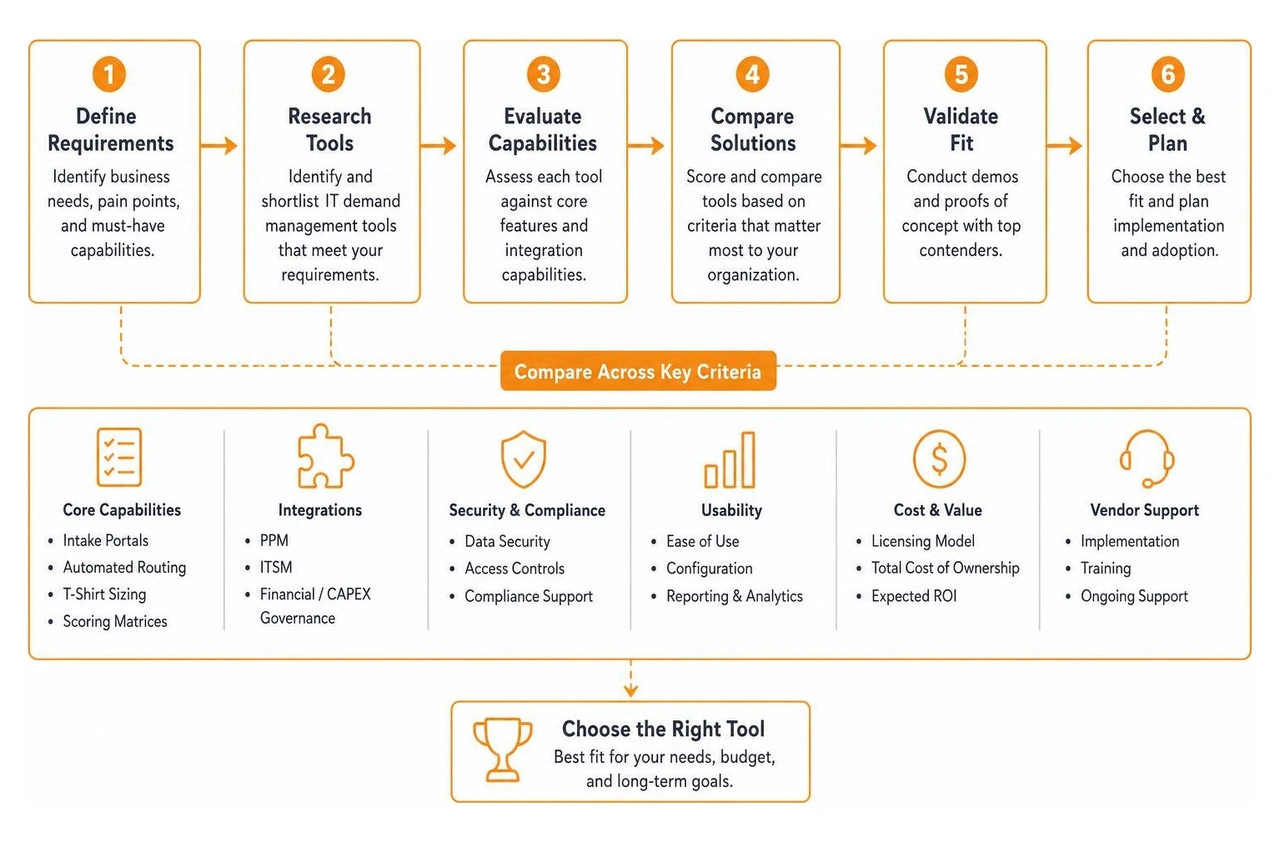
IT demand management software comparison process flow diagram

Below, we compare four of the leading it demand management tools on the market to help you identify the best fit for your team.

ServiceNow Demand Management

ServiceNow is a powerhouse in the enterprise space, particularly for organizations already utilizing its IT Service Management (ITSM) suite. Its Demand Management module is part of its broader Strategic Portfolio Management (SPM) offering.

  • Key Capabilities: ServiceNow excels at centralizing business, IT, and customer requests into a single pipeline. It features an interactive demand workbench, configurable bubble charts to visually compare risk versus reward, and timeline visualizations for tracking the backlog.
  • Use Cases: Best for large enterprises that want to link demand intake directly to their daily-use Service Catalog, downstream agile development pipelines, and change management workflows.
  • Deployment & Licensing: Cloud-based platform. Licensing is typically tied to broader SPM or platform-level user agreements.
  • Learn More: Read the official Demand Management - IT Demand Management - ServiceNow product page or download the Demand Management | Data Sheet - ServiceNow .

cplace IT Demand Management

cplace offers a highly flexible, platform-based approach to managing enterprise IT portfolios, placing a strong emphasis on connecting demand with enterprise architecture.

  • Key Capabilities: This tool allows you to map incoming IT demands directly to your existing business capabilities and application portfolios. It features collaborative dashboards, wizard-based request creation, and multi-dimensional evaluation tables using automated T-shirt sizing.
  • Use Cases: Ideal for organizations undergoing complex digital transformations that need to see the downstream impact of new technology requests on their current application stack before granting approval.
  • Deployment & Licensing: Highly customizable enterprise software requiring specific platform licensing.
  • Learn More: Explore the IT Demand Management | cplace solution overview.

edison365

edison365 is designed to bridge the gap between employee-driven innovation and structured IT execution, helping over 100 productive teams manage their technology pipelines.

  • Key Capabilities: It provides a highly visual platform that combines ideation, business case justification, and portfolio delivery. It features built-in templates, collaborative voting tools for crowdsourcing ideas, and Gantt charts for tracking active projects.
  • Use Cases: Perfect for organizations that want to foster a culture of innovation, allowing employees to submit ideas that can be systematically vetted, justified financially, and tracked through to completion.
  • Deployment & Licensing: SaaS deployment, often integrating natively with Microsoft 365 environments.

Triskell Software

Triskell Software is an industry-leading, enterprise-grade PPM and demand management solution supporting over 250,000 users globally with a 98% customer satisfaction rate.

  • Key Capabilities: Triskell excels at resource capacity planning, portfolio prioritization, and predictive modeling. It offers a highly configurable data model, customizable workflows, and personalized user interfaces that allow you to align the software with your specific business processes.
  • Use Cases: Best for mid-market to large organizations that need a flexible, standalone PPM tool to manage CAPEX investment portfolios, track rolling forecasts, and proactively identify resource bottlenecks.
  • Deployment & Licensing: Cloud-based SaaS model with flexible enterprise licensing.

Frequently Asked Questions About IT Demand Management Tools

How do IT demand management tools improve project prioritization?

These tools replace subjective "gut-feeling" decision-making with objective, data-driven scoring. By evaluating every request against a standardized matrix — comparing its strategic alignment, potential ROI, implementation risks, and resource requirements — stakeholders can clearly see which projects deliver the highest value.

Additionally, by integrating real-time resource capacity data, the software prevents teams from approving projects they do not have the manpower to deliver, eliminating bottlenecks before they start.

What is the difference between demand sensing and traditional forecasting?

Traditional forecasting relies almost entirely on historical data and static, rules-based statistical models to predict future technology and resource needs. While useful, it is highly reactive and struggles to account for sudden market shifts or unexpected disruptions.

In contrast, demand sensing leverages real-time, short-term data signals — such as current system performance, sudden market changes, or immediate capacity constraints — combined with machine learning algorithms to adjust forecasts autonomously. According to industry statistics, demand sensing can reduce forecasting errors by up to 50% and increase overall accuracy by up to 20%. For more on how AI is changing this landscape, read about Demand Planning Software Solutions Powered by AI .

How can mid-sized organizations leverage IT demand management tools without enterprise budgets?

You do not need a massive enterprise budget or a dedicated PMO team to start managing IT demand effectively. Mid-sized businesses can successfully implement these practices by focusing on a few key strategies:

  • Implement a Tiered Intake Model: Keep reviews light and simple for low-risk, routine purchases, while reserving detailed, strict reviews for high-cost projects or tools that touch sensitive data.
  • Standardize Workflows First: Before buying expensive software, map out your approval processes, intake questions, and scoring criteria using your existing systems.
  • Leverage SaaS and Managed Service Providers: Partnering with a local managed IT services provider allows you to access enterprise-grade demand management expertise, proactive cybersecurity reviews, and structured procurement workflows at a predictable monthly cost.

Conclusion

Managing the constant flow of technology requests does not have to feel like a losing battle. By implementing a structured IT demand management process and choosing the right supporting tools, your business can eliminate resource bottlenecks, stop shadow IT in its tracks, and ensure that every technology dollar spent directly supports your long-term goals.

At Next Level Technologies, we help small and mid-sized businesses across Columbus, OH and Charleston, WV take complete control of their technology estates. With over 20 years of local experience, our highly trained teams specialize in delivering proactive managed IT, enterprise-grade cybersecurity, and strategic technology planning tailored to your exact needs.

Whether you are a healthcare organization looking to keep your software updates compliant, a professional services firm seeking to streamline your systems, or a local non-profit striving to maximize a tight budget, we are here to help. Our staff undergoes extensive technical and cybersecurity training to ensure your operations stay secure, efficient, and ready to scale.

Ready to eliminate the technology guesswork and align your IT decisions with real business value? Let's build a structured, secure, and highly efficient technology roadmap together. Connect with our local team today to schedule your custom technology consultation.

Next Level Technologies

Our Latest Blog Posts

The Ultimate Guide to IT Lifecycle Management Software

Master it lifecycle management software with lifecycle tracking, automation, and secure retirement for hybrid IT environments.

July 17, 2026

The Definitive Guide to IT Support Services

Discover how an it support center delivers expert technical troubleshooting, security, and strategic value for your business.

July 9, 2026