Unlocking Efficiency: How Service Management Software Can Transform Your Business
January 29, 2026


Explore health service administration careers, leadership skills, degrees, salaries, and job outlook for modern healthcare executives.
October 24, 2026

Learn how Healthcare Management Administrators Inc optimizes self-funded plans, provider networks, and clinical quality for employers.
October 17, 2026

Upgrade your healthcare claims management for maximum accuracy with Next Level Technologies, serving Columbus, Ohio and Charleston, WV.
October 10, 2026
January 29, 2026
Service management software is a comprehensive digital solution designed to help businesses manage their field operations, IT services, and customer interactions from a single centralized platform. Whether you're dispatching technicians, tracking work orders, managing inventory, or handling IT support tickets, this software streamlines the entire service lifecycle—from initial customer request to job completion and invoicing.
Quick Answer: What Service Management Software Does
The challenge many mid-sized businesses face today is clear: outdated processes create bottlenecks. Field technicians wait for information. Office staff manually enter data multiple times. Customers get frustrated by slow response times. According to research by Microsoft, businesses implementing modern service management solutions see an average 346% return on investment over three years, with payback periods of less than six months.
Field service management software addresses these pain points by connecting everyone—from dispatchers to technicians to customers—in real time. It eliminates paper-based workflows, reduces manual errors, and ensures the right person gets to the right location with the right tools. For IT service management, the software centralizes support requests, automates ticket routing, and provides clear visibility into service level agreements.
The impact extends beyond efficiency. Companies using platforms like FieldEdge report saving 20+ hours per week on administrative tasks and 75% less time on reporting. Workiz users see productivity increases of 40% through automation. These aren't just numbers—they represent fewer overtime hours, happier employees, and customers who receive faster, more reliable service.
Modern service management software also addresses critical concerns like compliance and data security. With features supporting HIPAA, GDPR, and other regulatory standards, businesses can maintain audit trails, control access permissions, and ensure customer data stays protected. This is especially important as cyber threats continue to evolve.
Industries ranging from HVAC and plumbing to IT services and healthcare are adopting these solutions. The technology has matured beyond simple scheduling tools to become sophisticated platforms that leverage artificial intelligence, IoT sensor data, and predictive analytics. Companies can now anticipate equipment failures before they happen, optimize technician routes automatically, and provide customers with self-service portals that offer 24/7 access.
As Steve Payerle, President of Next Level Technologies, I've spent over 15 years helping businesses transform their operations through strategic technology solutions, including implementing service management software that addresses the unique challenges mid-sized companies face in managing both field operations and IT infrastructure. Based in Columbus, Ohio and Charleston, WV, our team has seen how the right platform—paired with proper implementation and cybersecurity protocols—can turn technology from a source of frustration into a competitive advantage.
Service management software terms at a glance:
At its heart, service management software is about bringing order to chaos. Imagine a busy day at your business: calls are coming in, technicians are out in the field, inventory is fluctuating, and customer expectations are high. Without a unified system, managing this intricate dance can be a nightmare. This software provides a centralized operation, acting as the brain that coordinates all activities.
For businesses with field operatives like plumbers, electricians, or HVAC technicians in Columbus, OH and Charleston, WV, this means bridging the gap between the office and the field. Dispatchers can assign jobs, track progress, and communicate vital information, while field teams receive everything they need on their mobile devices. This eliminates the need for endless phone calls, paper forms, and miscommunications.
Beyond field services, the scope extends to IT Service Management (ITSM). For us at Next Level Technologies, ITSM is critical. It involves a set of processes, policies, and tools to manage the delivery of IT services to customers. While traditional ITSM focuses on IT, modern service management software aims to connect all customer touchpoints across various departments, from HR and facilities to legal. This broader approach, often called Enterprise Service Management (ESM), uses the structured processes of ITSM to streamline services across the entire organization. This ensures a unified approach to service resolution, leading to a more satisfying customer experience, whether they're reporting a broken AC unit or a software bug. Learn more about IT Service Management (ITSM) and how it can benefit your business.

At the heart of any effective service management software are its core features, designed to automate and optimize every step of the service delivery process. These aren't just fancy add-ons; they're essential tools that empower your team and delight your customers.
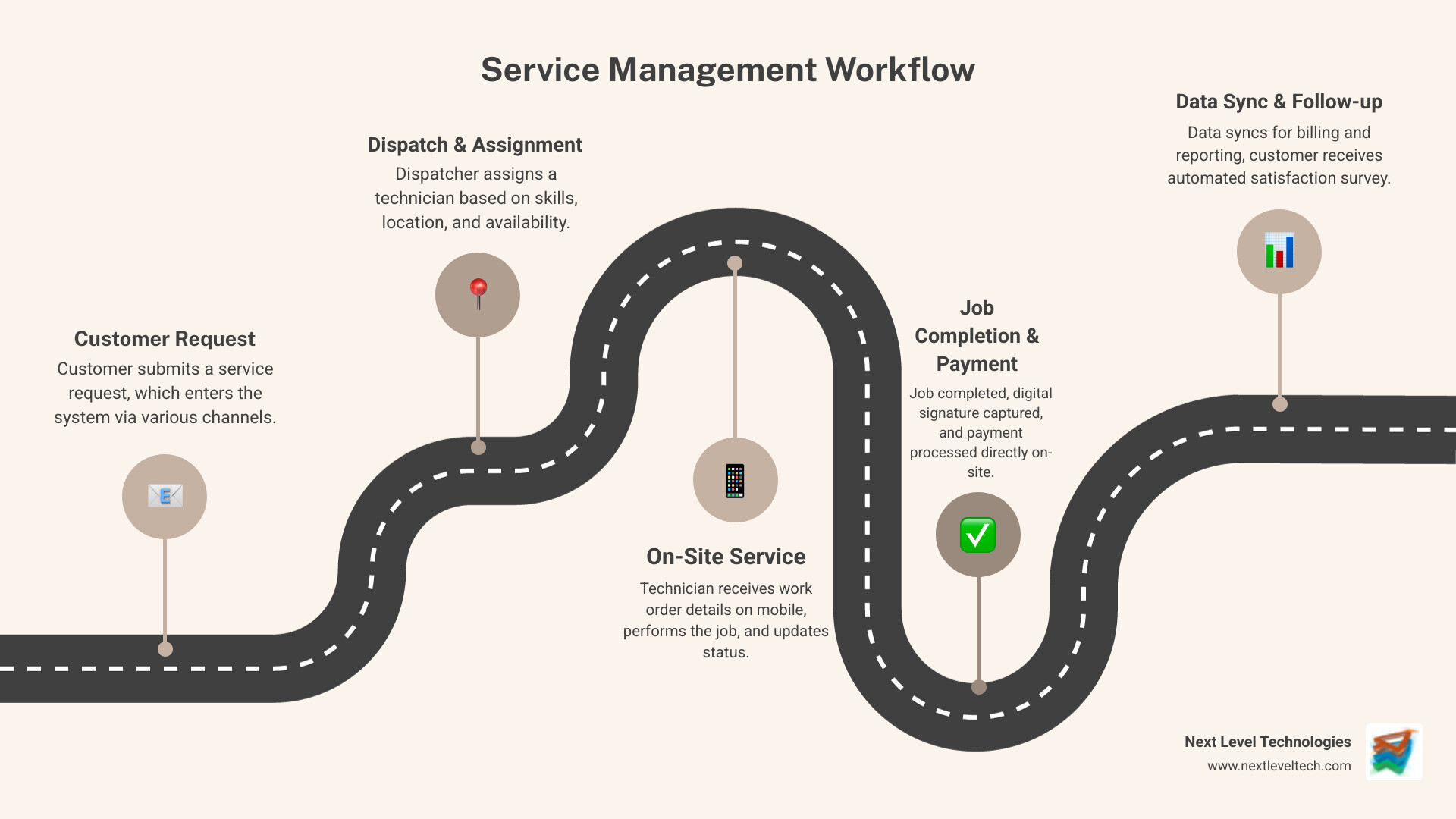
Work Order Management: This is where the magic begins. From the moment a customer requests a service, the software creates a digital work order. This order tracks everything: the customer's details, the nature of the issue, required parts, assigned technician, and status updates. It ensures that no job falls through the cracks and provides a complete audit trail from creation to invoicing.
Scheduling and Dispatching: Forget messy whiteboards and endless phone calls. Modern service management software offers intelligent scheduling. It optimizes technician routes based on location, traffic, real-time availability, and even technician skills. Dispatchers can see who's closest to an emergency call in Columbus, OH, or who has the specific expertise needed for a complex repair in Charleston, WV. This means faster response times and more efficient resource allocation.
Mobile Accessibility: Our field technicians are constantly on the move, so mobile access is non-negotiable. User-friendly mobile apps allow technicians to receive work orders, access customer history, update job statuses, take photos, collect signatures, and even process payments directly from their smartphones or tablets. Crucially, many apps offer offline capabilities, so work can continue seamlessly even in areas with poor internet connectivity, syncing updates once reconnected.
Inventory and Equipment Management: Running out of a critical part mid-job is a headache no one needs. Service management software helps track inventory levels in real-time, allowing businesses to manage stock, anticipate needs, and even order parts automatically. For equipment, it tracks asset health, maintenance history, and service interventions, enabling proactive maintenance and extending asset lifespans.
Customer Database (CRM): A robust customer database stores all client information, including contact details, service history, installed equipment, and communication logs. This ensures that every technician arriving on-site has a complete picture of the customer's needs and previous interactions, leading to a more personalized and efficient service experience.
Reporting and Analytics: What gets measured, gets managed. The software provides custom dashboards and detailed reports on key performance indicators (KPIs) like technician productivity, first-time fix rates, resolution times, and cost-to-serve. These insights are invaluable for identifying inefficiencies, optimizing operations, and making data-driven decisions that drive continuous improvement and profitability.
Effective service delivery hinges on seamless communication, and service management software is the ultimate facilitator. We've seen how improved communication can transform operations for our clients in Columbus, OH and Charleston, WV.
The software provides real-time updates on job statuses, technician locations, and customer interactions. This means everyone from the dispatcher to the CEO has an accurate, up-to-the-minute overview of operations. No more guessing games or frantic calls to locate a technician.
Features like dispatcher-technician chat allow for instant, direct communication, ensuring that field teams can quickly get answers to questions or report unexpected issues. This centralized information hub means that all relevant data—customer notes, equipment manuals, safety protocols—is accessible to those who need it, exactly when they need it.
Automated notifications keep everyone in the loop without constant manual intervention. Technicians receive alerts for new assignments or schedule changes, and customers can get automated updates on their service status, arrival times, and completion. This level of transparency builds trust and reduces inbound calls asking for updates. Understanding the distinctions between different support systems is also key; explore more about Help Desk vs. Service Desk vs. ITSM to see how these concepts fit together.
For IT departments, whether internal or external, an ITSM ticketing system within service management software is non-negotiable. It's the backbone of efficient IT service delivery.
When a user in Columbus, OH reports a software issue or a client in Charleston, WV needs a new laptop configured, a ticket creation and tracking system kicks into gear. This ticket captures all the details, assigns it to the appropriate IT specialist, and tracks its journey from submission to resolution.
Crucially, these systems facilitate SLA management. Service Level Agreements (SLAs) define the expected response and resolution times for different types of IT issues. The software monitors these agreements, ensuring that IT teams meet their commitments and alerting them if an SLA is at risk of being breached. This accountability is vital for maintaining customer satisfaction and trust.
Automation rules further streamline the process. Tickets can be automatically categorized, prioritized, and assigned based on keywords, user departments, or urgency. For instance, a "network down" ticket might automatically get routed to the highest priority queue and alert a specific network engineer. This reduces manual effort and speeds up initial response times.
Finally, knowledge base integration is a powerful feature. A well-populated knowledge base allows IT staff to quickly find solutions to common problems, reducing resolution times. It can also empower users to find answers themselves through a self-service portal, deflecting common requests and freeing up IT teams for more complex issues. For a deeper dive, check out our guide on ITSM Ticketing System. At Next Level Technologies, our highly trained staff, with extensive technical experience and cybersecurity training, are experts in implementing and managing these sophisticated ticketing systems, ensuring your IT operations run smoothly and securely.

Implementing service management software isn't just about getting a new tool; it's about fundamentally changing how your business operates. The benefits ripple through every aspect, leading to significant improvements in efficiency, productivity, and, ultimately, customer satisfaction.
Improved operational efficiency is one of the most immediate gains. By automating manual processes like scheduling, dispatching, and data entry, your team can achieve more with less. FieldEdge reports that their software can help businesses save 20+ hours per week on administrative tasks. Imagine what your team could do with an extra 20 hours! This isn't just about saving time; it's about optimizing workflows so that every minute is spent on value-added activities.
This directly translates to increased productivity. When technicians have all the information they need on their mobile device, routes are optimized, and administrative burdens are reduced, they can complete more jobs in a day. Workiz claims their automation features can increase productivity by 40%. This means more satisfied customers and a healthier bottom line.
Improved employee safety and compliance are also critical, especially for field service teams working in varied environments across Columbus, OH and Charleston, WV. Service management software can include features like real-time location tracking for emergency response, digital checklists for safety inspections, and the ability to access and complete compliance forms directly from the field. This not only protects your valuable employees but also helps your business adhere to industry regulations and labor laws.
Finally, resource optimization ensures that your inventory, equipment, and personnel are used to their fullest potential. By accurately tracking parts, equipment maintenance schedules, and technician availability, you can minimize waste, prevent costly downtime, and ensure that the right resources are always available for the job.
In today's competitive landscape, customer satisfaction is paramount. Happy customers become loyal advocates, and service management software is a powerful engine for achieving this.
One of the biggest impacts is on faster response times. When dispatchers can quickly identify the nearest available technician with the right skills, customers experience significantly reduced waiting periods. Gartner research highlights that greater customer satisfaction often results from faster response times and quicker fixes.
This also contributes to higher first-time fix rates. With technicians equipped with comprehensive customer history, access to manuals, and real-time support from the office, they're better prepared to resolve issues on the initial visit. This avoids frustrating callbacks and builds customer confidence.
Proactive communication is another game-changer. Instead of customers calling to ask for updates, the software can automatically send notifications about technician arrival times, job progress, and completion. Some systems even allow customers to track their service progress through a self-service portal. Gartner research emphasizes that proactive customer service is a key trend, helping to anticipate and address issues before they even become a problem.
Finally, the ability to provide personalized service based on a detailed customer database fosters a stronger relationship. When a technician knows a customer's service history, preferred communication methods, or specific equipment, it creates a custom experience that makes customers feel valued. This leads to increased customer loyalty and retention, which is invaluable for any business. For more insights on customer satisfaction and loyalty, you can refer to this Gartner research on customer loyalty.
Selecting the right service management software is a significant decision that can profoundly impact your business. It's not a one-size-fits-all solution, and what works for a large enterprise might not be the best fit for a growing business in Columbus, OH or Charleston, WV. We help our clients steer these choices, ensuring they pick a system that genuinely meets their needs.
One of the first considerations is the deployment model:
| Feature | Cloud-based Solutions | On-premises Solutions |
|---|---|---|
| Pros | - Lower upfront costs | - Full control over data and security |
| - Accessible from anywhere | - Customizable to a high degree | |
| - Automatic updates and maintenance | - No reliance on internet connectivity (for core functions) | |
| - Scalable (easily add/remove users) | ||
| Cons | - Reliance on internet connectivity | - Higher upfront costs (hardware, licenses) |
| - Less customization flexibility | - Requires internal IT staff for maintenance and updates | |
| - Data security depends on vendor | - Less accessible remotely | |
| - Subscription-based pricing can add up over time | - Scalability can be more challenging |
When making this choice, consider scalability (can it grow with your business?), ease of use (will your team adopt it quickly?), and mobile compatibility (is it truly field-friendly?). A complex system that nobody uses is just an expensive paperweight.
Integration capabilities are also paramount. Your service management software shouldn't operate in a silo. It needs to seamlessly connect with existing business systems like CRM (Customer Relationship Management) to manage customer interactions, accounting software (like QuickBooks) for billing and payroll, and ERP (Enterprise Resource Planning) systems for broader business functions. FieldEdge, for example, highlights its seamless integration with QuickBooks, ensuring no delays or mismatched data.
Cost considerations and ROI are always top of mind. While there's an investment, the returns can be substantial. Microsoft's study on Dynamics 365 Field Service showed a 346% ROI over three years with a payback period of less than six months. Other providers like FieldEdge report a 138% ROI in the first year. Look for transparent pricing models, whether it's subscription-based (per user, per job, or tiered) or a one-time license fee. Many offer free trials or free plans for smaller teams, like Connecteam which offers a free plan for up to 10 users.
Finally, don't overlook vendor support and training. A great product is only as good as the support behind it. Will the vendor provide adequate training for your team? What kind of customer service can you expect when issues arise? This is where a reliable partner like Next Level Technologies, serving businesses in Columbus, OH and Charleston, WV, can be invaluable.
Beyond the fundamental features, a few critical elements distinguish truly exceptional service management software.
Customization options are vital. Every business has unique workflows and needs. The best software allows you to tailor forms, fields, workflows, and dashboards without requiring extensive technical expertise, as highlighted by platforms like TeamDynamix. This ensures the software adapts to your business, not the other way around.
Data security and compliance cannot be overstated. For businesses dealing with sensitive customer data, adherence to regulations like HIPAA (for healthcare) or GDPR (for data privacy) is non-negotiable. The software should offer features like encrypted data storage, permission settings, and activity logs. At Next Level Technologies, we emphasize robust cybersecurity protocols as part of our managed IT services in Columbus, OH and Charleston, WV, ensuring that any service management software our clients use is protected against evolving threats. Our staff's extensive cybersecurity training ensures we can guide you through these complex requirements.
Finally, always consult user reviews. Real-world feedback from businesses similar to yours can provide invaluable insights into a software's strengths, weaknesses, and the quality of its support. For a comprehensive look at the various software options and how they fit into a broader IT strategy, explore our insights on ITSM Software.
The landscape of service management software is constantly evolving, with artificial intelligence (AI) and the Internet of Things (IoT) leading the charge. These aren't just buzzwords; they are technologies actively reshaping how services are delivered, making them smarter, faster, and more proactive.
Artificial Intelligence (AI) in service management is no longer a futuristic concept. AI agents are autonomous systems designed to gather data, make decisions, and execute tasks. They can adapt to new information and learn over time, automating complex workflows across IT, HR, and CRM. From intelligently assigning tickets to suggesting solutions, AI improves efficiency across the board.
One of the most exciting applications is predictive maintenance with IoT. Imagine a piece of equipment in a client's facility in Columbus, OH, transmitting real-time performance data. IoT sensors can monitor temperature, pressure, vibration, and other metrics. When the data indicates a potential issue or an impending failure, the service management software, powered by AI, can automatically create a work order, dispatch a technician, and even order the necessary parts – all before the equipment actually breaks down. This shift from reactive repairs to proactive service minimizes downtime and extends asset lifespans. Gartner research points to the growing trend of proactive or predictive customer service, aiming to anticipate problems before they happen. You can read more about proactive customer service trends from Gartner.
Another emerging trend is the rise of conversational UIs and voice commands. As field technicians drive or work with their hands, traditional text-based apps can be cumbersome or unsafe. Conversational interfaces, leveraging voice recognition, allow technicians to interact with the software hands-free, asking questions and receiving information audibly. This improves safety and efficiency, especially for mobile workers in Charleston, WV.
AI is fundamentally changing the game for service management software, offering unprecedented levels of automation and insight.
AI-powered scheduling goes beyond simple route optimization. It can dynamically adjust technician schedules in real-time based on changing conditions, traffic, new urgent jobs, and technician availability. Microsoft Dynamics 365 Field Service highlights its autonomous agent for optimizing technician schedules, ensuring the right person is always sent to the right place.
Chatbots for self-service are becoming increasingly sophisticated. Integrated into customer portals, these AI-powered assistants can answer common questions, guide users through troubleshooting steps, and even help them schedule appointments 24/7. This reduces the load on human support staff, allowing them to focus on more complex issues, while still providing immediate assistance to customers.
Predictive analytics for parts failure leverages historical data and IoT inputs to anticipate which components are likely to fail. This enables businesses to stock the right parts, in the right quantities, at the right locations, minimizing delays and improving first-time fix rates.
Automated ticket categorization uses AI to read incoming service requests (whether from email, chat, or a web form) and instantly categorize, prioritize, and assign them to the correct department or individual. This accelerates the initial response time and ensures that issues are routed efficiently, speeding up overall resolution. For a comprehensive understanding of managing IT services to meet business needs, dig into our ITSM Guide: Managing IT to Serve Company Needs. We at Next Level Technologies stay at the forefront of these AI advancements, ensuring our clients in Columbus, OH and Charleston, WV can leverage these cutting-edge technologies securely and effectively.
We've explored how service management software is far more than just a tool; it's a strategic asset that can redefine your business operations. From streamlining work orders and optimizing schedules to boosting customer satisfaction and leveraging the power of AI and IoT, the benefits are clear: improved operational efficiency, increased productivity, improved communication, and a stronger bottom line.
This software helps future-proof your operations, ensuring your business remains agile and competitive in an changing market. By embracing these technologies, you move from reactive problem-solving to proactive service delivery, delighting customers and empowering your teams.
At Next Level Technologies, we understand the unique challenges businesses face in managing their services, especially those in often-overlooked industries. Based in Columbus, OH and Charleston, WV, our expertise lies in guiding businesses through the selection, implementation, and ongoing management of sophisticated service management software solutions. Our highly trained staff possess extensive technical experience and undergo continuous cybersecurity training, ensuring that your systems are not only efficient but also robustly secure against modern threats. We don't just provide software; we provide a partnership that helps you achieve service excellence.
Ready to open up the full potential of your service operations? Let us help you steer the complexities and implement a service management software solution that transforms your business.
Explore health service administration careers, leadership skills, degrees, salaries, and job outlook for modern healthcare executives.
October 24, 2026
Learn how Healthcare Management Administrators Inc optimizes self-funded plans, provider networks, and clinical quality for employers.
October 17, 2026
