Incident Management: The Secret Sauce for Smoother Operations
February 18, 2026


Discover how a healthcare management services organization boosts practice efficiency, cuts overhead, and protects clinical autonomy.
October 3, 2026

Master denial management in medical billing with proven strategies to reduce denials, boost appeals success, and protect revenue cycle performance.
September 25, 2026

Compare the best healthcare learning management platforms for providers with Next Level Technologies, serving Columbus, Ohio and Charleston, WV.
September 19, 2026
February 18, 2026
Benefits of incident management include minimizing costly downtime, boosting customer satisfaction, strengthening security, ensuring compliance, fostering continuous improvement, driving team development, generating strategic insights, improving operational efficiency, enhancing service quality, and standardizing response across your organization.
Here's the reality: every minute of downtime costs money. For a single server, that's at least $100,000 per hour. When your systems fail, your customers can't access services, your employees can't work, and your reputation takes a hit. The question isn't if an incident will happen—it's when and how prepared you are to handle it.
Incident management is the structured process of identifying, responding to, and resolving any unplanned event that disrupts your IT services. It's not just about putting out fires. It's about restoring normal operations as quickly as possible while minimizing the impact on your business. Think of it as your emergency response plan for technology—a clear roadmap that tells everyone exactly what to do when things go wrong.
The benefits go far beyond just fixing broken systems. A solid incident management process helps you catch security threats faster, keep customers happy, meet regulatory requirements, and learn from every disruption to prevent future ones. It transforms your IT team from reactive firefighters into proactive problem-solvers.
Without a structured approach, incidents spiral into chaos. Teams scramble, communication breaks down, and what should take minutes to fix drags on for hours. With proper incident management, you have clarity, speed, and control—even in the middle of a crisis.
I'm Steve Payerle, President of Next Level Technologies, and I've spent over 15 years helping businesses in Columbus, Ohio, and Charleston, WV build resilient IT operations that turn potential disasters into manageable events. Throughout my career, I've seen how the Benefits of incident management transform struggling organizations into efficient, secure operations that can weather any storm.
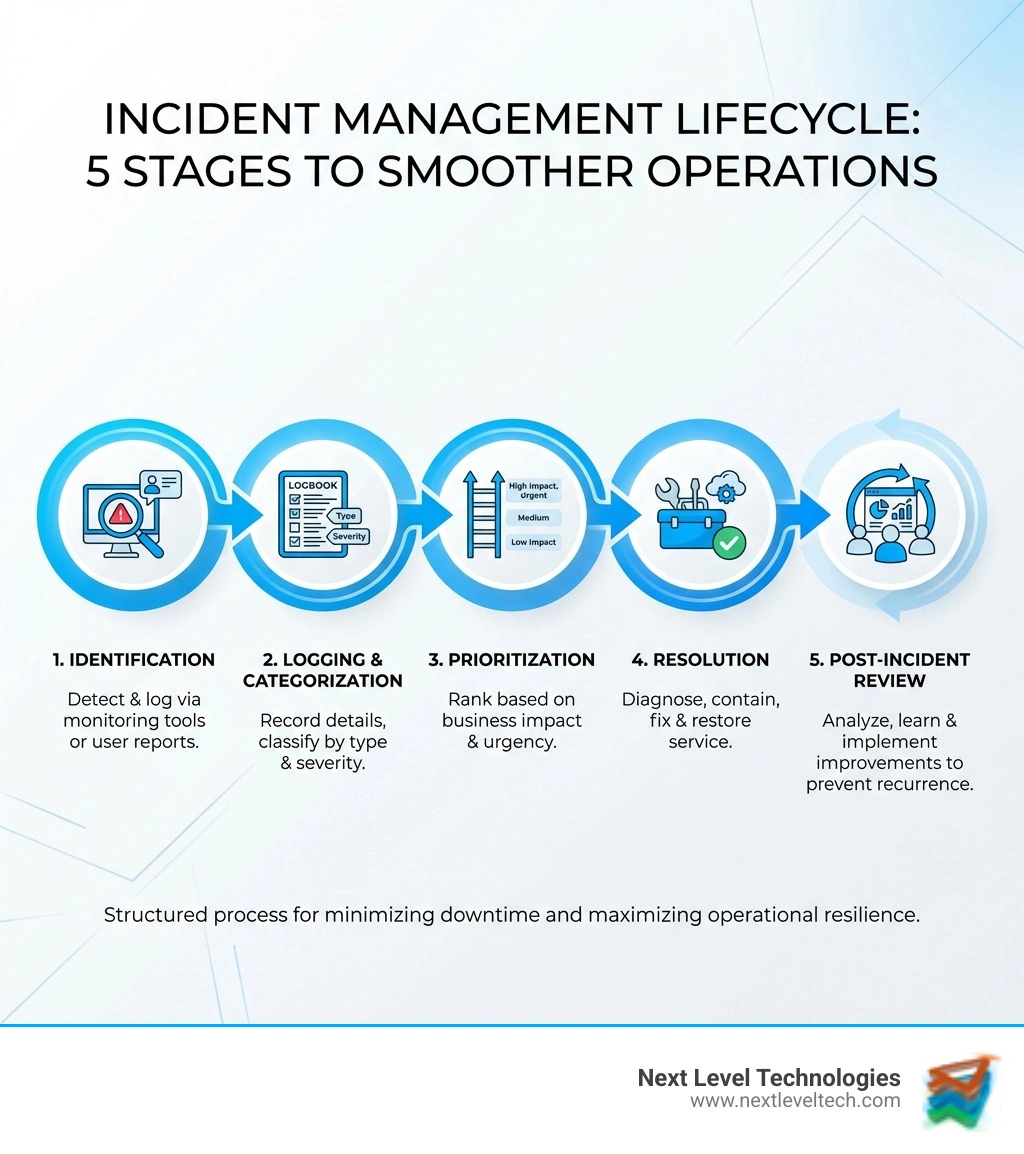

An incident is any unplanned interruption or reduction in the quality of an IT service—anything from a sluggish app to a security breach or a full network outage. Incident management is the structured process we use to identify, log, prioritize, diagnose, resolve, and learn from these events so we can restore normal service fast and minimize business impact.
Why it matters to organizations in Columbus, Worthington, and Charleston:
If you want a longer, nuts-and-bolts walkthrough, our IT Incident Management Complete Guide covers the full lifecycle and best practices.

At the heart of effective incident management are a few simple but powerful objectives:
These map directly to IT service principles in IT Service Management (ITSM): keep the lights on, keep users happy, and keep improving.
They’re related, but not the same. When the app is down, incident management gets it running again. Afterward, problem management digs into the root cause to keep it from happening again.
Incident Management focuses on restoring service fast. It is immediate, used during outages or service degradations, and usually results in a workaround or fix.
Problem Management focuses on eliminating the root cause. It happens over the medium or long term, often after stability is restored, and typically produces a root cause analysis, permanent fix, or planned change.
Both are vital, and both integrate with your help desk and service operations (see Help Desk vs. Service Desk vs. ITSM).
We promised the “secret sauce,” so here it is. The following ten benefits are why disciplined incident management becomes a strategic edge for organizations across Central Ohio and the Kanawha Valley.
Downtime is expensive. Industry research puts the average cost for a single server at at least $100,000 per hour. Faster detection, clear escalation paths, and pre-defined playbooks directly reduce Mean Time to Detect (MTTD) and Mean Time to Resolve (MTTR), protecting revenue and reputation.
For our clients in Columbus, Worthington, and Charleston, just shaving minutes off MTTR adds up quickly.
Reference insights:
Customers expect rapid resolution and clear communication. In recent surveys, 86% of service agents say customer expectations are higher than they used to be, and 93% of service ops leaders report a strong push to improve efficiency.
How incident management helps:
If you run a service desk, strengthening your process with our IT Service Desk Services ensures customers in Central Ohio and West Virginia hear from you before they have to ask.
Helpful overview: What Is Incident Management?
When security incidents occur, response time determines the blast radius. The latest research shows organizations with formal incident response teams and well-tested plans contain breaches dramatically faster and at lower cost.
Our teams in Columbus and Charleston train continuously and hold extensive cybersecurity credentials. We build and run playbooks through our IT Security Incident Management approach—rapid detection, containment, eradication, and recovery—so security events don’t become business-ending events.
Whether you operate under HIPAA, SOC 2, SOX, or other frameworks, you need documented, repeatable incident processes and audit trails.
Our IT Compliance programs align incident response with your audit requirements, making reviews smoother and reducing the risk of fines or legal exposure.
Blameless post-incident reviews transform setbacks into improvements. The UK HSE notes that systematic analysis and prevention strategies significantly reduce the likelihood of future incidents by targeting underlying causes.
Healthcare has long led the way on learning systems: the World Health Organization emphasizes transparent, nonpunitive reporting and shared learning to improve safety outcomes (WHO overview, supported by research like Brunsveld-Reinders et al. in intensive care settings: PubMed).
We bring that “just culture” mindset to IT: focus on facts, not blame; fix processes, not people; and feed insights into code, configuration, and training.
Well-run incidents are hands-on classrooms:
We formalize this with shadowing, playbooks, and retros so the knowledge sticks. For a practical angle on developing support teams, see our Business IT Support Best Practices 2025.
Incident data isn’t just for IT. It’s fuel for smarter decisions across your business:
As patterns emerge, we help translate technical signals into business actions—often intersecting with Data Protection and Security investments that reduce risk while improving user experience.
Good process equals less chaos:
With 93% of service ops leaders pushing hard on efficiency, process discipline and modern tooling matter more than ever. We deploy and tune ITSM Software and integrate monitoring and collaboration platforms so your teams can move quickly with confidence.
Reference: High-efficiency push and best practices overview in What Is Incident Management? Best Practices & More
Fewer incidents, shorter incidents, better outcomes:
We codify commitments in your IT Service Level Agreement and track metrics that matter: MTTR, SLA compliance rate, incident volume by category, and recurrence.
Standardization brings predictability and scale:
We align your process with proven frameworks like the National Incident Management System (NIMS) where appropriate, adapting its principles of roles, coordination, and communication to IT contexts in Central Ohio and West Virginia.
A durable framework blends people, process, and technology:
Our teams in Columbus, Worthington, and Charleston implement frameworks custom to your stack and risk profile, backed by our deep technical experience and extensive cybersecurity training.
Key roles we recommend for most organizations:
For teams without a large IT org, we augment capacity through IT Support for Small Businesses, ensuring you always have the right expertise on deck.
Modern incident response is tool-enabled:
For collaboration concepts, see guidance on establishing clear channels in platforms like Slack alongside our Microsoft-first approach for many clients.
An incident is any unplanned event that disrupts or reduces the quality of an IT service. That includes outages, degraded performance, failed integrations, security events, and even a single user blocked from a critical workflow—if it impacts business operations, it counts.
We prioritize by impact and urgency:
A payment gateway outage during peak hours? High impact, high urgency—top priority. A slow internal report generation affecting one department? Likely lower impact and urgency.
For a crisp overview of the lifecycle and prioritization, see What Is Incident Management?
A post-incident review (PIR) is a structured, blameless analysis conducted after resolution. We examine:
This approach aligns with safety learning systems endorsed in healthcare research (e.g., WHO incident reporting and learning systems) and applies equally well to IT.
Incidents are inevitable; chaos is optional. With a disciplined process, the Benefits of incident management cascade across your organization:
For organizations in Columbus, Worthington, and Charleston, partnering with a seasoned team makes all the difference—especially one with deep technical expertise and extensive cybersecurity training. We’ll help you standardize response, integrate tools, and coach your teams so every incident becomes a chance to improve.
Ready to turn disruption into resilience? We’re here to help with end-to-end planning, tooling, and on-call expertise. Explore our Managed IT Services and IT Support to put a robust incident management framework in place—and keep your business moving, no matter what happens next.
Additional reading and references:
Discover how a healthcare management services organization boosts practice efficiency, cuts overhead, and protects clinical autonomy.
October 3, 2026
Master denial management in medical billing with proven strategies to reduce denials, boost appeals success, and protect revenue cycle performance.
September 25, 2026
