The Proactive IT Playbook: Keeping Your Tech Ahead of the Curve
February 20, 2026


Discover how a healthcare management services organization boosts practice efficiency, cuts overhead, and protects clinical autonomy.
October 3, 2026

Master denial management in medical billing with proven strategies to reduce denials, boost appeals success, and protect revenue cycle performance.
September 25, 2026

Compare the best healthcare learning management platforms for providers with Next Level Technologies, serving Columbus, Ohio and Charleston, WV.
September 19, 2026
February 20, 2026
Proactive IT support is a strategic approach that prevents technology problems before they impact your business through continuous monitoring, automated maintenance, and predictive analytics—rather than waiting for systems to fail and then scrambling to fix them.
Key components of proactive IT support include:
For many business owners, IT support means one thing: someone to call when computers break down. But this reactive approach—often called "break-fix"—is costing businesses far more than they realize. The average cost of downtime for large enterprises can reach $9,000 per minute, and even small outages can lead to lost productivity, damaged reputation, and frustrated employees.
The problem is simple. When you wait for problems to happen, you're always playing catch-up. Your team can't work. Your customers can't access services. And your IT budget becomes unpredictable, with emergency repairs eating into resources that could drive growth.
Proactive IT support flips this model entirely. Instead of waiting for the fire alarm, you're installing sprinklers and checking the wiring. Instead of losing hours to a crashed server, you're getting alerts about potential issues days before they become critical. Instead of budgeting for "maybe" expenses, you're paying a predictable monthly cost that covers continuous protection.
This shift isn't just about technology—it's about business continuity and gaining a strategic advantage. When your systems run smoothly, your team stays productive. When security threats are caught early, your data stays safe. When you can plan IT spending with confidence, you can focus on what really matters: growing your business.
I'm Steve Payerle, President of Next Level Technologies, and since 2009 I've helped businesses across Columbus, Ohio, Charleston, WV, and nationwide transition from reactive firefighting to strategic proactive IT support that protects and propels their operations forward. Our team's extensive cybersecurity training and technical expertise have shown us repeatedly that the businesses thriving today are the ones treating technology as a competitive advantage, not a cost center.
Handy proactive it support terms:
In today's business world, the way we manage our technology can make or break our operations. Most organizations fall into one of two categories when it comes to IT support: reactive or proactive. While both aim to keep your systems running, their approaches and outcomes couldn't be more different.
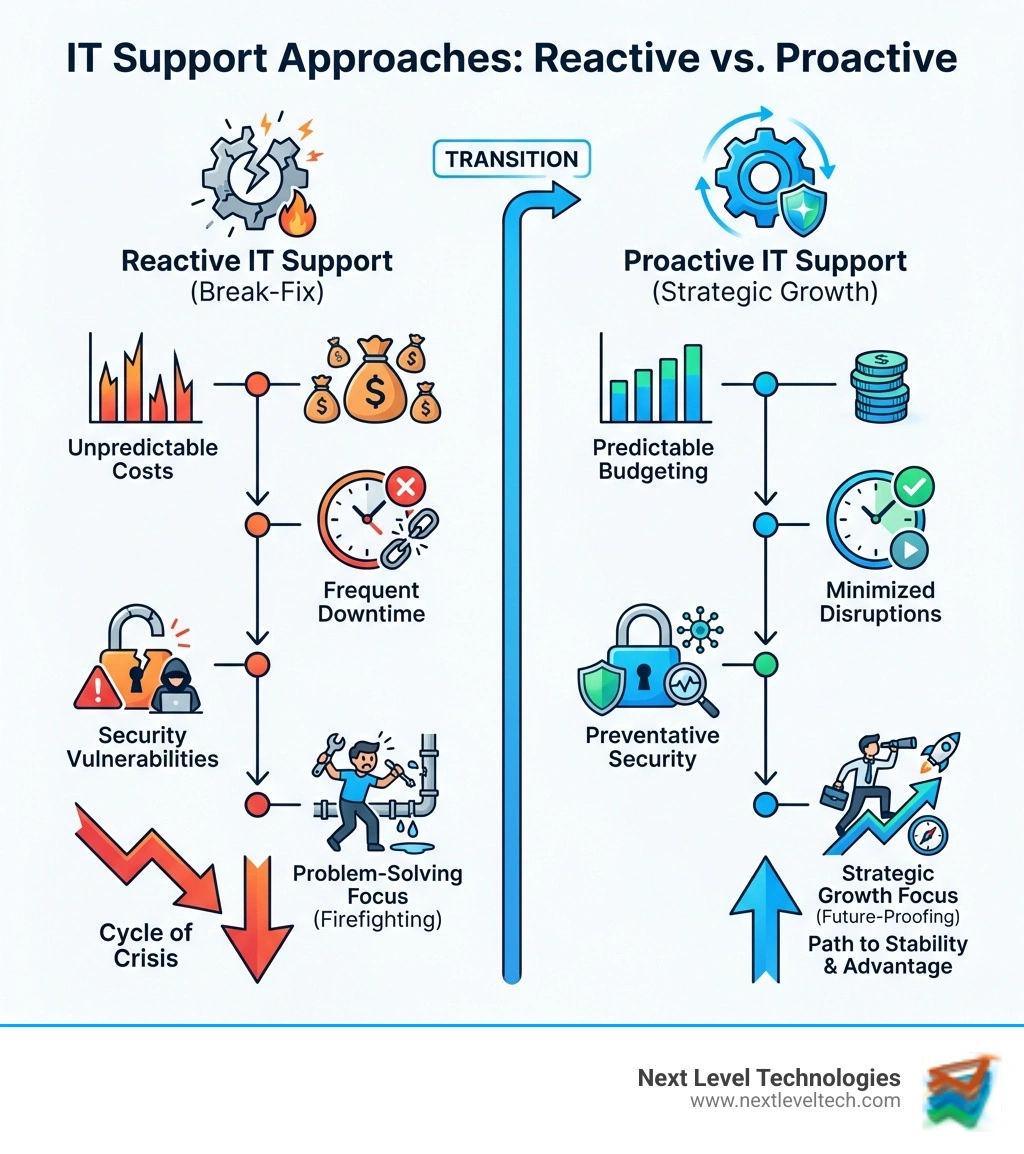
Reactive IT support, often called the "break-fix" model, is exactly what it sounds like. We wait for something to go wrong—a server crashes, a network goes down, a security breach occurs—and then we scramble to fix it. This approach can feel straightforward initially: you only pay when there's a problem. However, this seemingly simple model often leads to significant hidden costs and operational headaches.
Proactive IT support, on the other hand, is about preventing problems before they ever happen. It's a strategic method that involves constant monitoring, regular maintenance, and predictive analytics to detect and address potential issues before they can impact your business. Think of it like preventative healthcare for your IT systems, rather than emergency room visits.
Here's a quick comparison of how these two models stack up:
Cost model: Reactive IT support is unpredictable, with pay-as-you-go fixes and emergency expenses. Proactive IT support uses predictable monthly fees and planned investments.
Business impact: Reactive support often means frequent disruptions, unexpected downtime, and lost productivity. Proactive support minimizes downtime, improves efficiency, and supports business continuity.
Security posture: Reactive IT focuses on damage control after breaches or incidents. Proactive IT emphasizes prevention, continuous threat detection, and stronger defenses.
Focus: Reactive support is centered on problem-solving and quick fixes. Proactive support is built around strategic growth, innovation, and long-term stability.
With reactive IT, we often find ourselves in a constant cycle of firefighting. Downtime costs can quickly escalate, especially for large organizations where outages can reach millions of dollars per hour. We've seen businesses in Columbus, Ohio, and Charleston, WV struggle with recurring issues that consume valuable resources and prevent their teams from focusing on core business activities. This isn't just about fixing a computer; it's about lost productivity, missed opportunities, and a constant state of anxiety about what will break next.
Proactive IT support shifts this paradigm entirely. By identifying and resolving potential issues early, we dramatically reduce the risk of unexpected downtime. This approach transforms IT from a necessary evil into a strategic asset that consistently supports and drives your business forward.
One of the most compelling advantages of adopting a proactive IT support strategy is its profound impact on your budget and overall financial health. While the upfront cost of continuous monitoring and maintenance might seem higher than simply calling for a repair when needed, the long-term savings are substantial.
With proactive IT, we move to predictable budgeting. Instead of facing unpredictable, large capital expenditures for emergency fixes, your IT spending becomes a manageable operating expense, typically a consistent monthly fee. This allows you to plan your finances with confidence and avoid the shock of sudden, costly repairs. Studies show that proactive IT management can help reduce the risk of downtime to be as low as possible, directly impacting your bottom line.
This shift results in a lower total cost of ownership (TCO) for your IT infrastructure. We avoid expensive emergency repairs and the exorbitant costs associated with downtime. For large enterprises, the average cost of downtime can be as high as $9,000 per minute, a figure that can quickly bankrupt a smaller operation. By preventing these incidents, we save you significant capital. Our comprehensive IT Cost Reduction Strategies focus on this very principle: investing wisely upfront to save massively down the road.
The return on investment (ROI) of prevention is clear. By addressing issues before they escalate, we protect your assets, maintain productivity, and secure your data, all while keeping your budget predictable.
While the reactive, "break-fix" model might appear cheaper on the surface, it often comes with a multitude of hidden costs that can cripple a business. These aren't just monetary expenses; they include intangible losses that impact employee morale, customer trust, and long-term growth.
One of the most significant hidden costs is productivity loss. When systems fail, employees can't work. This leads to wasted time, missed deadlines, and a direct hit to your output. Furthermore, frequent IT issues contribute to employee disengagement. Studies show that disengaged employees cost the world $8.8 trillion in low productivity—9% of the world’s GDP. Imagine the impact on your team in Columbus, Ohio, or Charleston, WV when they're constantly battling IT frustrations instead of focusing on their tasks.
Beyond productivity, there's the risk of reputational damage. Customers expect seamless service, and repeated outages or security incidents can erode their trust, potentially driving them to competitors. In 2024, Forbes Advisor found that 70% of consumers are willing to leave their current brand if they find a higher-quality alternative, with 48% saying that customer service plays a significant role in that decision. Poor IT directly impacts customer service.
Then there are the very real dangers of security vulnerabilities and data breach risks. Reactive IT often means we're addressing security incidents after they've occurred, leaving your business vulnerable. Such cyber threats are expected to cost businesses all over the world up to $15.6 trillion by 2029. Large organizations can be looking at costs of up to $1-5 million per hour in the event of system-wide outages, which doesn't include potential penalties or legal fees from data breaches.
Finally, relying on reactive support often means escalating ticket costs. Handling issues at higher support levels (Level 1-3) costs twice more than resolving them proactively or at lower levels. These escalating costs, coupled with the unpredictable nature of reactive IT, make budgeting a nightmare and drain resources that could be better spent on innovation and growth.

Now that we understand the critical difference between reactive and proactive approaches, let's dive into the core components that make proactive IT support so effective. This strategy means we're not just fixing problems; we're actively managing your IT environment to ensure stability, security, and peak performance. It's about turning your IT into a strategic asset that propels your business forward.
The essence of proactive IT is to identify and prevent incidents entirely through continuous monitoring and predictive analysis. This includes a range of services designed to keep your systems healthy and secure. From 24/7 monitoring that acts as an early warning system to sophisticated predictive analytics that anticipate potential failures, every component is designed to keep your technology ahead of the curve. Effective IT Incident Management relies heavily on these proactive measures, allowing us to resolve issues before they become critical. We also prioritize robust disaster recovery planning and strategic IT planning, ensuring your technology aligns perfectly with your business goals.
At the heart of proactive IT support lies continuous monitoring and maintenance. This isn't just about checking a box; it's about constant vigilance over your entire digital environment.
We implement real-time network monitoring to keep a watchful eye on your network's health, identifying any unusual activity or performance dips immediately. Server health checks are performed regularly to catch potential issues like impending hard drive failures or unusual CPU usage before they lead to downtime. Automated patching ensures that all your software and operating systems are up-to-date with the latest security fixes and performance improvements. This reduces vulnerabilities and keeps your systems running smoothly without manual intervention.
Effective IT Asset Management plays a crucial role here, providing valuable insights into service contracts approaching renewal and equipment nearing its end-of-life. This foresight allows for planned upgrades and replacements, avoiding unexpected failures. Endpoint management ensures that every device connected to your network, from desktops in Columbus, Ohio, to mobile devices used by remote staff in Charleston, WV, is secure and optimized. Through system performance optimization, we fine-tune your infrastructure to ensure maximum efficiency and speed, providing a seamless experience for your employees and customers.
In an era where cyber threats are more sophisticated than ever, fortifying your defenses with proactive IT support is non-negotiable. Our team, with its extensive cybersecurity training, understands that security isn't a one-time fix but an ongoing process.
We conduct regular vulnerability assessments to identify weaknesses in your systems before malicious actors can exploit them. We leverage threat intelligence feeds to stay updated on the latest cyber threats, ensuring our defenses are always current. Installing User Behavior Analytics (UBA) is highly beneficial for proactively detecting security breaches and monitoring for unusual activity, which is often a sign of an ongoing attack.
Employee security training is another critical layer. With the rise of increasingly convincing phishing scams and deepfake technology designed to trick employees, educating your team is paramount. We empower your staff to recognize these threats, changing them into your first line of defense. Our IT Security Services Ultimate Guide elaborates on these crucial strategies. Finally, managed firewalls provide a robust perimeter defense, protecting your network from inbound attacks, monitoring for outbound bots, and controlling website access.
Technology isn't just the problem; it's also the most powerful solution in proactive IT support. Automation and advanced technologies play a pivotal role in enabling us to anticipate and prevent issues at scale.
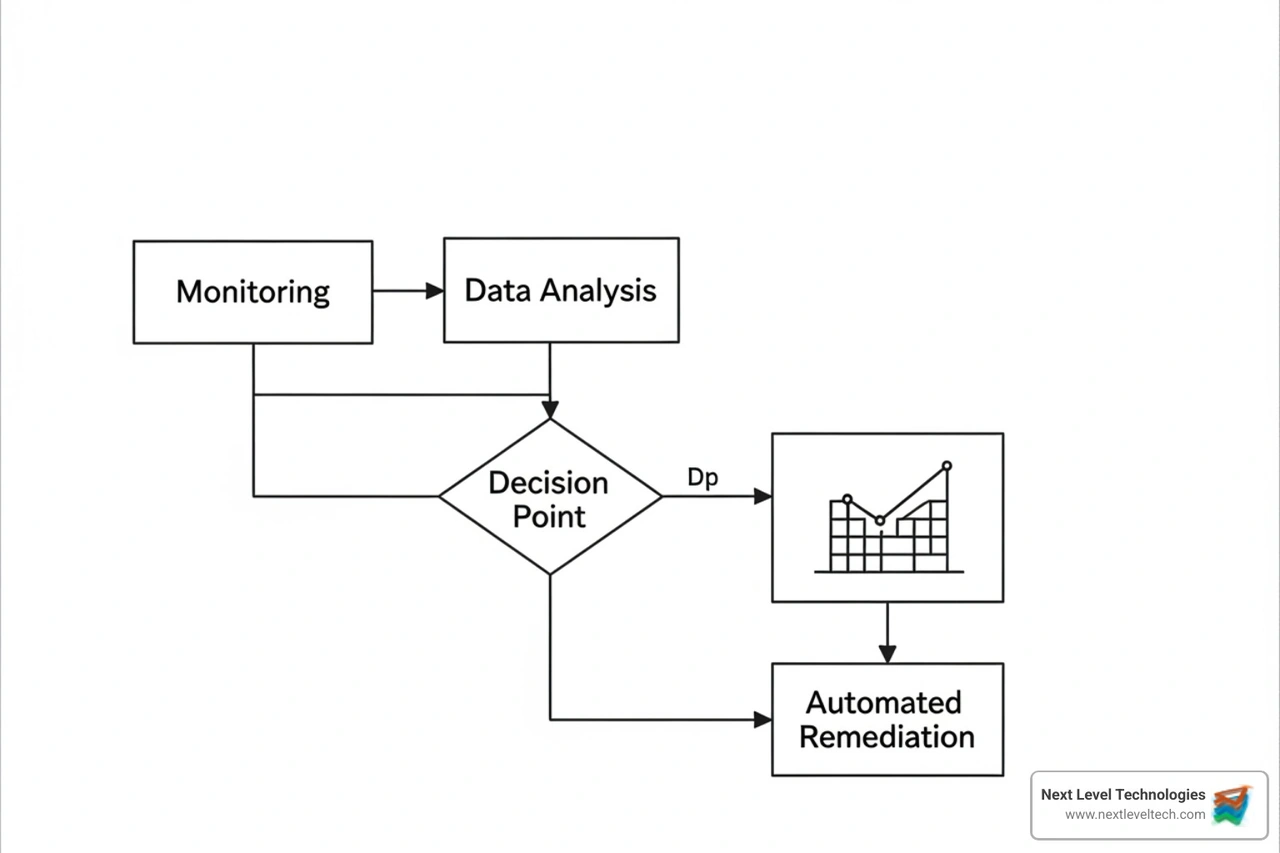
The role of AI and machine learning is rapidly expanding, allowing IT systems to analyze vast amounts of data in real-time. This helps us identify subtle patterns that indicate potential failures, enabling predictive analytics and automated remediation. Common IT issues such as high CPU usage, low disk space, or repeated system errors can often be predicted and resolved automatically before they ever impact a user. In its 2017 State of IT survey, IT community Spiceworks found that after mobility and security, IT automation technology was the third most widely adopted tech trend—30% of IT pros used it, and another 19% planned to.
We use scripting combined with remote management to develop automated solutions for common endpoint registry issues or recurring client database problems. This saves our technical teams valuable time and ensures consistent, rapid resolution. Self-healing IT mechanisms can automatically deploy patches, updates, or other fixes in the background without user intervention. This reduces human error and ensures continuous service uptime.
By leveraging these powerful tools, we can streamline IT operations, reduce the burden of repetitive tasks, and free up our experts to focus on more complex, strategic initiatives. Implementing robust IT Service Management ITSM solutions further integrates these technologies, creating a seamless and highly efficient proactive IT environment.
Transitioning from a reactive "break-fix" model to proactive IT support is a strategic decision that can redefine your business's relationship with technology. It's a journey that requires careful planning, but the rewards—predictable costs, improved security, and improved productivity—are well worth the effort. Here's our 5-step guide on how to implement proactive IT support for your business:
Before we can implement a proactive strategy, we need to understand your current landscape. This step involves a thorough audit of your existing IT infrastructure. We'll identify recurring problems and bottlenecks by analyzing past support ticket data and incident reports. This helps us pinpoint where your IT is most vulnerable and where reactive fixes are most common. We'll also evaluate your current security posture to identify any gaps. Our expertise in IT Infrastructure and Security means we can provide a comprehensive overview and actionable insights specific to your operations in Columbus, Ohio, or Charleston, WV.
Once we understand your current state, the next step is to clearly define what success looks like. We'll work with you to establish clear objectives for your proactive IT support strategy. This includes setting key performance indicators (KPIs) such as reduced downtime, faster resolution times for remaining incidents, and improved system performance metrics. We'll also define service level agreements (SLAs) to ensure our services meet your expectations. While the shift to proactive support is gaining traction, Gartner predicts that only 30% of customer service and support organizations will have a proactive approach by 2023, highlighting the competitive edge you can gain by embracing this model now.
With goals in place, it's time to put the tools and processes to work. This involves deploying advanced monitoring software across your network and endpoints, implementing automation tools for routine maintenance, and establishing a comprehensive knowledge base for common issues. We'll also develop a robust disaster recovery plan custom to your business, ensuring rapid recovery in the event of unforeseen circumstances. As a leading provider of Managed IT Services in the region, we specialize in integrating these tools and processes seamlessly into your operations.
Technology is only as strong as the people using it. An essential part of any proactive IT support strategy is empowering your team and end-users. This includes regular security awareness training, educating them on new processes, and fostering a proactive culture throughout your organization. By teaching employees how to recognize phishing attempts, avoid suspicious links, and practice good cyber hygiene, we significantly reduce the risk of human error—one of the leading causes of security incidents. Empowered users also mean fewer help desk tickets, allowing our IT professionals to focus on strategic initiatives.
The final, and arguably most crucial, step is selecting the right partner to implement and manage your proactive IT support. This isn't just about finding someone to fix computers; it's about finding a strategic ally who understands your business goals.
When evaluating Managed Service Providers (MSPs), look for a team with proven technical expertise and extensive cybersecurity certifications. Our staff, located in Columbus, Ohio, and Charleston, WV, boasts deep technical knowledge and continuous training to stay ahead of evolving threats. We understand the unique challenges faced by businesses in our communities and are committed to providing custom solutions.
Key considerations include 24/7 support availability, ensuring that your systems are always monitored, and issues are addressed promptly, regardless of the time zone. Scalability is also vital; your IT partner should be able to adapt their services as your business grows or contracts. For IT Consulting for Small Businesses, finding a partner with a strong local presence, like us, ensures personalized service and a deep understanding of your operational context. We pride ourselves on being more than just a vendor; we aim to be an extension of your team.
Proactive IT support fundamentally shifts IT spending from unpredictable, large capital expenditures for emergency fixes to a predictable, manageable operating expense. While it may involve a consistent monthly fee, it significantly reduces the total cost of ownership by preventing costly downtime, which Forbes estimates can be as high as $9,000 per minute for large enterprises. This predictable model allows for better financial planning and investment in growth, rather than constantly reacting to unforeseen expenses.
No, businesses of all sizes benefit from a proactive approach. For small and medium-sized businesses, preventing a single major incident can be the difference between growth and failure. The financial impact of downtime or a cyberattack can be disproportionately severe for smaller operations. Managed IT Services and IT Support providers, like us, often offer scalable solutions custom to the needs and budgets of SMBs, ensuring that even the smallest businesses in Columbus, Ohio, or Charleston, WV can access enterprise-grade protection and efficiency.
Absolutely. A co-managed IT model allows an external provider to supplement your internal team. We can handle the 24/7 monitoring, automation, and specialized security tasks, freeing your in-house staff to focus on strategic, business-specific projects that drive innovation and competitive advantage. This collaborative approach leverages the specialized technical experience and extensive cybersecurity training of our staff, enhancing your existing team's capabilities without the need for additional full-time hires. It's a powerful way to get the best of both worlds.
Proactive IT support is not just a service; it's a business strategy that fosters resilience, improves security, and drives growth. By shifting from a reactive to a proactive model, you transform your technology from a potential liability into a powerful strategic asset. You gain predictable costs, minimized downtime, improved security, and the peace of mind that comes from knowing your IT infrastructure is consistently optimized and protected.
The expert team at Next Level Technologies, with its highly trained staff and locations in Columbus, Ohio, and Charleston, WV, specializes in implementing these comprehensive solutions. We believe that technology should empower your business, not hinder it. Our commitment to continuous monitoring, advanced automation, and robust cybersecurity measures ensures that your systems are always ahead of the curve.
Take the first step towards a more stable and secure IT environment by exploring our managed IT services. Let us help you open up the full potential of your technology and secure your future.
Discover how a healthcare management services organization boosts practice efficiency, cuts overhead, and protects clinical autonomy.
October 3, 2026
Master denial management in medical billing with proven strategies to reduce denials, boost appeals success, and protect revenue cycle performance.
September 25, 2026
