Beyond the Buzz: Understanding IT as a Service
January 15, 2026


Upgrade your healthcare claims management for maximum accuracy with Next Level Technologies, serving Columbus, Ohio and Charleston, WV.
October 10, 2026

Discover how a healthcare management services organization boosts practice efficiency, cuts overhead, and protects clinical autonomy.
October 3, 2026

Master denial management in medical billing with proven strategies to reduce denials, boost appeals success, and protect revenue cycle performance.
September 25, 2026
January 15, 2026
IT as a service (ITaaS) is an operational model where a service provider delivers information technology services to your business on a subscription or consumption basis, rather than you owning and managing all the hardware, software, and support yourself.
Quick Definition:
For many businesses, there's a frustrating disconnect: outdated systems, disruptive downtime, and security threats create a budget black hole. ITaaS fundamentally changes this dynamic. Instead of a sunk cost, IT becomes a strategic partner for your business goals. It shifts the model from owning technology to consuming it as a flexible, scalable service—much like electricity.
This isn't just outsourcing; it's a move from a reactive, static IT model to a proactive, dynamic one that scales with your needs. With 94% of companies using cloud software and 72% of businesses citing cost savings as a primary driver for ITaaS, the model proves its value by eliminating the waste of traditional IT management.
I'm Steve Payerle, President of Next Level Technologies. Since 2009, I've helped hundreds of businesses in Columbus, Ohio and Charleston, WV transform their IT operations with IT as a service models. Our team's extensive cybersecurity training and technical experience have shown us that when businesses shift to ITaaS, they don't just cut costs—they open up innovation, improve security, and gain a true competitive advantage.
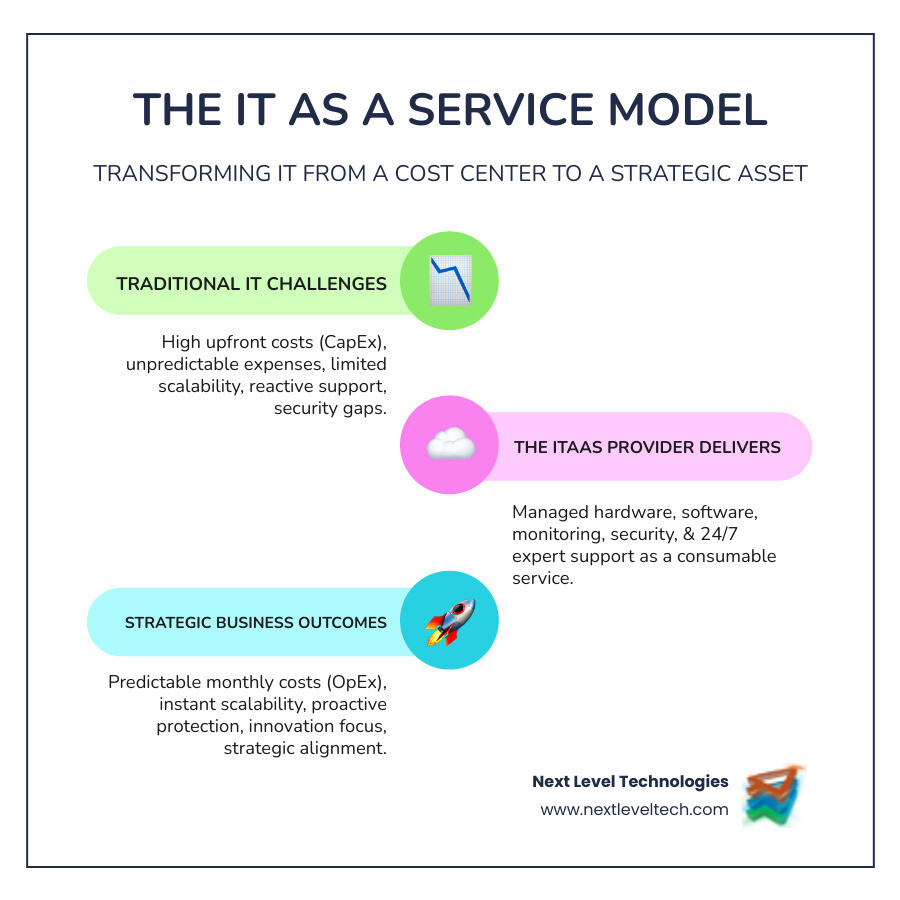
Basic it as a service glossary:
The traditional IT model involved purchasing all hardware and software, then hiring an in-house team for maintenance. This meant significant upfront capital expenditure (CapEx), slow scaling, and a reactive "break-fix" approach that led to unpredictable costs and frustrating downtime.
IT as a service flips this script. It treats IT like a utility, shifting costs from CapEx to predictable operational expenditure (OpEx). Instead of owning the infrastructure, you pay a monthly fee for the resources and support you consume, allowing for dynamic, on-demand scaling. The move to ITaaS is a fundamental shift from reactive to proactive management. An ITaaS provider continuously monitors your environment, resolving potential issues before they cause downtime and keeping your business running smoothly.

Here's a breakdown of how ITaaS differs from traditional IT:
| Feature | Traditional IT | IT as a Service (ITaaS) |
|---|---|---|
| Cost Model | Ownership model, High Capital Expenditure (CapEx) | Subscription/Consumption model, Predictable Operational Expenditure (OpEx) |
| Scalability | Slow, requires significant upfront investment | Rapid elasticity, scales up or down on demand |
| Management | In-house team, often reactive, siloed | Expert provider, proactive, business-aligned, strategic |
| Focus | Maintaining hardware, fixing issues | Delivering business outcomes, innovation, value-add |
| Technology Access | Limited to internal capabilities | Access to cutting-edge, enterprise-grade tools and expertise |
| Risk Management | Internal responsibility, can be resource-intensive | Shared responsibility, provider manages significant risks |
The shift to IT as a service is a mindset change. IT transforms from a cost center into a strategic business enabler. This model frees your internal teams from routine maintenance, allowing them to focus on strategic initiatives that drive revenue. As an ITaaS provider, we become a strategic partner, helping you align technology investments with your business goals. This strategic alignment is a key component of a good IT strategy. The result is improved employee productivity, as staff have reliable tools and prompt support to focus on their core tasks.
The financial impact of IT as a service is compelling. Traditional IT involves hefty, unpredictable capital investments. ITaaS operates on a pay-as-you-go model, so you only pay for what you use. This flexibility allows you to scale resources up or down with demand, such as during a seasonal spike, without buying new hardware.
This predictability is a huge advantage for budgeting, as a monthly service fee allows you to forecast IT costs accurately. With 72% of businesses citing cost savings as a primary reason for investing in ITaaS, the shift from a CapEx to an OpEx model frees up capital for growth. This approach is central to effective IT cost optimization strategies.
At the heart of IT as a service is cloud computing, which provides the infrastructure for delivering IT resources on demand. The widespread adoption of cloud software (94% of companies) and virtualization (92% of businesses) underpins the ITaaS model.
The National Institute of Standards and Technology (NIST) defines cloud computing by five essential characteristics that make ITaaS powerful. You can read the full text in The NIST Definition of Cloud Computing, but they boil down to:
Within the ITaaS framework are three primary service models: Infrastructure as a Service (IaaS), Platform as a Service (PaaS), and Software as a Service (SaaS).
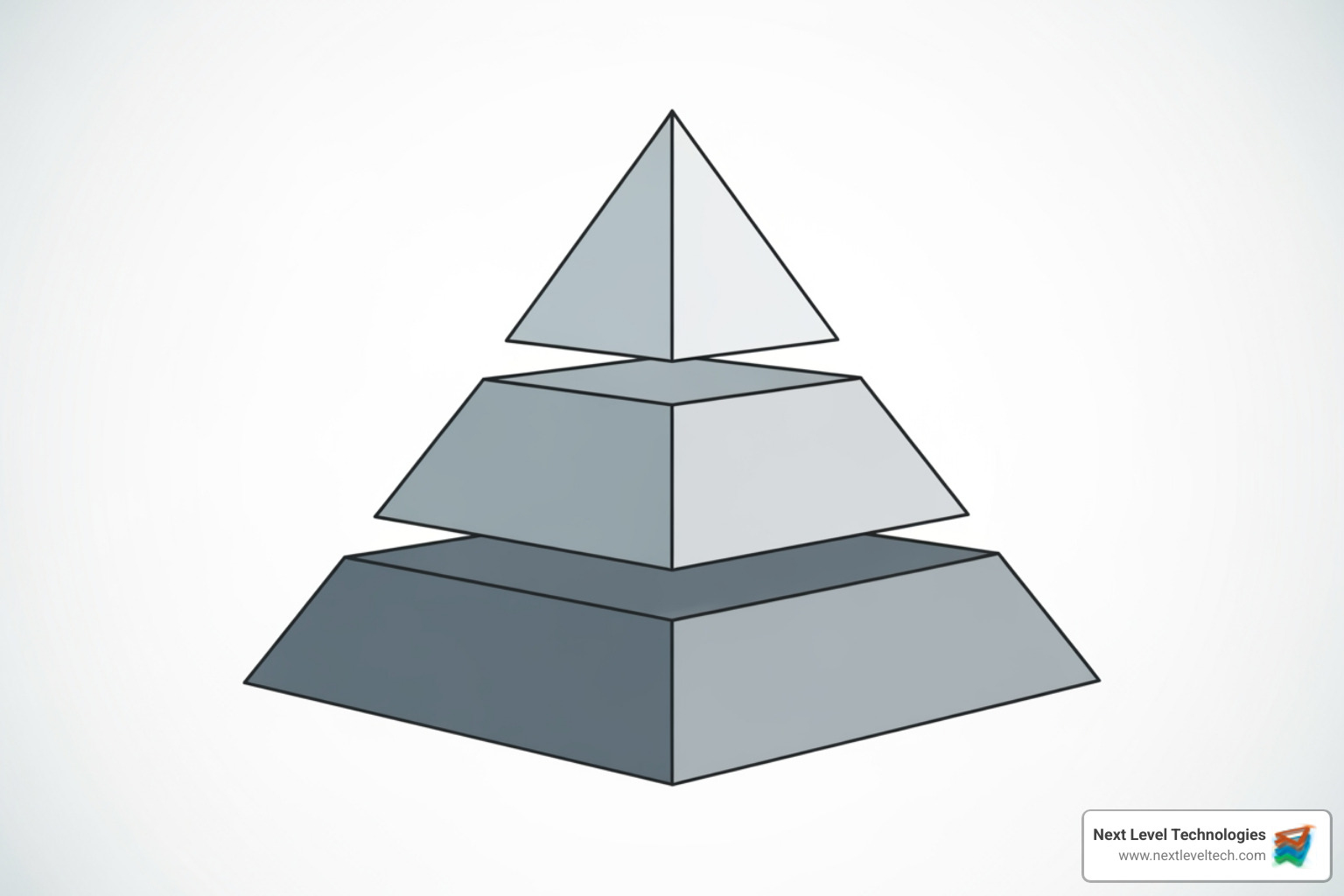
IaaS provides the fundamental building blocks of cloud computing: virtualized servers, storage, and networking. You rent this infrastructure from a provider, freeing you from maintaining a data center while retaining control over operating systems and applications. IaaS is highly scalable and metered by use, making it a flexible foundation. For a deeper dive, see the Definition of IaaS from Gartner. At Next Level Technologies, we help businesses in Columbus and Charleston ensure their cloud hardware infrastructure is robust and efficient.
PaaS offers a complete application development and deployment environment in the cloud. The vendor hosts the hardware and software tools, allowing your developers to build, test, and scale applications more quickly and at a lower cost. PaaS simplifies development by managing the underlying infrastructure, letting your team focus on coding and innovation. We help clients with managing cloud applications effectively in a PaaS model.
SaaS is the most widely recognized model, delivering entire software applications over the internet on a subscription basis. The vendor manages everything, and you access the software via a web browser. Common examples include Microsoft 365 and CRM systems. The convenience of SaaS is a key reason why 94% of companies use cloud software. Explore how SaaS can benefit your business to learn more.
Adopting IT as a service open ups profound business potential by turning IT from an overhead into a streamlined utility that drives growth.
The core benefits of an ITaaS model are numerous and impactful:
We invite you to explore the benefits of ITaaS to see how these advantages can translate into tangible results.
A standout benefit of IT as a service is its inherent scalability. In a business environment, ITaaS allows you to scale resources on demand to handle a viral marketing campaign or adapt to remote work. When demand surges, your provider can instantly provision more computing power; when it subsides, you can scale back, paying only for what you use. This elasticity is crucial for cost control and business continuity. For more on how these solutions can benefit your operations, consider our comprehensive cloud services for businesses.
In an era of sophisticated cyber threats, robust security is non-negotiable. IT as a service significantly improves your security posture, especially for businesses in Columbus, Ohio and Charleston, WV without a dedicated in-house cybersecurity team.
Our team at Next Level Technologies, with its extensive cybersecurity training, provides a level of protection that surpasses what most businesses can achieve alone. This includes:
Partnering with an ITaaS provider like Next Level Technologies gives you a vigilant guardian for your digital assets. Learn more about our managed cybersecurity services and data backup and recovery solutions.
Transitioning to IT as a service is a strategic move that requires careful planning. A successful shift involves an implementation roadmap, addressing cultural changes, and meticulous vendor management. The process is often guided by best practices for IT service management (ITSM) and requires a cultural shift toward viewing IT as a business enabler. Effective vendor management, through clear Service Level Agreements (SLAs), is also crucial to ensure your provider is accountable for meeting your business needs.
While the promise of IT as a service is bright, businesses should be aware of potential challenges:
Selecting the right IT as a service provider is a critical decision. You need a strategic partner who understands your business goals. When evaluating partners, especially for businesses in Columbus, Ohio, and Charleston, WV, consider the following:
Choosing an ITaaS provider is a long-term partnership. For a detailed guide, see our article on 7 factors to consider when choosing an IT support company. You might also find our insights on IT consulting for small businesses helpful.
The landscape of IT as a service is continuously evolving, driven by rapid advancements in technology. We're seeing exciting trends emerge that promise to make ITaaS even more powerful, efficient, and intelligent.
These innovations highlight how ITaaS is not a static solution but a dynamic framework that incorporates the latest technological advancements to deliver superior value. To stay ahead of the curve, keep an eye on the latest innovations in IT support technology.
IT as a service significantly improves IT security by centralizing management with a specialized provider. This model enables proactive 24/7 monitoring for faster threat detection and response. Providers like Next Level Technologies invest in advanced cybersecurity tools, extensive staff training, and robust disaster recovery solutions that often exceed in-house capabilities. This results in a stronger security posture, expert management of compliance standards (like HIPAA or SOC), and reduced risk of data breaches. To understand more, explore IT security services.
IT as a service (ITaaS) is the overarching model of delivering all IT functions as a consumable service focused on business outcomes. Managed IT Services is a common and effective way to implement ITaaS. It involves outsourcing IT management to a third-party provider for a predictable fee. In short, ITaaS is the philosophy, and Managed IT Services is the practical execution.
IT as a service is a catalyst for business agility and innovation. By offloading routine IT management to a provider, your internal teams can focus on strategic initiatives. The scalability of ITaaS means your business can quickly pivot, launch new projects, or adapt to market changes without being hindered by IT infrastructure limitations. This ability to rapidly provision resources and access cutting-edge technology directly fuels an environment where innovation can thrive.
When technology is constantly evolving, and business demands are more dynamic than ever, embracing IT as a service is no longer just an option—it's a strategic imperative. We've seen how ITaaS transforms IT from a reactive cost center into a proactive, value-driven partner, delivering unparalleled scalability, predictability, and security. It's about empowering your business to focus on what it does best, while experts handle the complexities of your technology infrastructure.
For businesses in Columbus, Ohio, and Charleston, WV, making this shift means future-proofing your operations, gaining access to top-tier technical experience and extensive cybersecurity training, and leveraging technology as a true competitive advantage.
At Next Level Technologies, we don't just provide IT services; we partner with you to understand your unique business needs and develop custom ITaaS solutions that drive your success. We believe in using the power of technology to lift your business to the next level.
Are you ready to stop worrying about IT and start innovating? Contact us to revolutionize your business with IT as a Service.
Upgrade your healthcare claims management for maximum accuracy with Next Level Technologies, serving Columbus, Ohio and Charleston, WV.
October 10, 2026
Discover how a healthcare management services organization boosts practice efficiency, cuts overhead, and protects clinical autonomy.
October 3, 2026
