How to Master Small Business PCI Compliance Without Losing Your Mind
April 15, 2026


Upgrade your healthcare claims management for maximum accuracy with Next Level Technologies, serving Columbus, Ohio and Charleston, WV.
October 10, 2026

Discover how a healthcare management services organization boosts practice efficiency, cuts overhead, and protects clinical autonomy.
October 3, 2026

Master denial management in medical billing with proven strategies to reduce denials, boost appeals success, and protect revenue cycle performance.
September 25, 2026
April 15, 2026
Small business PCI compliance is a requirement for any business that accepts credit or debit card payments — no matter how few transactions you process. Here's what you need to know at a glance:
What is PCI compliance? It means following the Payment Card Industry Data Security Standard, or PCI DSS, to protect cardholder data.
Who needs it? Any business that accepts, processes, or stores credit or debit card payments.
Which level applies to most small businesses? Usually Level 4, for businesses with fewer than 20,000 e-commerce transactions or up to 1 million total transactions per year.
How do you become compliant? Complete the right Self-Assessment Questionnaire, run required quarterly vulnerability scans, and submit an Attestation of Compliance.
What happens if you do not comply? You may face fines of $5,000-$10,000 per month, higher processing fees, and possible loss of card payment privileges.
Running a small business means wearing a lot of hats. Security compliance probably isn't the one you enjoy most. But the stakes are real: 60% of small businesses that suffer a data breach close within six months. Nearly half of all breaches now target smaller businesses — not just big corporations.
The uncomfortable truth? Many small business owners don't realize they're already out of compliance, or that their payment system may be storing sensitive card data without their knowledge. An improperly configured system or a single employee mistake can expose your customers — and your entire business.
PCI DSS isn't just red tape. It's a practical security framework that, when followed, dramatically reduces your risk of a costly breach.
I'm Steve Payerle, President of Next Level Technologies, and I've spent over 15 years helping small and mid-sized businesses in Columbus, Ohio and Charleston, WV navigate exactly these kinds of challenges — including small business PCI compliance — with a team of deeply trained cybersecurity professionals. In the sections ahead, I'll walk you through everything you need to know to get compliant, stay compliant, and protect what you've built.
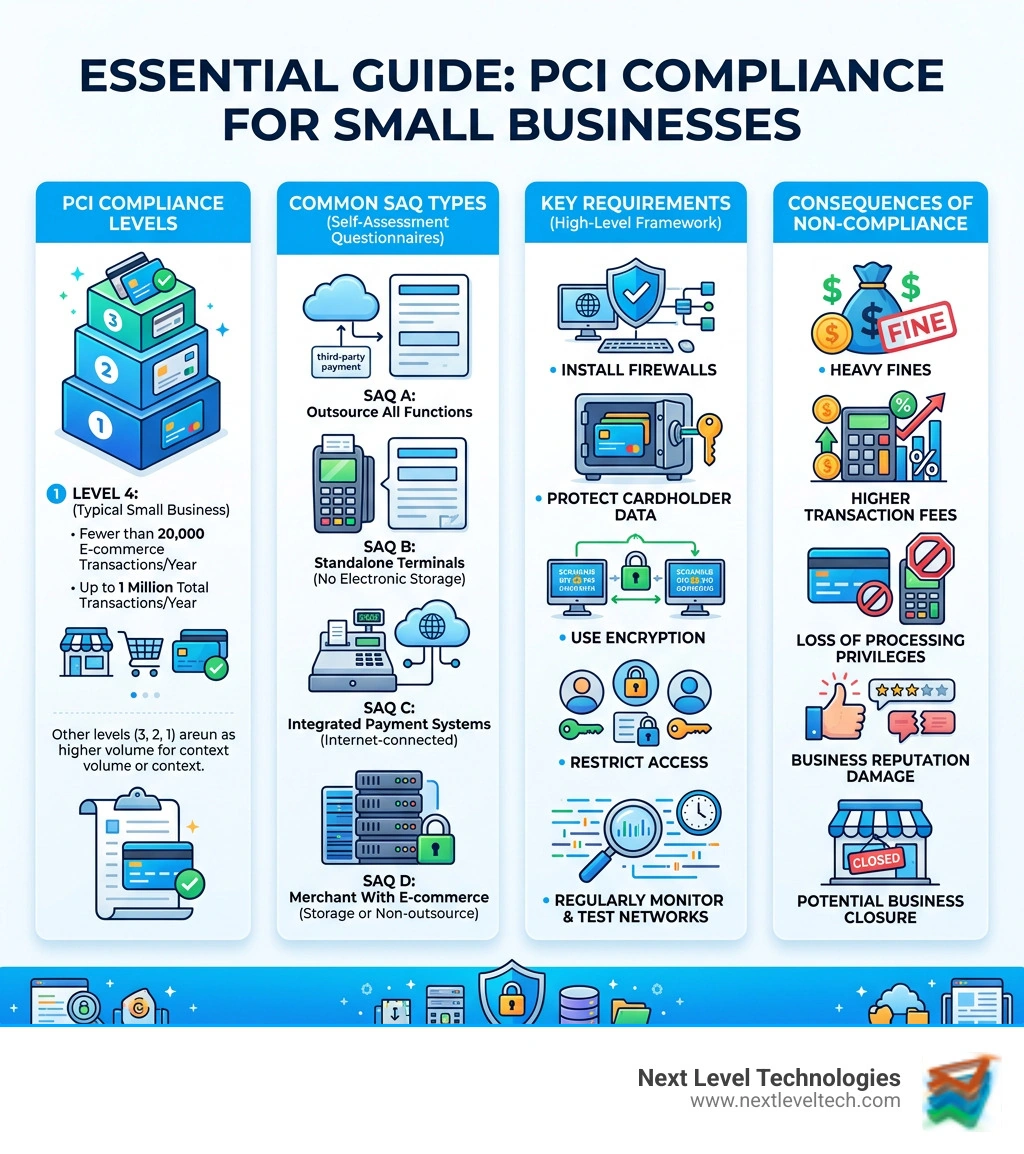
Quick small business PCI compliance terms:
At its core, the Payment Card Industry Data Security Standard (PCI DSS) is a set of technical and operational requirements designed to protect cardholder data. It wasn't created by the government, but by the PCI Security Standards Council, a global forum founded by major card brands like Visa, Mastercard, American Express, and Discover.
Think of PCI DSS as the "rules of the road" for handling credit cards. If you accept plastic, you are contractually obligated to follow these rules. Why? Because a single breach can leak thousands of Primary Account Numbers (PANs), names, and expiration dates. This data is "low-hanging fruit" for cybercriminals who use it for fraudulent purchases or sell it on the dark web.
For a local shop in Charleston or a boutique in Columbus, the impact of a breach is often terminal. Beyond the immediate loss of customer trust, Visa merchant security guidelines and processor contracts stipulate heavy financial penalties. You could face monthly non-compliance fines ranging from $5,000 to $10,000, and in severe cases, you might lose your merchant status entirely, rendering you unable to accept cards.
We often talk about demystifying-it-compliance-beginners-guide-for-small-business-success because many owners feel overwhelmed by the jargon. However, compliance is essentially a common-sense security shield. It ensures that when a customer hands you their card, their data doesn't end up in the wrong hands due to a weak password or an unpatched router.
One of the first things we help our clients determine is which "level" they fall into. The PCI Council categorizes merchants based on their annual transaction volume.
The vast majority of our partners in Ohio and West Virginia are Level 4 merchants. While the requirements for Level 4 are less stringent than the heavy-duty audits required for Level 1, they are still mandatory. With over 45 billion credit card transactions occurring annually, the scale of the risk is massive.

It’s important to note that transaction volume is aggregated across all your channels—in-store POS terminals, online gateways, and even phone orders. If you suffer a data breach, your card brand can "promote" you to Level 1 status regardless of your size, forcing you to undergo much more expensive, professional audits. Staying ahead of the curve is a major way to achieve it-compliance-benchmarks and keep your operational costs low.
The "meat" of PCI compliance consists of 12 core requirements. These are divided into six broader goals, ranging from building a secure network to regularly monitoring your systems.
Achieving compliance involves more than just checking a box; it requires it-compliance-assessments to see where your current systems might be leaking data. For example, did you know that simply deleting a file doesn't always remove the data? A "secure delete" that overwrites the data is often required to truly protect unencrypted card info.
With the transition to PCI DSS 4.0, the standards have become more focused on risk-based outcomes. Here is a simplified look at the 12 requirements:
For a deeper dive into the technical specifics, the PCI DSS Quick Reference Guide is an excellent resource for understanding how these apply to your specific hardware.
For most small businesses, the path to validation is the Self-Assessment Questionnaire (SAQ). This is a self-reporting tool that helps you demonstrate you are meeting the 12 requirements.
The "alphabet soup" of SAQs can be confusing, so we’ve broken down the most common types for Level 4 merchants:
SAQ A: For businesses that fully outsource payment processing, such as using a hosted checkout page.
SAQ B: For businesses using standalone dial-out payment terminals with no electronic cardholder data storage.
SAQ C: For businesses with internet-connected payment applications that do not store cardholder data.
SAQ D: For businesses that do not fit another SAQ type, including those storing cardholder data electronically.
You can find the appropriate Self-Assessment Questionnaire on the PCI Council website. Once the SAQ is complete, you’ll also need to sign an Attestation of Compliance (AoC), which is a formal declaration that you are, in fact, compliant.
Compliance isn't a "one and done" annual event; it’s a year-round commitment. One of the most critical technical requirements is the quarterly network vulnerability scan. If your POS system is connected to the internet, you must have an external scan performed every three months.
These scans must be conducted by an Approved Scanning Vendor (ASV). You can find an ASV through the official PCI directory. These scans look for "holes" in your digital fence that hackers could exploit.
To simplify your life, we highly recommend using third-party payment processors that offer tokenization. Tokenization replaces sensitive card data with a "token" that is useless to hackers. This significantly reduces your "compliance scope"—meaning there are fewer systems you have to worry about securing.
Other best practices include:
Staying updated with a security-compliance-guide-2026 can help you anticipate future changes in the standard.
Even with the best defenses, you need an incident response plan. If you suspect a breach, every second counts.
60% closure rate for breached SMBs? It’s often not the breach itself that kills the business, but the legal fees, fines, and loss of reputation that follow. Consistent it-compliance-monitoring is the best way to catch threats before they become catastrophes.
For a very small business (Level 4) using a simple SAQ, the cost can be under $1,000 per year, covering the SAQ and quarterly ASV scans. However, costs increase if you need hardware upgrades, new software, or professional consulting. Compared to a $10,000 monthly fine for non-compliance, it’s a bargain.
No. While using a PCI-compliant processor like Stripe or Square handles a huge portion of the security (up to 90% of the requirements), you are still responsible for your own "on-site" security, such as your physical POS terminals, your office Wi-Fi, and your employee training.
Beyond the $5,000–$10,000 monthly fines, you may be liable for the cost of re-issuing credit cards, forensic audits (which can cost tens of thousands), and legal settlements. You may also be forced to move to Level 1 compliance, which requires an expensive annual on-site audit by a Qualified Security Assessor (QSA).
Mastering small business PCI compliance doesn't have to be a nightmare. By breaking it down into manageable steps—identifying your level, choosing the right SAQ, and maintaining basic technical hygiene—you can protect your business and your customers' trust.
At Next Level Technologies, we pride ourselves on our technical experience and the extensive cybersecurity training our staff undergoes. Whether you are in Columbus, Ohio or Charleston, WV, we are here to help you navigate the complexities of PCI DSS so you can focus on what you do best: running your business.
If you’re ready to take the stress out of compliance, explore our Managed IT Services and IT Support to see how we can build a secure foundation for your company's future.
Upgrade your healthcare claims management for maximum accuracy with Next Level Technologies, serving Columbus, Ohio and Charleston, WV.
October 10, 2026
Discover how a healthcare management services organization boosts practice efficiency, cuts overhead, and protects clinical autonomy.
October 3, 2026
