IT Support Blog

Insights
Mastering Secure Data Access: Keep Your Business Data Under Lock and Key

Mastering Secure Data Access: Keep Your Business Data Under Lock and Key

December 3, 2025

Written by

Why Your Business Data Needs Military-Grade Protection

Secure data access—ensuring only authorized users can interact with your sensitive information—is non-negotiable for any business. With 95% of data breaches caused by human error and evolving cyber threats, robust data protection is a matter of survival.

Quick Answer: What is Secure Data Access?

Secure data access means controlling who can access your data through:

  1. Authentication - Verifying user identity (often with Multi-Factor Authentication)
  2. Authorization - Determining what authenticated users can actually do
  3. Encryption - Scrambling data so only authorized parties can read it
  4. Monitoring - Continuously watching for suspicious activity
  5. Access Controls - Limiting permissions based on job roles (least privilege)

The stakes are immense. A single breach can lead to crippling fines, such as GDPR penalties up to 4% of annual revenue or €20 million and HIPAA violations costing $50,000 per offense, not to mention lost customer trust and operational chaos.

Many mid-sized businesses are vulnerable due to a piecemeal approach to IT, creating gaps attackers exploit. However, implementing strong secure data access doesn't require a huge IT team—it requires the right strategy and expertise.

I'm Steve Payerle, President of Next Level Technologies, and for over 15 years, I've helped businesses in Columbus, Ohio, and Charleston, WV, build these strategies. Our team's extensive cybersecurity training allows us to deliver practical, forward-thinking security solutions for businesses of all sizes.

Infographic showing the three pillars of secure data access: Confidentiality (ensuring only authorized users access data through authentication and encryption), Integrity (protecting data from unauthorized modification through access controls and monitoring), and Availability (ensuring data remains accessible to authorized users through redundancy and disaster recovery) - secure data access infographic

What is Secure Data Access and Why is it Crucial?

Secure data access is the framework of policies and technologies that keeps your organization's digital information safe. Data is the lifeblood of your operations, making its protection vital for several reasons:

  • Business reputation and customer trust are on the line. A single breach can destroy years of goodwill and send customers to your competitors.
  • Operational continuity depends on secure access. Data loss or corruption can grind your business to a halt, hitting productivity and revenue.
  • Competitive advantage is gained through strong security. It allows you to innovate confidently and attract security-conscious clients.
  • Regulatory compliance is mandatory. Laws like GDPR and HIPAA have severe penalties. It's essential to understand the difference between data security (protecting data) and data privacy (how data is collected and used). For more on this, see our article on data privacy and compliance strategies and GDPR guidance from the ICO.

The Fundamental Principles of Data Security

Effective secure data access is built on three core principles:

  • Authentication verifies a user's identity. While passwords are a start, Multi-Factor Authentication (MFA) is now essential. MFA requires multiple verification factors (e.g., a password and a code from a mobile app), making unauthorized access much harder. Our Multi-Factor Authentication: Complete Guide explains how to implement it.
  • Authorization defines what an authenticated user can do. This is governed by the Principle of Least Privilege (PoLP): grant users only the minimum access needed for their job. This limits potential damage if an account is compromised.
  • Encryption scrambles data into an unreadable format without a decryption key. This protects data at rest (stored on drives or in the cloud) and data in transit (moving across networks), rendering stolen data useless to attackers.

Common Risks of Insecure Data Access

Failing to secure data access exposes your business to severe risks:

  • Data breaches lead to the theft of confidential information, causing financial and reputational damage.
  • Insider threats, whether malicious or accidental, are a major risk. CompTIA notes that 95% of data breaches involve human error, highlighting the need for controls and training.
  • Ransomware attacks encrypt your data and hold it hostage, potentially halting your entire operation. Our guide on protecting your data from ransomware offers defensive strategies.
  • Phishing and malware trick employees into giving up credentials or installing malicious software, creating a foothold for data theft.
  • Regulatory non-compliance with laws like GDPR and HIPAA can result in massive fines and legal trouble.

A Practical Guide to Implementing Secure Data Access

Implementing secure data access is an ongoing process of adapting your defenses. At Next Level Technologies, our teams in Columbus, OH and Charleston, WV leverage their extensive cybersecurity training to build layered security systems that evolve with threats. Effective security combines smart policies, modern technology, and continuous monitoring. Our IT Security Services: The Ultimate Guide details how these elements create a robust security foundation.
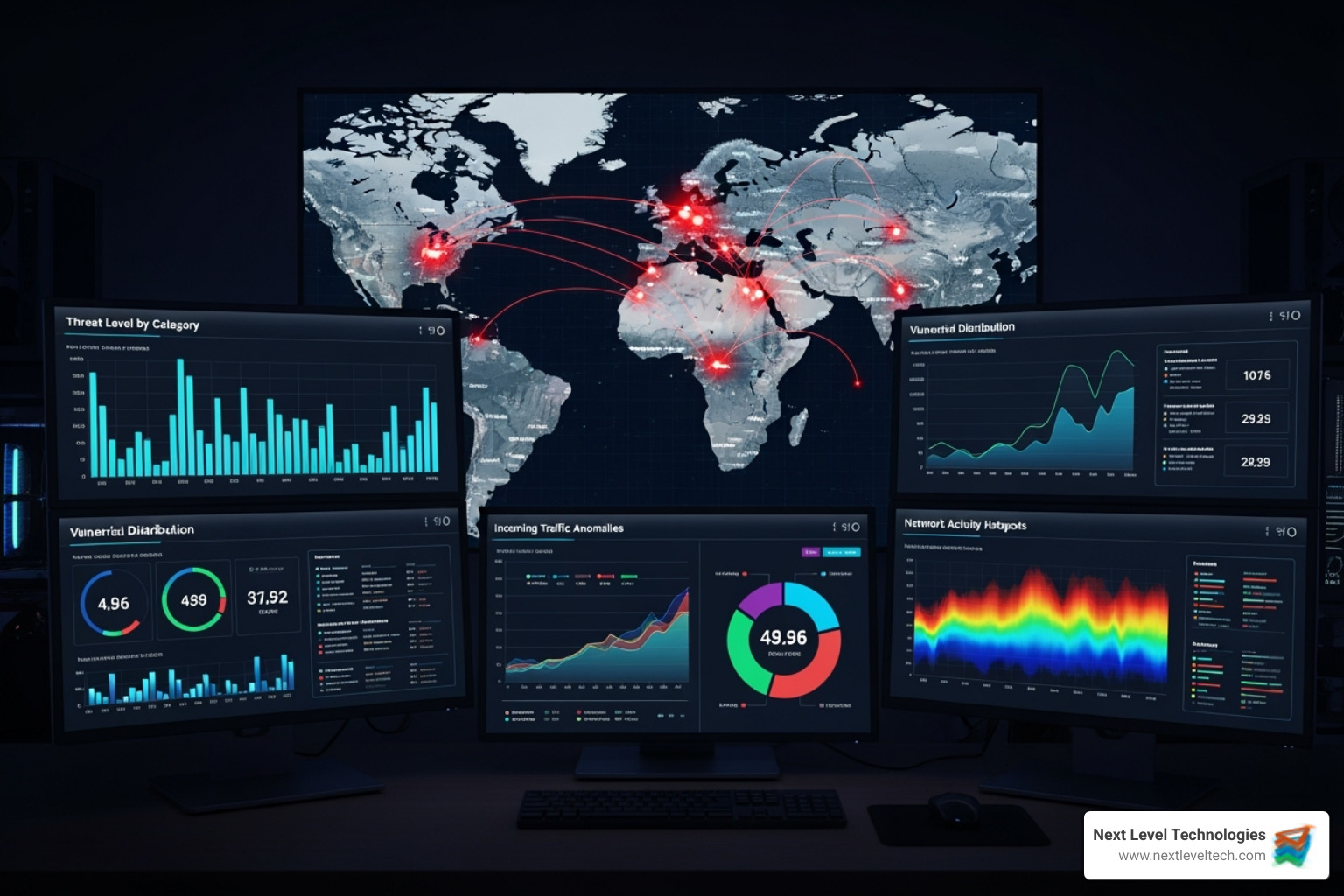
Security Operations Center Dashboard - secure data access

Step 1: Establish Strong Access Control Policies

Technology is useless without clear rules. Start with Role-Based Access Control (RBAC), assigning permissions to roles (e.g., "Sales Manager") instead of individuals. This simplifies management and reduces risk when employees change roles. For higher security, Attribute-Based Access Control (ABAC) uses multiple factors—like user role, location, and time of day—to make granular access decisions.

Crucially, you must conduct regular access reviews to remove outdated permissions. Our team helps clients implement IT Security Policy Compliance frameworks to ensure this happens. Your policies should define user authentication standards (requiring MFA), role definitions, data classification, access request processes, and incident response procedures.

Step 2: Leverage Modern Security Technologies

Policies need technology for enforcement. Our extensive cybersecurity training keeps us current on the most effective tools.
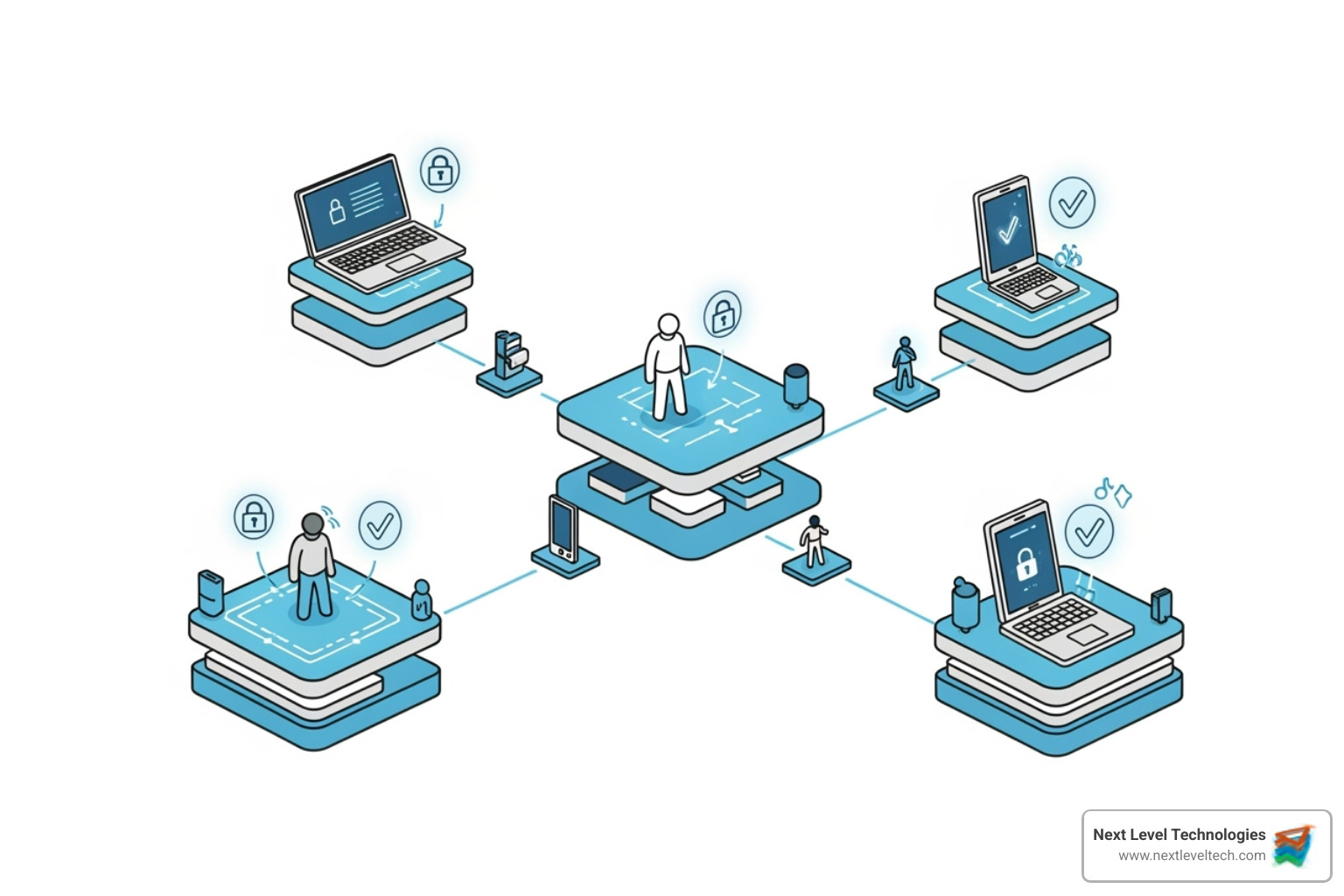
  • Zero Trust Architecture is a modern necessity. It abandons the old "trust but verify" model for "never trust, always verify." Every access request is scrutinized, which drastically limits an attacker's ability to move through your network if they breach the perimeter. Explore the technical details in this overview of Zero Trust principles.
  • Data Loss Prevention (DLP) solutions monitor and block unauthorized attempts to move sensitive data, such as emailing customer lists or uploading files to personal cloud storage.
  • Tokenization and data masking replace sensitive data (like credit card numbers) with non-sensitive placeholders (tokens), protecting the real data in a breach.
  • Modern encryption, including hardware security modules (HSMs) and client-side encryption, provides advanced protection for data and encryption keys. Our Advanced Threat Protection Solutions combine these technologies for a coordinated defense.

Zero Trust Model Illustration - secure data access

Step 3: Secure Your Modern Work Environments

Cloud services and remote work require specific security measures. Our teams in Columbus, OH, and Charleston, WV, have deep technical expertise in securing these distributed environments.

  • Cloud security operates on a shared responsibility model. The provider secures the infrastructure, but you are responsible for configuring access controls, encrypting data, and monitoring your cloud environment. Misconfigurations are a common vulnerability. Our Cloud Security Best Practices guide helps prevent them.
  • Securing remote work requires moving beyond traditional VPNs. Secure Access Service Edge (SASE) is a cloud-based approach that combines network security with Zero Trust principles, giving remote users secure access only to the resources they need. Before granting access, systems should check device posture (e.g., is antivirus updated?) and always enforce Multi-Factor Authentication (MFA). Our Remote Work Security Solutions Guide covers the essential technologies and policies.

The Human Element: Compliance, Training, and Incident Response

Even the best technology can't stop a user from clicking a malicious link. The fact that 95% of data breaches involve human error is a wake-up call: your people are your most critical security layer. At Next Level Technologies, our highly trained staff in Columbus, OH, and Charleston, WV, understands that creating a security-conscious culture is paramount. Our extensive cybersecurity training has proven that educated employees are the best defense for secure data access.

A team participating in a cybersecurity training session - secure data access

The data protection landscape is complex and filled with regulations that have serious penalties.

  • GDPR (General Data Protection Regulation) applies if you handle data of EU citizens, with fines up to 4% of global annual turnover or €20 million. It mandates consent, breach notifications, and data subject rights. The GDPR guidance from the ICO is an excellent resource.
  • HIPAA (Health Insurance Portability and Accountability Act) governs protected health information in the US. Violations can lead to fines up to $50,000 per offense and potential prison time.
  • PCI DSS (Payment Card Industry Data Security Standard) is required for processing credit cards. Non-compliance can result in fines up to $100,000 per month and loss of payment processing ability.
  • CCPA (California Consumer Privacy Act) gives California residents rights over their personal data, with penalties up to $7,500 per intentional violation.

Our team's technical expertise can help you steer these requirements, which are detailed in our guide on Understanding IT Compliance Requirements for Different Industries.

Here's a quick comparison of these major regulations:

RegulationScopeKey RequirementsPenalties for Non-Compliance
GDPRPersonal data of EU citizensConsent for data processing, data breach notification (72 hrs), data subject rights (access, erasure), data protection by design.Up to 4% of global annual turnover or €20 million.
HIPAAProtected Health Information (PHI) in the USAdministrative, physical, and technical safeguards for PHI; privacy rule, security rule, breach notification rule.Up to $50,000 per violation, max $1.5M/year, criminal charges.
CCPAPersonal information of California consumersRight to know, delete, and opt-out of sale of personal information; non-discrimination for exercising rights.Up to $7,500 per intentional violation, $2,500 per unintentional violation.

The Critical Role of Employee Education

Attackers are experts at psychological manipulation, so your team needs the skills to recognize threats.

  • Cybersecurity training programs must be regular and engaging, not just an annual checkbox.
  • Phishing simulations are invaluable. They provide a safe way for employees to practice identifying malicious emails, turning mistakes into learning moments. Our extensive cybersecurity training experience shows this dramatically improves vigilance.
  • Social engineering awareness teaches your team to recognize manipulation tactics like pretexting and baiting.
  • Clear reporting procedures empower employees to raise the alarm immediately when they spot something suspicious, which is crucial for rapid incident response. Our approach to Cybersecurity Solutions for Education demonstrates how continuous learning transforms security.

Preparing for the Worst: Incident Management

No security is perfect, so you must prepare for a breach. A documented Incident Response Plan (IRP) is your playbook for a crisis. It outlines steps for detection, response, and recovery.

  1. Containment: Immediately isolate affected systems to stop the threat from spreading.
  2. Eradication: Completely remove the threat from your environment to prevent it from returning.
  3. Recovery: Restore systems and data from clean backups. This is why solid Data Backup and Recovery practices are non-negotiable.
  4. Post-Incident Analysis: Review what happened to learn from the event and strengthen your defenses.

Our team's technical expertise in IT Security Incident Management helps businesses in Columbus, OH, and Charleston, WV, develop and test an effective IRP.

Frequently Asked Questions about Data Access Security

Here are answers to the most common questions we hear from businesses in Columbus, Ohio and Charleston, WV.

How does a Zero Trust model improve secure data access?

Traditional security trusts anyone inside the network. Zero Trust operates on the principle of "never trust, always verify," scrutinizing every single access request, regardless of its origin. This improves secure data access by:

  • Reducing the attack surface: An attacker who gets inside can't move freely.
  • Enforcing least-privilege access: Users get only the exact permissions they need.
  • Increasing visibility: All access attempts are logged and analyzed, making it easier to spot suspicious activity.
  • Enabling context-aware security: Access decisions are based on user identity, location, device health, and other factors.

Our team's extensive cybersecurity training allows us to implement practical Zero Trust architectures for your business.

What is the first step a small business should take to improve data security?

The crucial first step is to conduct a comprehensive IT security assessment. You can't protect what you don't understand. An assessment will:

  1. Identify where your sensitive data lives.
  2. Evaluate your current access controls.
  3. Pinpoint vulnerabilities like outdated software or weak permissions.

Based on the findings, you can prioritize actions. For most small businesses, this means implementing Multi-Factor Authentication (MFA), applying the principle of least privilege, and starting basic employee security training. Our team at Next Level Technologies specializes in helping businesses in Columbus, OH, and Charleston, WV, with these assessments, providing actionable recommendations that fit your budget.

How often should we conduct security audits and employee training?

More often than you think. Security is an ongoing process, not a one-time event.

  • Security Audits: Conduct formal, comprehensive audits at least annually, or more frequently if your business undergoes significant changes. This should be supplemented with continuous monitoring. We also recommend annual penetration testing by an external team.
  • Employee Training: Provide comprehensive awareness training at least annually, but more frequent touchpoints are better. Use quarterly phishing simulations and monthly security tips to keep awareness high. New hires should be trained during onboarding.

Cyber threats evolve constantly, so your defenses must too. Our team's extensive cybersecurity training ensures we can help you build an audit and training schedule that effectively protects your business.

Conclusion

The journey through secure data access reveals a clear truth: protecting your data is the foundation of your business. Customer trust, operational stability, and your reputation all depend on it. The question isn't whether you can afford to invest in security, but whether you can afford not to.

We've covered the building blocks: Authentication, Authorization, and Encryption. But technology alone isn't enough. A security-conscious culture, built through regular training and backed by a solid incident response plan, is just as critical.

Keeping up with evolving threats and regulations is a full-time job. This is where expert guidance is invaluable. At Next Level Technologies, our teams in Columbus, OH, and Charleston, WV, use their extensive cybersecurity training and technical expertise to build security strategies that work. We provide enterprise-level protection without the complexity, simplifying security so you can focus on your business.

The threats are real, but so is our commitment to protecting you. If you're ready for comprehensive protection that provides peace of mind, let's talk.

Strengthen your security with expert Managed IT Services and Support

Next Level Technologies

Our Latest Blog Posts

APM Explained Optimizing Your IT Application Portfolio

Master it application portfolio management. Optimize IT costs, reduce complexity, and align strategy for business growth.

December 4, 2025

The ABCs of Computer Hardware and Networking: Learn the Essentials

Learn basic computer hardware and networking essentials. Discover components, connections, and how your digital world operates. Start here!

December 2, 2025