Smart Health IT and Why Your Data Needs a Brain
April 8, 2026


Discover how a healthcare management services organization boosts practice efficiency, cuts overhead, and protects clinical autonomy.
October 3, 2026

Master denial management in medical billing with proven strategies to reduce denials, boost appeals success, and protect revenue cycle performance.
September 25, 2026

Compare the best healthcare learning management platforms for providers with Next Level Technologies, serving Columbus, Ohio and Charleston, WV.
September 19, 2026
April 8, 2026
IT for health — short for health information technology — is the use of digital tools to collect, store, manage, and share medical information. Here's a quick breakdown:
Health IT (HIT) means electronic systems used to manage patient health data.
EHR means a digital record of a patient's full medical history.
Health Information Exchange (HIE) means securely sharing patient data across providers.
Telehealth means remote care delivered through video, sensors, or apps.
Clinical Decision Support means alerts and tools that help providers make better care decisions.
Think of health IT as the nervous system of modern healthcare. Without it, critical patient data gets lost between providers, errors slip through the cracks, and care becomes fragmented.
The numbers tell a clear story. As of 2019, 84% of nursing homes had adopted an EHR system — up from less than two-thirds in 2016. Yet nursing homes still lag far behind hospitals, where 96% had EHRs by 2016. That gap has real consequences: 1 in 5 Medicare beneficiaries experiences an adverse event within 35 days of a nursing home admission, and nearly 60% of those events are preventable.
Health IT isn't just a back-office upgrade. It's a patient safety issue.
I'm Steve Payerle, President of Next Level Technologies, and I've spent over 15 years helping businesses — including healthcare organizations across Columbus, Ohio and Charleston, WV — build secure, efficient IT infrastructures that protect sensitive data. My team's deep cybersecurity expertise makes us uniquely positioned to guide organizations through the complexities of IT for health. In the sections ahead, we'll break down everything you need to know — from EHR basics to emerging innovations — so you can make smarter decisions about your health IT strategy.
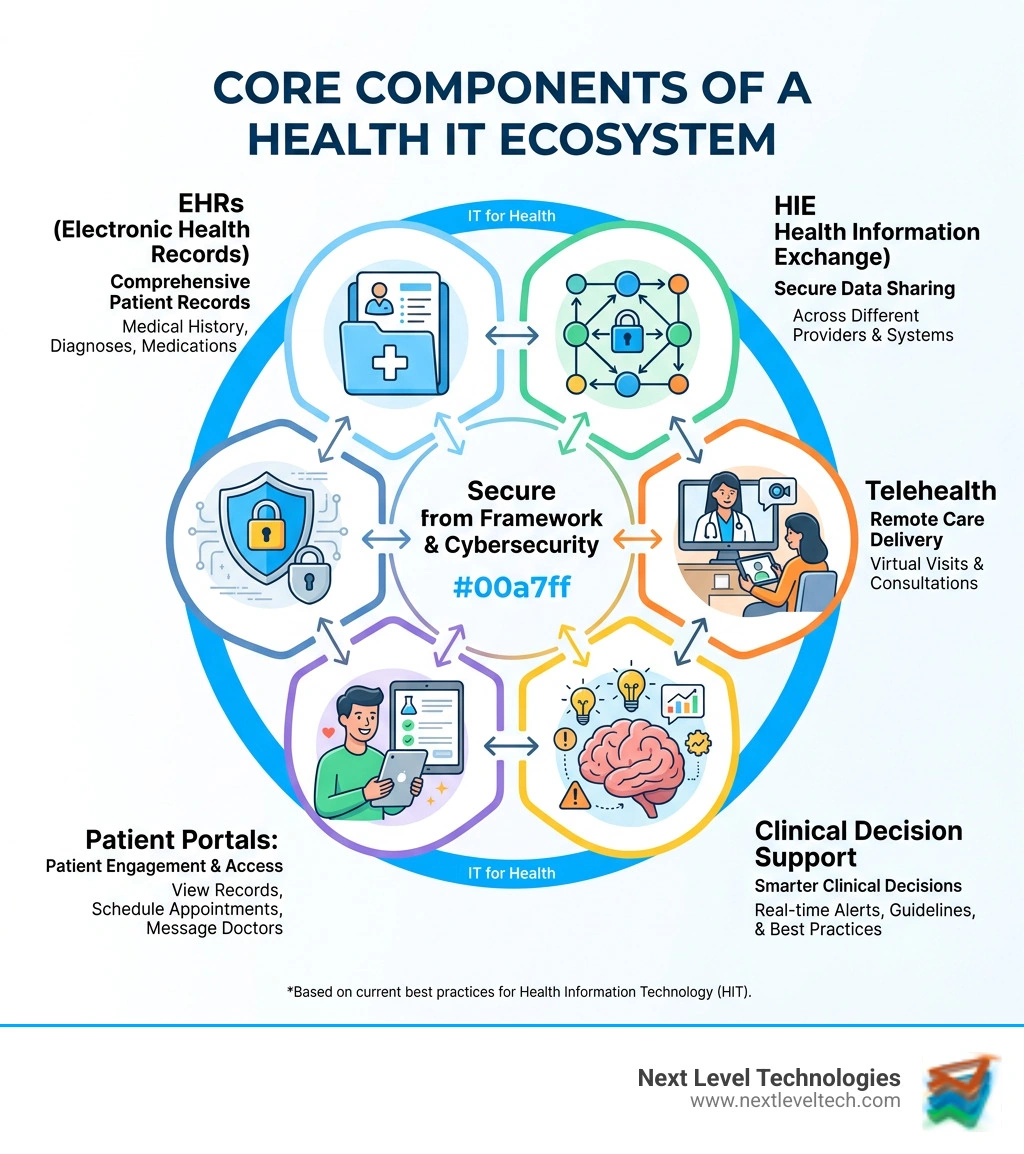
When we talk about it for health, we aren't just talking about replacing a paper clipboard with a PDF. True Health Information Technology (HIT) involves the comprehensive electronic processing, storage, and exchange of health information in a secure environment. It is the framework that allows electronic Protected Health Information (ePHI) to move safely from a specialist in Columbus to a primary care physician in Worthington, or a nursing home in Charleston.
At its core, HIT is designed to improve the quality of healthcare, prevent medical errors, and reduce costs by increasing efficiency. It’s about making sure the right person has the right data at the exact moment they need to make a clinical decision. However, this exchange doesn't happen in a vacuum. To work, these systems must follow strict Privacy and Security Framework guidelines. These principles—including individual choice, transparency, and robust safeguards—ensure that while data is accessible to providers, it remains locked away from cybercriminals.
In long-term care, the "brain" of your data needs to be particularly sharp. Unlike a quick visit to an urgent care clinic, nursing home care involves long-term monitoring of complex populations with multiple chronic conditions. This is where specialized it for health becomes a literal lifesaver.
Nursing homes rely on the Minimum Data Set (MDS 3.0), a standardized assessment tool that tracks resident health. When this data is integrated into a smart HIT system, it supports person-centered care planning. Instead of a generic care track, the technology helps staff notice subtle changes in a resident’s condition over months or years. We believe that providing IT Support for Healthcare in these settings requires a deep understanding of these long-stay requirements, ensuring that the technology supports the staff rather than burdening them.
It’s easy to get lost in the alphabet soup of medical tech. While people often use these terms interchangeably, they serve very different purposes in the it for health ecosystem:
For providers, having the right Electronic Health Record Support is what turns a digital filing cabinet into a tool for better outcomes.
The road to digital transformation hasn't been equally smooth for everyone. While the HITECH Act poured $35 billion into EHR adoption for hospitals and physicians, nursing homes were largely excluded from those federal financial incentives. This created a significant digital divide.
As noted in the National Academies of Sciences, Engineering, and Medicine report on nursing home quality, this lack of funding has turned many nursing home EHRs into "data silos." Even if a facility has an EHR, they might not be able to easily send that data to a local hospital. This is why we focus so heavily on interoperability in our Healthcare Management IT Services Guide. True it for health means that when a resident is transferred, their medication list and care plan arrive at the hospital before they do.
For our partners in more rural parts of West Virginia or the outskirts of the Ohio Tri-state area, the challenges are even steeper. High-speed broadband access isn't always a given, and smaller facilities often lack the budget for a full-time IT department.
Technical equity is a major concern. If a rural nursing home can't access the same high-level data exchange as a large facility in Columbus, the residents suffer. We bridge this gap through Consulting Healthcare IT, helping smaller facilities implement lean, cloud-based infrastructures that provide "big city" connectivity without the "big city" price tag.
The most compelling reason to invest in it for health is simple: it saves lives. Statistic about preventable adverse events? Many of those are medication errors or missed signs of infection during a transition of care.
When systems talk to each other, the results are staggering. For example, the Missouri Quality Initiative utilized Health Information Exchange (HIE) to reduce hospitalizations by 40%. Even more impressive, they saw a nearly 60% decrease in potentially avoidable hospitalizations over eight years. By using Data Analytics Healthcare, providers can spot trends—like a sudden spike in falls or a specific floor's infection rate—and intervene before a crisis occurs.
We’ve all heard about physician and nurse burnout. A major culprit is "technology overload." If a nurse has to fight with a slow computer or click through 20 screens to document a single pill, the technology has failed.
Smart it for health solves this through:
Effective Healthcare IT Service Management focuses on the "user experience" of the clinician, ensuring the tech is a help, not a hurdle.
We are entering an era where it for health looks like something out of a sci-fi movie. Assistive technologies are moving from research labs into actual resident rooms.
To support these innovations, the backbone of the facility must be strong. This is why many are moving toward Cloud Computing Healthcare models that can handle the massive data loads these sensors and robots generate.
The pandemic was a trial by fire for it for health. When visitation was banned, technology became the only link between residents and their families. Facilities that already had robust Wi-Fi and tablet programs fared much better.
Beyond Zoom calls, HIT played a massive role in infection control. Surveillance dashboards allowed facilities to track PPE levels and infection spikes in real-time. We also saw the rise of TEFCA (the Trusted Exchange Framework and Common Agreement), which is working to create a "network of networks" so that health data can be shared nationally as easily as we swipe a credit card. Our work in Healthcare Network Security Services ensures that as these networks expand, they remain impenetrable to hackers who targeted healthcare facilities during the height of the crisis.
The biggest hurdles are high upfront costs and a lack of the same federal incentives that hospitals received. Additionally, many facilities struggle with interoperability—the ability for different systems to "talk" to one another. Finally, there is a significant training gap; without ongoing support, staff may revert to paper "workarounds" that compromise safety. This is why IT Support for Medical Practices must include a heavy emphasis on staff education.
HIT moves us away from "one-size-fits-all" care. By using standardized assessments and real-time data, care plans can be updated daily based on a resident's actual needs. It also allows for better family engagement, as portals can keep loved ones informed about care milestones and daily activities.
Sensors are the future of "passive" monitoring. They can track vitals, sleep patterns, and movement without requiring a resident to push a button or wear a bulky device. This leads to early illness detection—spotting a UTI or heart failure symptoms days before they become an emergency.
At Next Level Technologies, we believe that it for health should be a tool for empowerment, not a source of frustration. Whether you are operating a practice in Columbus, Ohio, or a skilled nursing facility in Charleston, WV, your data deserves a "brain" that can organize, protect, and utilize it to its fullest potential.
Our team brings extensive cybersecurity training and technical experience to every project. We understand that in healthcare, a "server down" message isn't just an inconvenience—it’s a disruption to patient care. By providing comprehensive Managed IT Services and IT Support, we handle the "bits and bytes" so you can focus on the hearts and minds of your patients. Let's work together to make your healthcare technology go to the next level.
Discover how a healthcare management services organization boosts practice efficiency, cuts overhead, and protects clinical autonomy.
October 3, 2026
Master denial management in medical billing with proven strategies to reduce denials, boost appeals success, and protect revenue cycle performance.
September 25, 2026
