The Definitive Guide to Comparing Infrastructure Management Services
August 1, 2026


Compare cloud backup services with this guide to backup cloud database service architecture, security, and disaster recovery.
September 12, 2026
Compare cloud based backup services with our ultimate checklist covering encryption, recovery, and compliance for your business.
September 5, 2026

Protect your business with expert Phishing protection Columbus services from Next Level Technologies, based in Columbus, Ohio and Charleston, WV.
August 27, 2026
August 1, 2026
Infrastructure management services are the processes, tools, and support systems that keep your IT environment — servers, networks, cloud platforms, and software — running reliably, securely, and efficiently.
Here's a quick breakdown of what they cover:
The goal is simple: keep your business running without interruption, while controlling costs and reducing risk.
For mid-sized businesses in particular, this is no longer optional. Organizations today face a growing gap between the complexity of their IT environments and their internal capacity to manage them. According to industry research, 60% of server downtime events are caused by configuration errors — not hardware failures. That's a people-and-process problem, not a technology one.
And the stakes are rising. While 77% of executives say they need to adopt generative AI to stay competitive, only 25% believe their current IT infrastructure can actually support it. The gap between ambition and readiness is widening fast.
Whether you're a healthcare organization navigating HIPAA compliance, a professional services firm trying to eliminate downtime, or a non-profit stretching a tight IT budget — understanding your infrastructure management options is the critical first step.
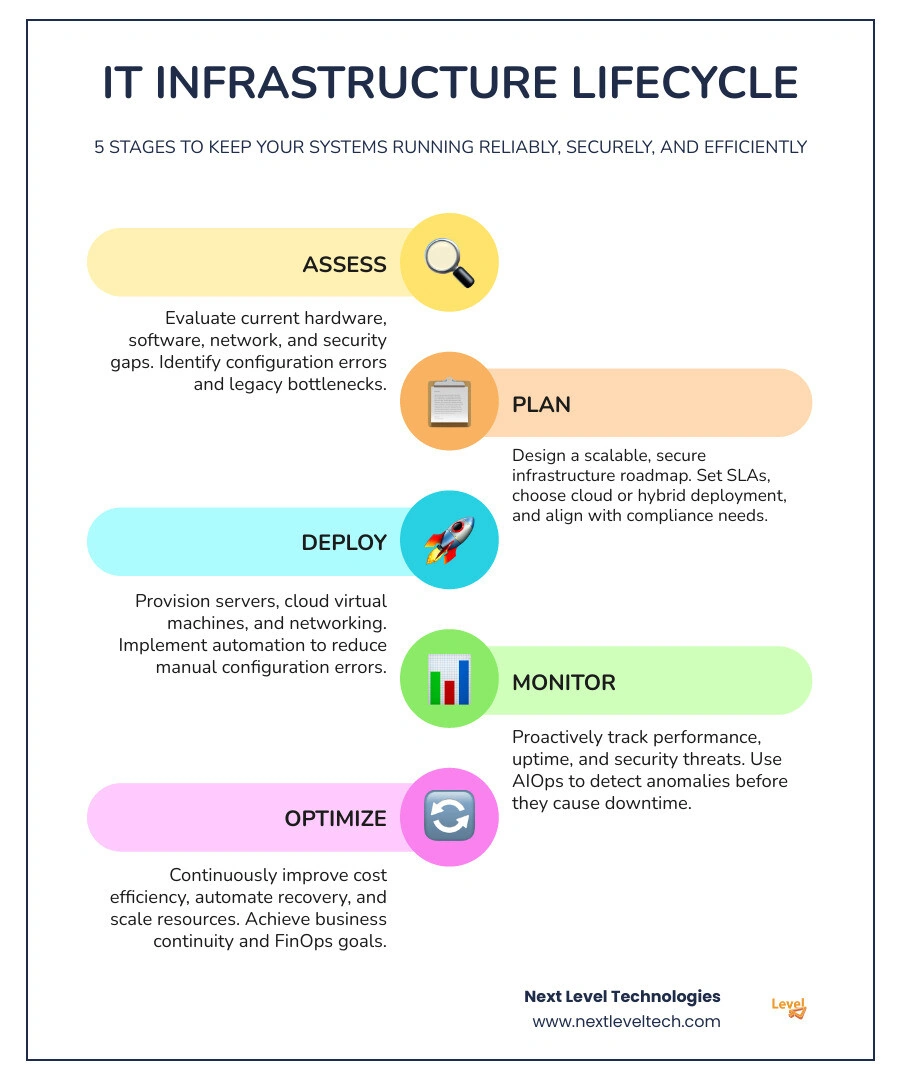
Infrastructure management services further reading:
At its heart, IT infrastructure management is the discipline of keeping your organization's digital core healthy. Think of it as the central nervous system of your business. Without a stable foundation, daily operations sputter: emails drop, databases freeze, customer-facing portals go offline, and employees find themselves locked out of critical applications.
In modern business, your digital core directly dictates your operational efficiency and capacity to scale. However, maintaining this digital core has become increasingly difficult due to the accumulation of legacy systems. Many organizations fall into a costly trap: they spend the majority of their IT budget simply keeping outdated servers alive, leaving almost nothing for strategic growth.
Industry data highlights this ongoing struggle:
When we ignore the health of our infrastructure, we don't just risk slow load times; we actively threaten our business continuity. A single major network outage or server crash can cost thousands of dollars per minute in lost productivity and compromised customer trust. Effective infrastructure management shifts your organization from a reactive "break-fix" cycle to a proactive, highly optimized state. By establishing robust management practices, you ensure that your technology acts as a springboard for growth rather than a financial anchor.
For a comprehensive look at how to evaluate and structure your internal systems, you can check out our IT Infrastructure Management Complete Guide.
An enterprise IT environment is composed of three primary pillars. These components must work in perfect harmony to support modern software applications and secure data flows.
To keep these pillars standing strong, high-performing organizations rely on enterprise infrastructure standards. Frameworks like the Information Technology Infrastructure Library (ITIL) help align IT services directly with broader business objectives, ensuring that every piece of hardware, software, and networking gear serves a clear operational purpose.
Managing these pillars comes with several challenges. Today, organizations face three major roadblocks: legacy system maintenance, escalating security risks, and severe talent shortages.
To overcome these hurdles, organizations must prioritize technical experience and extensive cybersecurity training for their IT staff. When your internal teams or external partners undergo rigorous, continuous training, they are far better equipped to preemptively identify vulnerabilities and manage complex environments.
If you are unsure where your systems currently stand, starting with a professional evaluation is highly recommended. Our IT Infrastructure Assessment Complete Guide provides a step-by-step framework to help you identify hidden bottlenecks, security gaps, and legacy liabilities before they cause unexpected downtime.
When people search for "infrastructure management," they are often surprised to find that the term spans two entirely different worlds: the physical, civil engineering world of municipal assets, and the digital world of enterprise IT and cloud ecosystems. Understanding the scope of these services is critical to choosing the right partner.
To appreciate the diversity of this industry, let's look at how physical municipal infrastructure management compares to digital IT infrastructure management.
In the physical world, civil infrastructure services focus on assets like roads, highways, and public pathways. For example, municipalities and state departments of transportation utilize specialized equipment like automated laser condition survey (LCMS-2) vans to map roadway health. They use Sidewalk Surface Testers (SST) to automate pedestrian walkway evaluations, and perform Falling Weight Deflectometer (FWD) testing on active highways to measure pavement strength under load. These physical programs rely heavily on civil engineering standards like ASTM (American Society for Testing and Materials) and AASHTO (American Association of State Highway and Transportation Officials) to ensure public safety and allocate municipal budgets.
In stark contrast, digital infrastructure management services focus on the virtual and logical assets that power businesses. Instead of surveying asphalt, digital infrastructure managers oversee servers, virtual machines, local networks, cloud databases, and cybersecurity systems. Rather than ASTM standards, digital services are guided by the ITIL framework, which standardizes IT service delivery, incident response, and change management.
While the physical side keeps our vehicles moving safely on the road, the digital side keeps our data flowing securely through the wire. For modern businesses, our focus is almost exclusively on digital and cloud infrastructure management—ensuring that our servers and cloud environments remain online, secure, and ready to scale.
Selecting the right provider for your digital infrastructure is one of the most consequential decisions your leadership team will make. The right partner can transform your IT from a frustrating cost center into a powerful engine of growth.
When evaluating potential partners, look closely at their service delivery metrics and operational models. Many traditional providers rely solely on Service Level Agreements (SLAs), which measure purely technical metrics like "99.9% server uptime." While SLAs are important, modern infrastructure management is shifting toward Experience Level Agreements (XLAs). XLAs measure how those technical systems actually impact your employees and customers—tracking user satisfaction, support responsiveness, and overall digital workplace productivity.
For mid-sized businesses in Ohio and West Virginia, relying on massive global integrators often leads to slow response times and generic, cookie-cutter solutions. That is why local support in Columbus, OH and Charleston, WV is so valuable. A local partner understands the unique challenges of regional healthcare networks, professional firms, and non-profits, and can provide fast, on-site assistance when physical hardware issues arise.
Furthermore, make sure your partner's staff possesses deep technical experience and extensive cybersecurity training. When security breaches can ruin a business overnight, having certified, highly trained local engineers managing your systems is your best line of defense. The value of this specialized support is clear: 82% of companies that fully achieve their desired cloud outcomes rely heavily on managed services to guide their journey.
Optimizing your IT infrastructure requires moving away from reactive troubleshooting and embracing proactive, automated management strategies. When systems are standardized and monitored continuously, performance improves, security risks drop, and operational costs plummet.
Modern infrastructure management is being revolutionized by three core disciplines: AIOps (Artificial Intelligence for IT Operations), intelligent automation, and FinOps (Financial Operations).
By integrating machine learning into monitoring tools, AIOps can predict hardware failures and identify network anomalies before they impact your users. Automation takes this a step further by executing self-healing runbooks—automatically restarting failed services, deploying security patches, and provisioning resources without requiring human intervention. This proactive approach dramatically reduces human error, which is crucial given that 60% of server downtime events are caused by configuration errors.
Meanwhile, FinOps focuses on cloud cost optimization. In hybrid and multi-cloud environments, it is incredibly easy for cloud spending to spiral out of control due to idle virtual machines and over-provisioned storage. FinOps practices introduce financial accountability to the cloud, using tagging, rightsizing, and automated scheduling to eliminate waste.
The financial and operational impact of combining these modern strategies is massive:
However, adopting these technologies requires careful planning. As mentioned earlier, there is a stark 77% vs. 25% AI readiness gap: while 77% of executives feel pressured to adopt generative AI quickly, only 25% believe their infrastructure is mature enough to support it. Bridging this gap requires a structured modernization roadmap. For businesses looking to implement advanced DevOps pipelines, automated incident response, and cloud optimization frameworks, partnering with an experienced IT provider that offers deep technical experience and extensive cybersecurity training can provide the necessary support to transition successfully.
A resilient infrastructure strategy relies heavily on virtualization, hybrid cloud models, and robust disaster recovery planning.
Virtualization abstracts physical hardware, allowing a single physical server to run multiple independent virtual machines. This drastically reduces your physical hardware footprint, lowers energy costs, and makes your workloads highly portable. If a physical server needs maintenance, virtual machines can be migrated to another host with zero downtime.
In a hybrid cloud environment, organizations combine on-premise hardware with public cloud services. This offers the ultimate flexibility: sensitive data (such as patient medical records) can be stored securely on local servers to satisfy strict compliance regulations, while scalable cloud resources handle day-to-day application workloads.
However, even the most advanced hybrid cloud environments are vulnerable to natural disasters, power outages, and cyberattacks. That is why a comprehensive disaster recovery plan is non-negotiable. To build an effective plan, organizations must conduct a thorough Business Impact Analysis (BIA) to establish two critical metrics:
By establishing clear RTOs and RPOs, you can design automated backup schedules and failover systems that ensure your business survives even the worst-case scenarios. If you are running a smaller organization and want to learn how to implement these enterprise-grade strategies on a realistic budget, take a look at our guide on IT Infrastructure for Small Business.
The three main areas are hardware (physical servers, storage devices, and data centers), software (operating systems, hypervisors, and core business applications), and networking (routers, switches, firewalls, and internet connectivity). These three pillars must work together seamlessly to support your business applications.
A Service Level Agreement (SLA) is a technical contract that measures system-centric performance, such as "99.9% network uptime" or "response to critical tickets within 1 hour." An Experience Level Agreement (XLA) focuses on the human element, measuring how those systems affect user satisfaction, employee productivity, and overall business outcomes. XLAs ensure that IT services actually work well for the people using them.
Legacy systems are highly complex, difficult to secure, and prone to failure. They create a massive financial drain, with 56% of executives reporting that the cost of maintaining old hardware and software leaves them with too little budget to invest in modernization. This technical debt limits innovation and prevents companies from adopting modern technologies like cloud computing and AI.
Managing a modern IT infrastructure is a complex, high-stakes responsibility. Between rising cybersecurity threats, complex hybrid cloud environments, and the constant pressure to modernize, small and mid-sized businesses need more than just a basic IT support line—they need a strategic partner.
At Next Level Technologies, we provide proactive managed IT services, advanced cloud solutions, and enterprise-grade cybersecurity to businesses across Columbus, Ohio and Charleston, West Virginia. With more than 20 years of experience, our local teams specialize in helping healthcare organizations, professional services firms, and non-profits eliminate downtime, maintain strict HIPAA compliance, and scale with absolute confidence.
What sets us apart is our commitment to technical excellence. Our local engineers undergo extensive cybersecurity training and possess deep technical experience, ensuring that your network is monitored, optimized, and protected by highly qualified professionals. Whether you are looking to secure your hybrid cloud, optimize your server performance, or implement a bulletproof disaster recovery plan, we deliver enterprise-grade technology with fast local response times and predictable monthly costs.
Stop letting legacy bottlenecks and IT worries hold your business back. Let us modernize and protect your digital core so you can focus on what you do best.
Ready to take your technology to the next level? Explore our Managed IT Services and IT Support today to partner with local experts who are dedicated to your long-term success.
Compare cloud backup services with this guide to backup cloud database service architecture, security, and disaster recovery.
September 12, 2026
Compare cloud based backup services with our ultimate checklist covering encryption, recovery, and compliance for your business.
September 5, 2026

