Why Offshore Software Development Matters for Growing Businesses
Offshore software development is the practice of hiring a software development team located in a different country—typically one with a significant time zone difference—to build, maintain, or improve your software products and systems. Companies choose this approach to:
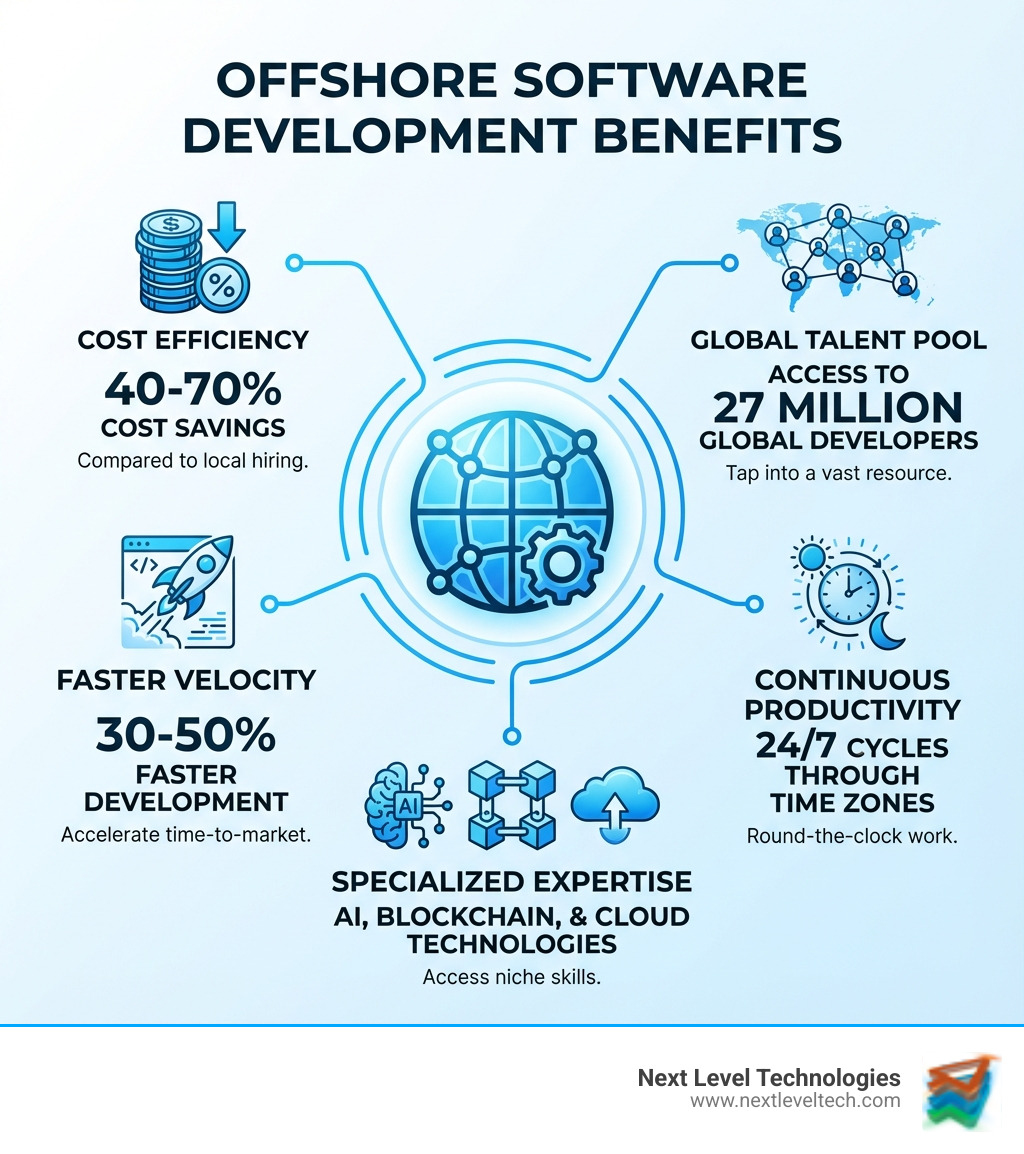
- Reduce costs by 40-70% compared to local hiring
- Access specialized talent in areas like AI, cybersecurity, and cloud infrastructure
- Scale teams quickly without the delays of local recruitment
- Accelerate time-to-market through 24/7 development cycles
- Focus internal resources on core business functions
Picture this: it's 3 AM in Columbus, and while your team sleeps, skilled developers halfway around the world are bringing your software vision to life. This isn't science fiction—it's the reality of modern offshore software development, and it's reshaping how mid-sized businesses compete in the digital economy.
The numbers tell a compelling story. The global IT outsourcing market reached $318.5 billion in 2020 and is projected to hit $425.19 billion by 2026. Meanwhile, 58% of tech companies now use offshore talent, with 75% calling it critical for maintaining competitiveness. The reason? A senior software engineer costs $120K-$150K annually in the U.S., but an equally skilled developer in Eastern Europe runs $40K-$70K.
But here's what most articles won't tell you: offshore development isn't just about saving money. It's about solving the talent shortage crisis. It's about building products faster when your market window is narrow. It's about accessing specialized skills—blockchain experts, AI engineers, DevOps specialists—that you simply can't find locally, or can't afford to hire full-time.
The COVID-19 pandemic accelerated this shift dramatically. Remote work went from "nice to have" to standard practice overnight, erasing the psychological barriers that once made offshore teams seem risky. Today, companies like Microsoft, Google, and IBM have proven that distributed teams can deliver world-class products—and mid-sized businesses are following their lead.
Yet offshore development comes with real challenges. Communication gaps. Time zone juggling. Quality concerns. Security risks. The difference between success and failure isn't whether you offshore—it's how you offshore. The right partner, clear processes, and proactive management turn these challenges into advantages.
I'm Steve Payerle, President of Next Level Technologies, where we've helped businesses across Columbus, Ohio, and Charleston, WV, steer complex IT decisions for over a decade. While we specialize in managed IT services and cybersecurity, I've guided countless clients through offshore software development partnerships, helping them avoid costly mistakes and build successful distributed teams.
Understanding the Landscape: What is Offshore Development?
So, what exactly is offshore software development? At its core, it's about extending your team beyond geographical borders to leverage global talent and resources. It's a strategic move that can dramatically impact your business's agility and competitiveness.
Let's clarify the terminology, as these terms are often used interchangeably, but they each have distinct meanings:
- Outsourcing: This is the broadest term. It simply means delegating a task or process to a third-party outside your organization. This third party could be down the street or across the globe.
- Onshoring: This is a type of outsourcing where you hire a third-party company within your own country. For a business in Columbus, Ohio, onshoring would mean hiring a development firm in, say, California or even West Virginia. The key is that they're in the same country.
- Nearshoring: This involves outsourcing to a neighboring country or one within a similar time zone (typically within a 1-4 hour difference). For companies in the U.S., Mexico or Canada are common nearshoring destinations. This offers some cost benefits while minimizing time zone challenges.
- Offshoring: This is outsourcing to a geographically distant country, often on a different continent, resulting in a significant time zone difference (e.g., 8+ hours). This model typically offers the greatest cost savings and access to vast talent pools, but it also introduces unique communication and management considerations.
The key differentiator for offshore software development is that significant time zone difference. This isn't just a logistical hurdle; it can be a strategic advantage, enabling "follow-the-sun" development cycles where work continues almost 24/7. This allows us to tap into a global talent pool estimated at around 27 million developers.
Here’s a quick overview to help us distinguish these models:
| Feature | Onshoring | Nearshoring | Offshoring |
|---|
| Location | Same country | Neighboring country or similar time zone | Geographically distant country/different continent |
| Cost | Highest | Moderate | Lowest |
| Time Zone | Same or minimal difference | Minimal to moderate difference (1-4 hours) | Significant difference (8+ hours) |
| Communication | Easiest (often in-person) | Relatively easy (some overlap) | Requires careful planning (asynchronous, overlap) |
For more insights into leveraging external expertise, explore our Outsourced IT Services.
Commonly Outsourced Services
Modern offshore software development has evolved far beyond simply handing over basic coding tasks. Today, it encompasses a vast array of specialized services that can significantly boost your company's capabilities. Here are some of the most common types of services we see businesses in Columbus and Charleston successfully offshoring:
- Custom Software Development: Building unique applications custom to your specific business needs, from internal tools to customer-facing platforms.
- Web & Mobile App Development: Creating responsive websites, sophisticated web applications, and native or cross-platform mobile apps for iOS and Android.
- AI/ML Engineering: Developing predictive analytics, machine learning models, natural language processing (NLP) integrations, and automation solutions. This is an area where specialized talent is often scarce locally.
- DevOps & Cloud Infrastructure: Setting up Continuous Integration/Continuous Deployment (CI/CD) pipelines, managing cloud environments (AWS, Azure, GCP), and ensuring infrastructure resilience.
- Cybersecurity Services: Conducting security audits, implementing robust encryption procedures, ensuring compliance with industry standards like HIPAA or SOC 2, and designing secure system architectures. Our staff at Next Level Technologies, with their extensive cybersecurity training, often partner with clients to oversee these critical aspects.
- Quality Assurance (QA) & Testing: Ensuring your software is bug-free and performs flawlessly through comprehensive testing strategies.
- Data Engineering & Business Intelligence (BI): Building scalable data pipelines, performing data ingestion and change, and creating dashboards for actionable business insights.
- Product Maintenance & Support: Providing ongoing updates, bug fixes, and technical support for existing software products.
As you can see, modern offshore software development is about strategic partnership, not just cheap labor. It's about accessing the expertise you need, when you need it, to drive your business forward.
Weighing the Pros and Cons of Offshore Software Development
Like any strategic business decision, offshore software development comes with its own set of advantages and challenges. Understanding both sides is crucial for building a successful partnership.

Primary Benefits for Your Business
When executed thoughtfully, offshore software development can be a game-changer for businesses in Columbus, Ohio, and Charleston, WV, offering significant strategic advantages:
- Cost Reduction: Often the primary driver, the salary difference is substantial. A U.S. developer earning $120K–$150K might have an equally skilled counterpart in Eastern Europe earning $40K–$70K. This can lead to savings of up to 53%, with 70% of companies citing cost reduction as their key reason for outsourcing.
- Access to Specialized Skills: The global talent pool has roughly 27 million developers. When local talent for niche technologies like AI or blockchain is scarce or expensive, offshoring provides access to a global network of experts. About 70% of companies offshore for this reason.
- Faster Time-to-Market: A "follow-the-sun" model with teams in different time zones enables 24/7 development. This round-the-clock productivity can accelerate project completion by 30-50%, getting your product to market faster.
- Scalability and Flexibility: Offshore partners make it easy to adjust team size for project needs without lengthy in-house hiring processes. You can quickly scale your team up for a large project or down after a release.
- Focus on Core Business Functions: Delegating software development allows your internal team to concentrate on strategic initiatives, innovation, and core business operations instead of getting bogged down in development tasks.
- Diverse Perspectives: An offshore team brings fresh perspectives and varied problem-solving approaches. As a Harvard Business Review study found, cognitively diverse teams solve problems faster, leading to more innovative solutions.
Deloitte's 2020 Global Outsourcing Survey highlights that 70% of respondents cited cost reduction as the key driver for outsourcing. You can dive deeper into these findings by checking out Deloitte's Global Outsourcing Survey.
Potential Risks and How to Mitigate Them
While the benefits are compelling, acknowledge and prepare for the potential risks associated with offshore software development:
- Communication Barriers: This is a frequent challenge, with 54% of offshore projects facing communication issues. Differences in language, culture, and communication styles can cause misunderstandings.
- Mitigation: Establish clear communication protocols, use visual aids (diagrams, wireframes), encourage frequent check-ins, and ensure the offshore team has strong English proficiency.
- Cultural Differences: Varying work ethics, holidays, and social norms can impact team dynamics and project timelines.
- Mitigation: Foster a culture of mutual respect and understanding. Treat the offshore team as an extension of your in-house team, and invest in cultural awareness training if necessary.
- Time Zone Challenges: While a benefit for 24/7 development, significant time differences can make real-time collaboration tricky.
- Mitigation: Schedule overlapping work hours for critical meetings, rotate meeting times, and leverage asynchronous communication tools. Plan for clear communication windows.
- Quality Control Issues: Without well-defined processes, concerns about code quality can arise. Poor software quality is costly, costing U.S. companies an estimated $2.42 trillion annually.
- Mitigation: Implement rigorous Quality Assurance (QA) processes from the outset, including regular code reviews, automated testing, and clear definition of "done." Picking an Agile team that prioritizes continuous testing can make a huge difference.
- Intellectual Property (IP) Risks: Protecting your ideas and proprietary code is paramount.
- Mitigation: Ensure robust Non-Disclosure Agreements (NDAs) and comprehensive contracts are in place, clearly defining IP ownership. Choose partners in countries with strong legal frameworks for IP protection. We recommend working with partners who demonstrate a proven track record of safeguarding client assets.
- Data Security Threats: Sharing sensitive data with an external team raises security concerns. In fact, 53% of companies identify data security as a top concern in offshore contracts.
- Mitigation: Partner with firms that adhere to international security standards (e.g., SOC 2, ISO 27001) and compliance frameworks (like HIPAA for healthcare or PCI DSS for financial data). Implement strict access controls, data encryption, and regular security audits. Our own staff at Next Level Technologies receives extensive cybersecurity training, and we always advise our clients in Columbus and Charleston to vet partners thoroughly on their security posture.
By proactively addressing these potential pitfalls with strong project management, clear communication, and a well-vetted partner, we can effectively mitigate risks and harness the full power of offshore software development. For more on managing external IT relationships, check out our insights on IT Services Outsourcing Companies.
Your Strategic Playbook for Success
Successfully navigating offshore software development isn't about luck; it's about strategy, clear processes, and fostering a true partnership. It requires proactive management and a mindset that accepts collaboration across distances.

How to Choose the Right Offshore Software Development Partner
Selecting the right partner is arguably the most critical step in your offshore software development journey. This decision will significantly influence your project's success, cost-effectiveness, and overall experience. Here's a list of key evaluation criteria we recommend for businesses in Columbus and Charleston:
- Technical Expertise & Domain Fit: Does the partner have proven experience with the specific technologies (e.g., cloud-native development, AI/ML, data engineering) and industry domain your project requires? We look for partners who can demonstrate deep technical depth and a clear understanding of our clients' business context.
- Industry Experience & Track Record: How long have they been in business? What's their portfolio like? Look for case studies that detail the problem, solution, team, tech stack, and impact.
- Security Protocols & Compliance: This is non-negotiable. Ensure the provider complies with relevant standards such as SOC 2, ISO 27001, GDPR, or HIPAA. Ask about their data protection policies, access controls, and incident response plans. Our staff's extensive cybersecurity training at Next Level Technologies means we understand the importance of this, and we guide our clients to demand the highest standards.
- Client Testimonials & Case Studies: Don't just take their word for it. Check independent review platforms like Clutch and GoodFirms, and ask for client references. Look for consistent positive feedback on their reliability, quality, and communication.
- Communication Skills & English Proficiency: Clear and effective communication is the bedrock of any successful remote collaboration. Assess their team's English language skills and their proposed communication strategy.
- Cultural Fit & Values Alignment: While cultural differences exist, look for partners whose values align with yours. Do they prioritize transparency, collaboration, and problem-solving?
- Transparent Pricing Models: Understand their pricing structure (fixed-price, time & materials, dedicated team). Ensure all costs are clear upfront to avoid hidden fees.
- Delivery Maturity & Governance: How do they manage projects? What methodologies do they use (Agile, Scrum)? What reporting and accountability structures are in place?
- IP and Security Policies: Review their contracts carefully regarding intellectual property ownership, data privacy, and security guarantees.
For startups especially, choosing the right partner can be make-or-break. Find more custom advice in our guide on IT Outsourcing for Startups.
Effectively Managing Your Offshore Team
Once you’ve found your ideal partner, the next step is effective management. This involves more than just delegating tasks; it's about integrating the offshore software development team into your workflow and fostering a cohesive unit.
- Set Clear Goals & KPIs: Define project objectives, deliverables, and Key Performance Indicators (KPIs) upfront. Break down larger goals into manageable milestones. As Forbes suggests, "breaking up goals helps both you and your remote team visualize your targets."
- Establish Communication Protocols: Set clear expectations for communication frequency, preferred channels (e.g., daily stand-ups via video, asynchronous updates via Slack or Jira), and response times. Consistency is key.
- Use Project Management Tools: Leverage tools like Jira for task tracking, Slack or Microsoft Teams for instant messaging, and Zoom or Google Meet for video conferencing. These tools bridge geographical gaps and keep everyone on the same page.
- Adopt Agile Methodologies: Agile development, particularly Scrum, is highly effective for remote teams. Agile projects are 28% more successful than traditional methods, and 81% of Agile teams use Scrum or a hybrid. Scrum divides your development cycle into smaller iterations called sprints, promoting collaboration and quick adaptation to changes. A PWC study highlights the success of Agile project delivery.
- Foster a Unified Team Culture: Treat your offshore team as an integral part of your organization. Include them in company announcements, celebrate successes, and encourage informal interactions. Building rapport helps overcome psychological distances.
- Schedule Regular Check-ins: Beyond daily stand-ups, schedule weekly or bi-weekly deep-dive meetings. For teams with significant time zone differences, rotate meeting times to ensure everyone gets a chance to participate during their working hours.
Effective management transforms a distant team into a truly collaborative extension of your in-house capabilities, ensuring your offshore software development efforts yield the best results.
Navigating Costs and Top Destinations
Understanding the financial landscape and the global talent map is crucial for any business in Columbus or Charleston considering offshore software development. It's not just about finding the cheapest option, but the best value for your investment.
Popular Regions for Offshore Software Development
The world is rich with skilled IT talent, and several regions have emerged as hotspots for offshore software development due to their unique strengths:
- Eastern Europe (e.g., Ukraine, Poland): This region is highly favored by U.S. and Western European companies. Countries like Ukraine (with over 200,000 engineers) and Poland offer a strong balance of high-quality technical education, robust English proficiency (Croatia, for instance, ranks 11th out of 113 countries in English proficiency), and cultural compatibility. While hourly rates are higher than in Asia, they are still significantly lower than in the U.S., making it ideal for complex product engineering and R&D.
- Asia (e.g., India, Philippines, Vietnam): Asia boasts the largest talent pools and often the lowest rates. India, for example, produces roughly 1 million engineering graduates every year, leading to a massive supply of skilled developers. The Philippines is known for its strong English language skills and customer service orientation. This region is excellent for scalable engineering support and projects where cost optimization is a top priority, though larger time zone differences require careful management.
- Latin America (e.g., Mexico, Brazil, Argentina): This region is increasingly popular for U.S. companies due to its closer time zone alignment, which facilitates real-time collaboration. Countries like Brazil are blossoming as IT services hubs. While costs are typically higher than in Asia, they are still competitive, and the cultural proximity can be a significant advantage, especially for fintech, e-commerce, and cloud solutions.
Each region has its nuances in terms of talent specialization, cost structure, and cultural fit. We advise our clients to carefully evaluate these factors against their project requirements.
What Influences Offshore Software Development Costs?
The cost of offshore software development isn't a single, fixed number; it's a dynamic equation influenced by several factors:
- Developer Hourly Rates: This is the most significant variable, differing dramatically by region. While a U.S. developer might average $97,763 per year, an equally skilled developer in Eastern Europe could be $36,000 annually. Hourly rates can range from $15-$35/hr in Asia, $25-$45/hr in Eastern Europe, and $25-$45/hr in Latin America.
- Project Complexity & Scope: A simple mobile app will cost considerably less than a complex enterprise-level system with intricate integrations and advanced features. The more features, integrations, and custom logic required, the higher the cost.
- Team Size & Seniority: A larger team means more personnel costs. Senior developers, with their extensive experience and specialized skills, command higher rates than junior or mid-level developers.
- Technology Stack: Niche or cutting-edge technologies (like advanced AI/ML frameworks or specific blockchain protocols) might require highly specialized developers, which can increase costs due to demand and limited supply.
- Engagement Model:
- Fixed Price: Best for projects with clearly defined requirements and a stable scope. The total cost is agreed upon upfront.
- Time & Materials (T&M): Ideal for projects with evolving requirements or unclear scope, as you pay for the actual hours worked and resources used. This offers flexibility but requires diligent monitoring.
- Dedicated Team: You hire a team that works exclusively on your project, often on a monthly fee basis. This provides maximum control and integration.
Understanding these variables is key to effective budgeting and ensuring that your offshore software development investment delivers maximum value. For local context and custom solutions, consider reaching out to our experts for Columbus IT Outsourcing.
Frequently Asked Questions about Offshore Development
We frequently encounter similar questions from businesses in Columbus and Charleston exploring offshore software development. Here are some of the most common ones:
How do I protect my intellectual property (IP) when offshoring?
Protecting your intellectual property is paramount. It's a valid concern, and we advise our clients to take several precautions:
- Robust Non-Disclosure Agreements (NDAs): Ensure all team members, not just the company, sign legally binding NDAs.
- Strong Contracts: Your contract with the offshore partner should explicitly state IP ownership, assigning all rights to your company upon completion. It should also cover terms for data privacy and security.
- Secure Infrastructure: Partner with companies that have certified secure development environments and strict access controls. Our staff at Next Level Technologies, with their extensive cybersecurity training, often help clients assess and implement these secure practices.
- Jurisdiction: Choose partners in countries with strong legal frameworks that recognize and enforce IP rights.
- Restrict Access: Limit access to sensitive parts of your codebase or proprietary information on a need-to-know basis.
- Incremental Releases: If possible, consider breaking down your project into smaller, self-contained modules and releasing them incrementally.
By taking these steps, you can significantly mitigate IP risks.
What is the difference between offshoring and outsourcing?
This is a common point of confusion!
- Outsourcing is the general practice of hiring an external third party to perform tasks or services that were previously handled in-house. This third party could be local or international.
- Offshoring is a type of outsourcing where the external third party is located in a geographically distant country, typically with a significant time zone difference.
So, while all offshoring is outsourcing, not all outsourcing is offshoring. You can outsource to a company down the street (onshoring), or to a neighboring country (nearshoring), but only when that partner is far away, across oceans, do we call it offshoring.
How has AI impacted offshore development?
AI is rapidly changing the landscape of offshore software development, bringing both new opportunities and new demands:
- AI-powered Coding Assistants: Tools like GitHub Copilot are increasing developer productivity, meaning offshore teams can potentially deliver more code faster.
- Automated Testing: AI-driven testing tools can improve quality assurance, leading to more robust software and reducing the time spent on manual testing.
- Predictive Analytics for Project Management: AI can analyze project data to predict potential delays, resource needs, and risks, allowing for more proactive management of offshore teams.
- Increased Demand for Specialized AI/ML Developers: As businesses in Columbus and Charleston increasingly look to integrate AI into their products, the demand for specialized AI/ML engineers (often found through offshore models) is skyrocketing. In fact, by 2025-2027, it's estimated that 70-90% of development tasks could be handled by AI. This means offshore teams are increasingly offering services in AI/ML engineering, data infrastructure, and product strategy.
AI is making offshore software development more efficient and simultaneously creating new areas of expertise that companies need to find globally.
Build Your Future with a Strategic Partner
The world of offshore software development is dynamic, offering immense potential for businesses in Columbus, Ohio, and Charleston, WV, looking to innovate, scale, and compete effectively. It's clear that offshoring is no longer just a cost-cutting measure; it's a strategic tool for accessing global innovation, overcoming talent shortages, and accelerating your path to market dominance.
However, the key to open uping this potential lies in choosing the right partner. A secure, experienced partner who understands your needs, shares your vision, and is committed to transparent communication and robust security protocols. This is where Next Level Technologies comes in.
We specialize in providing expert managed IT services and support, guiding businesses through complex technology decisions. Our staff, with their deep technical experience and extensive cybersecurity training, are adept at assessing your needs and helping you forge successful partnerships, whether they are local or global. We understand the unique challenges faced by businesses in our regions and are equipped to ensure your IT infrastructure and development efforts are secure, efficient, and aligned with your strategic goals.
The future of software development is globally distributed, and with the right playbook and the right partner, we can help you thrive in this exciting new era.
Get expert Managed IT Services and Support