Detailed Guide to Comparing ITSM Tools
January 30, 2026


Compare cloud backup services with this guide to backup cloud database service architecture, security, and disaster recovery.
September 12, 2026

Compare cloud based backup services with our ultimate checklist covering encryption, recovery, and compliance for your business.
September 5, 2026

Protect your business with expert Phishing protection Columbus services from Next Level Technologies, based in Columbus, Ohio and Charleston, WV.
August 27, 2026
January 30, 2026
IT Service Management Tools are a necessity. As information technology becomes the backbone of business, its complexity has grown immensely, making dedicated tools essential for success.
So, what exactly are IT Service Management Tools?
For mid-sized businesses, the right ITSM tools transform IT from a headache into a powerful asset. They streamline operations, bolster cybersecurity, and ensure compliance, all while boosting efficiency and cutting costs. From onboarding new employees to resolving critical incidents, they help IT teams keep businesses humming.
As President of Next Level Technologies, I've helped businesses in Columbus, Ohio, and Charleston, WV, leverage advanced IT Service Management Tools to secure and propel their operations. My team delivers excellence, backed by extensive technical experience and cybersecurity training, to transform how businesses handle their technology needs.
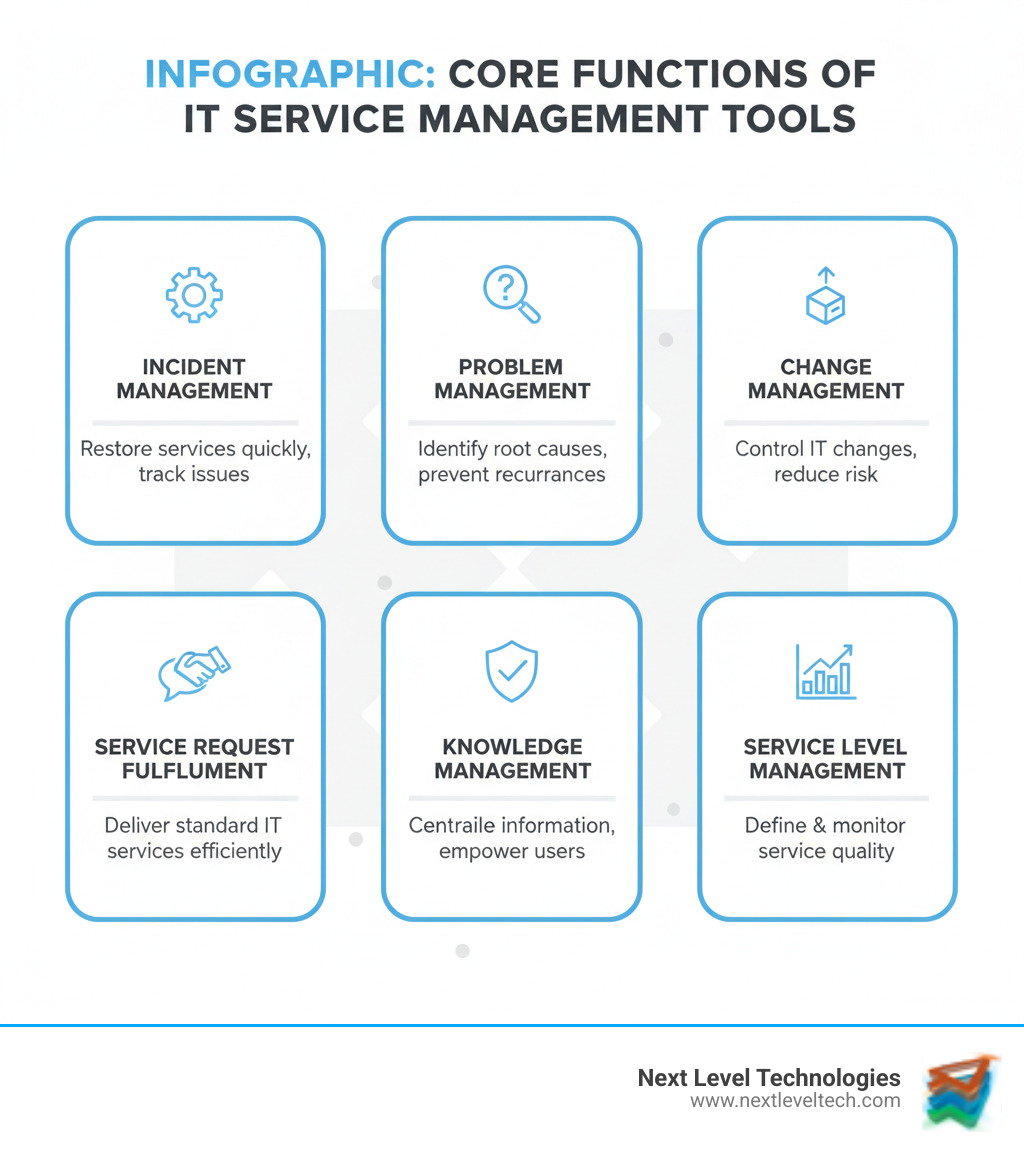
An effective IT strategy is more than just fixing things when they break; it's a strategic approach called IT Service Management (ITSM). At Next Level Technologies, we view ITSM as a roadmap to smoother operations and stronger security for businesses in Columbus, Ohio, and Charleston, WV. Backed by our extensive technical experience and cybersecurity training, we turn reactive IT headaches into a proactive powerhouse, ensuring your IT services consistently meet business needs.
This is achieved through a set of core practices—the building blocks that guide every IT service's journey and keep your operations running efficiently.

First, Incident Management is the rapid response unit for unexpected issues like a server outage. The goal is to restore normal service as quickly as possible, minimizing business disruption. With the right IT Service Management Tools, organizations can improve Mean Time To Resolution (MTTR) for high-priority incidents by up to 92%.
When incidents recur, Problem Management acts as a detective to find the root cause. Instead of just applying a temporary fix, it focuses on permanent solutions to prevent future issues, turning reactive work into proactive prevention.
To introduce new software or update systems without causing chaos, Change Management provides a structured process. It ensures all changes are planned, reviewed, and authorized to minimize risk and prevent disruptions, often using automation from advanced IT Service Management Tools.
Service Request Management handles routine, non-emergency needs like requests for a new laptop or software access. It streamlines fulfillment through a user-friendly service catalog, making it easy for employees to get what they need.
Knowledge Management involves creating a "library of answers" by capturing and sharing valuable information. A well-stocked knowledge base empowers users to solve issues themselves, which can increase self-service rates by an incredible 87% and reduce the IT team's workload.
Finally, IT Asset Management (ITAM) tracks all company technology—hardware, software, and licenses—throughout its lifecycle. This practice is key for optimizing costs, ensuring regulatory compliance, and maintaining a secure, organized IT environment.
Established frameworks offer blueprints for building a top-notch ITSM strategy.
ITIL (Information Technology Infrastructure Library) is the most widely recognized framework, providing best practices to align IT services with business needs. The latest version, ITIL 4, emphasizes value creation and customer experience.
DevOps unites software development (Dev) and IT operations (Ops) to deliver services faster and more reliably. It promotes collaboration through agile practices, and many IT Service Management Tools integrate with DevOps workflows.
Inspired by manufacturing, Lean principles focus on maximizing value by eliminating waste. In ITSM, this means streamlining processes and continuously improving service delivery.
Other valuable frameworks exist, like COBIT (for IT governance), SIAM (for managing multiple service providers), and IT4IT (an operating model for IT).
IT Service Management Tools empower IT operations teams to support the entire production environment. These tools facilitate the tasks and workflows needed to deliver quality IT services. Understanding these tools is foundational for modern IT, as Gartner explains.
Implementing a robust ITSM solution transforms your entire business operation. For our clients in Columbus, Ohio, and Charleston, WV, the benefits translate into smoother operations, happier employees, and a stronger bottom line. These IT Service Management Tools help turn IT from a puzzle into a powerful partner, driving digital change and business value.

Increased Efficiency and Productivity: ITSM streamlines IT processes by automating routine tasks. This leads to faster issue resolution, smoother request handling, and less downtime. Effective tools can improve Mean Time To Resolution (MTTR) by 92%, and AI-driven tools can reduce it by an additional 47%. This allows your staff to focus on strategic projects instead of recurring problems.
Standardized Service Delivery: By following frameworks like ITIL, ITSM ensures every service interaction is consistent and high-quality. This predictability builds trust, as employees know they will receive the same level of excellent support every time.
Cost Reduction: Automating tasks, reducing downtime, and optimizing IT assets naturally cuts operational expenses. Proactive problem management prevents costly recurring incidents, while self-service options can lead to an 87% increase in self-service rates, further reducing support costs.
Risk Mitigation: ITSM minimizes the risks associated with IT changes. Meticulous change management processes ensure every modification is planned, tested, and authorized, reducing the chance of outages or security breaches. At Next Level Technologies, our cybersecurity training and technical experience ensure ITSM tools also help you maintain regulatory compliance.
Digital Change Alignment: ITSM builds a flexible and scalable IT foundation that empowers your business to adopt new technologies and innovate confidently. It ensures IT services are aligned with business goals, turning technology investments into drivers of strategic growth. Our experts in Columbus, Ohio, and Charleston, WV, guide clients through this digital change securely.
Improved User Experience and Satisfaction: At its core, ITSM is about making every IT interaction positive. By empowering employees with self-service portals, knowledge bases, and prompt support, we create happier, more productive teams. Organizations have reported user satisfaction rates as high as 99.3% after implementing effective ITSM solutions. Understanding service level agreements (SLAs) is key to setting and meeting these expectations.
Selecting the right IT Service Management Tools is a critical decision impacting efficiency, satisfaction, and business agility. It's not a one-size-fits-all choice. At Next Level Technologies, we guide businesses in communities like Worthington, Ohio, and Charleston, WV, through this complex process.
Before looking at tools, understand your own landscape.
Once you understand your needs, evaluate tools based on these features.
Here’s a simplified comparison of features across different tiers of ITSM tools:
FeatureBasic ITSM ToolIntermediate ITSM ToolAdvanced ITSM ToolIncident ManagementTicketing, tracking, basic prioritizationAdvanced routing, escalation, customizable workflowsAI-driven categorization, automated resolution, predictive incident managementService Request ManagementSimple request formsCustomizable service catalog, approval workflowsAI-powered request fulfillment, automated provisioning, enterprise service management capabilitiesKnowledge ManagementBasic articles, FAQsStructured knowledge base, self-service integrationAI-driven content generation, intelligent search, personalized recommendationsAsset ManagementManual asset trackingAutomated findy, lifecycle management, basic CMDBComprehensive ITAM/CMDB, dependency mapping, license management, integration with ITOMChange ManagementManual change loggingStandardized change processes, approval boardsAutomated change risk assessment, real-time alerts, integration with development pipelinesAutomationBasic task automationWorkflow automation, rule-based actionsAI-powered automation, intelligent agents, robotic process automation (RPA)Reporting & AnalyticsStandard reports, basic dashboardsCustomizable reports, real-time dashboards, SLA monitoringPredictive analytics, AI-driven insights, advanced performance monitoring, business intelligence integrationThird-Party IntegrationsLimited, often manualAPIs for common toolsExtensive out-of-the-box integrations, robust API, integration with enterprise systemsAI CapabilitiesMinimal or noneChatbots for simple queriesConversational AI, predictive analytics, AI agents, generative AI for content/summariesScalabilitySmall teams, limited usersGrowing SMBs, mid-sized organizationsLarge enterprises, global operations, complex IT environments
AI and automation are actively reshaping modern ITSM, offering greater efficiency and resilience to businesses in Columbus, Ohio, and Charleston, WV.
At Next Level Technologies, our technical experience and cybersecurity expertise allow our clients to harness the power of AI safely and effectively.
Let's clear up some of the most common questions that businesses in Columbus, Ohio, and Charleston, WV, often ask about IT Service Management Tools.
While often used interchangeably, these terms have a key distinction.
A help desk is primarily reactive, focusing on "break/fix" scenarios. It's the tactical team that troubleshoots immediate problems to restore normal service quickly.
A service desk, in contrast, is strategic and proactive. It includes the help desk's functions but goes further, acting as the single point of contact for all IT interactions. It manages incidents, service requests, changes, and knowledge, focusing on overall service delivery and user enablement. Modern IT Service Management Tools are built around this broader service desk concept.
Absolutely. This is known as Enterprise Service Management (ESM). It involves applying the principles and tools of ITSM—like structured workflows, service catalogs, and knowledge management—to other business departments.
By extending ITSM, organizations can streamline processes and improve efficiency across the board.
ESM breaks down departmental silos and fosters collaboration. It's a holistic approach we discuss with clients in Columbus, Ohio, and Charleston, WV, to optimize operations beyond core IT.
While implementing an IT Service Management Tool offers immense benefits, it's not without challenges. At Next Level Technologies, our technical experience and cybersecurity training help businesses steer these common issues:
We've explored IT Service Management Tools, from their core benefits to the future of AI and automation. It's clear these tools transform IT from a reactive expense into a powerful engine for growth.
The key takeaway is that the right ITSM tool is more than software—it's an enabler. It empowers IT teams, boosts productivity, and makes your organization more agile. However, a tool's potential is only open uped when combined with well-defined processes and expert guidance. That's where the real magic happens.
At Next Level Technologies, we are that expert partner for businesses in Columbus, Ohio, Charleston, WV, and surrounding communities. With our extensive technical experience and deep cybersecurity knowledge, we help you steer the complexities of IT Service Management. We don't just install software; we provide peace of mind by ensuring your IT infrastructure is optimized for success.
Ready to lift your IT services? Our managed IT services are crafted to meet your needs. We’ll help you choose, implement, and master the IT Service Management Tools that will drive your business forward, securely and efficiently.
Compare cloud backup services with this guide to backup cloud database service architecture, security, and disaster recovery.
September 12, 2026
Compare cloud based backup services with our ultimate checklist covering encryption, recovery, and compliance for your business.
September 5, 2026
